Stakeholder Agreement Template 2026

Get Form
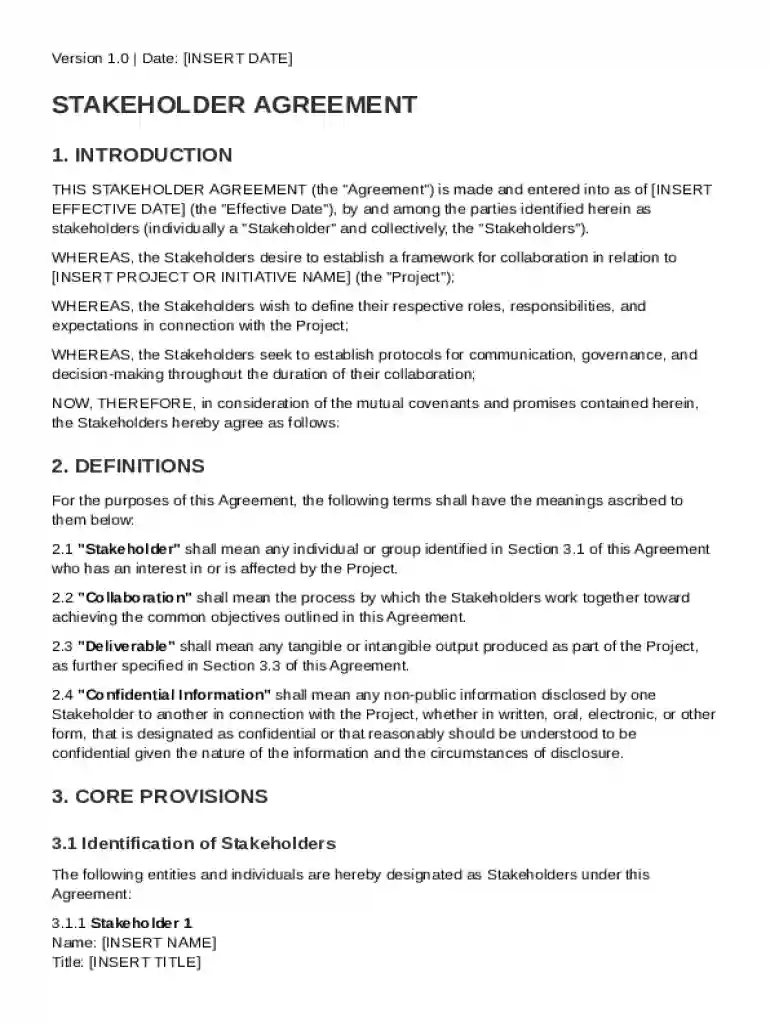
Stakeholder Agreement Template Preview on Page 1

Here's how it works

01. Edit your form online
Type text, add images, blackout confidential details, add comments, highlights and more.

02. Sign it in a few clicks
Draw your signature, type it, upload its image, or use your mobile device as a signature pad.

03. Share your form with others
Send it via email, link, or fax. You can also download it, export it or print it out.

Definition & Meaning

A Stakeholder Agreement Template serves as a blueprint to formalize cooperation among various stakeholders involved in a project. This template delineates critical roles, responsibilities, and expectations among parties to promote effective collaboration. By establishing clear communication channels and decision-making processes, it minimizes misunderstandings and conflicts. Whether it pertains to internal teams, external partners, or cross-departmental efforts, this template provides a comprehensive framework for all parties to align their efforts towards common objectives. It covers both organizational and project-specific elements to ensure all parties are on the same page.

Key Features

  • Role Definition: Clarifies each party's contributions and responsibilities.
  • Communication Protocols: Outlines how information will be shared.
  • Governance Structures: Defines the leadership hierarchy and decision-making process.
  • Conflict Resolution: Provides mechanisms to handle disputes efficiently.

How to Use the Stakeholder Agreement Template

The Stakeholder Agreement Template is designed to be flexible and adaptable to various projects and industries. The process to utilize this template effectively involves a few key steps to ensure all stakeholders can work together seamlessly.

Steps for Effective Utilization

  1. Identify Stakeholders: Start by listing all relevant parties that will be involved.
  2. Define Contributions: Clearly outline what each stakeholder will bring to the table.
  3. Set Communication Guidelines: Establish how and when stakeholders will communicate.
  4. Agree on Decision-Making Process: Ensure all parties consent to how decisions will be made and documented.

Practical Examples

  • Corporate Projects: In a corporate setting, a stakeholder agreement might be used to initiate large-scale initiatives like software development.
  • Community Efforts: For community projects, it can bring together local government, nonprofits, and businesses to support regional development.

Key Elements of the Stakeholder Agreement Template

The Stakeholder Agreement Template incorporates several essential components that make it a comprehensive document to cover all necessary aspects of stakeholder collaboration.

Fundamental Components

  • Confidentiality Provisions: Protects sensitive information shared among parties.
  • Data Protection Measures: Ensures compliance with relevant data protection laws.
  • Reporting Schedules: Sets up regular intervals for progress reporting.
  • Termination Conditions: Outlines how and when the agreement can be modified or terminated.

Detailed Breakdown

  • Governance Structures: Specify who will lead meetings and how decisions are approved.
  • Meeting Schedules: Outlines the frequency and format of stakeholder meetings.

Steps to Complete the Stakeholder Agreement Template

Completing the Stakeholder Agreement Template requires careful attention to detail and input from all relevant parties to ensure comprehensive coverage of all elements.

Step-by-Step Process

  1. Gather Initial Inputs: Collect all necessary information from stakeholders.
  2. Draft the Document: Use the template to draft an initial version of the agreement.
  3. Review and Revise: Share the draft with all parties for feedback.
  4. Finalize and Sign: Make final revisions and obtain signatures from key stakeholders.

Common Challenges

  • Alignment of Interests: Ensuring all stakeholders have aligned interests and objectives.
  • Comprehensive Coverage: Capturing all necessary elements without overwhelming participants.

Legal Use of the Stakeholder Agreement Template

A Stakeholder Agreement not only functions as an operational guide but also has legal implications that extend to accountability and compliance.

Legal Considerations

  • Legally Binding: Once signed, the agreement is legally binding, holding stakeholders accountable for their commitments.
  • Conflict Resolution: Provides legal recourse in the event of a dispute.
  • Modifications: Any changes to the agreement must be documented and agreed upon in writing by all parties.

Regulatory Compliance

  • Data Protection Laws: Ensures alignment with data protection and confidentiality laws.
  • Business Regulations: Adheres to industry-specific legal standards.

State-specific Rules for the Stakeholder Agreement Template

The legal and operational environment for stakeholder agreements can vary by state, and it is crucial to understand these differences when drafting the agreement.

Considerations

  • Jurisdictional Variances: Recognize that some states may require specific clauses or modifications.
  • Industry Regulations: Certain industries might face additional state-specific regulatory requirements.

Best Practices

  • Consult Legal Expertise: Engage legal professionals familiar with state-specific requirements.
  • Tailor for Compliance: Adjust the agreement template to adhere to local laws and regulations.

Examples of Using the Stakeholder Agreement Template

The template can be applied to numerous real-world situations where collaboration among stakeholders is critical. Understanding its application helps in utilizing it effectively.

Case Studies

  • Technological Collaborations: Enterprises frequently use this template for joint ventures in technological innovation and research.
  • Public-Private Partnerships: In infrastructure projects, government agencies and private firms use the agreement to align goals and responsibilities.

Practical Outcomes

  • Enhanced Accountability: Ensures stakeholders are accountable for their roles.
  • Improved Communication: Structured communication channels streamline project execution.

Who Typically Uses the Stakeholder Agreement Template

Identifying typical users of the Stakeholder Agreement Template can help in understanding the context and environment in which it is most beneficial.


decoration image ratings of Dochub

Stakeholders and Contexts

  • Project Managers: Utilize the template to manage stakeholder interactions efficiently.
  • Executives: Use it to align organizational goals with project undertakings.
  • Legal Teams: Ensure compliance and legal protection through structured agreements.

Industry Applications

  • Construction: Coordinating between contractors, suppliers, and developers.
  • Healthcare: Aligning interests among providers, payers, and regulatory bodies.
be ready to get more

Complete this form in 5 minutes or less

Get form

Got questions?

We have answers to the most popular questions from our customers. If you can't find an answer to your question, please contact us.
Contact us
It has been associated with colonialist practices Another reason to rethink using this term is its colonialist associations. During the Westward expansion, European settlers literally staked land to claim their ownership, displacing (or worse) the Indigenous people who originally lived there.
In summation, heres a general template for partnership agreement that you could follow: Partnership Name and Business Purpose. Term of Partnership. Capital Contributions. Ownership and Profit Sharing. Management and Decision-Making. Duties and Responsibilities. Withdrawal, Death, or Incompetency of a Partner.
Here are some best practices to consider: Clearly Define Roles and Responsibilities Make sure that each stakeholders roles and responsibilities are clearly defined and outlined in the agreement Establish a Clear Communication Plan Develop a communication plan that outlines how stakeholders will communicate with each
A shareholders agreement includes a date; often the number of shares issued; a capitalization table that outlines shareholders and their percentage ownership; any restrictions on transferring shares; pre-emptive rights for current shareholders to purchase shares to maintain ownership percentages (for example, in the
A stakeholder agreement is a contract struck between an external stakeholder in a project and an organization. It makes sure that everyone involved understands their rights and obligations.

Security and compliance

At DocHub, your data security is our priority. We follow HIPAA, SOC2, GDPR, and other standards, so you can work on your documents with confidence.

Learn more
ccpa2
pci-dss
gdpr-compliance
hipaa
soc-compliance
be ready to get more

Complete this form in 5 minutes or less

Get form

People also ask

A stakeholder agreement is a written agreement between all parties involved in a project that outlines the terms and conditions of their involvement. It sets guidelines for communication, decision-making, and conflict resolution, and it clarifies the roles and responsibilities of each stakeholder.
Some of the most notable types of stakeholders include a companys shareholders, customers, suppliers, and employees. Some stakeholders, such as shareholders and employees, are internal to the business.

Related links