01. Edit your form online
Type text, add images, blackout confidential details, add comments, highlights and more.

Type text, add images, blackout confidential details, add comments, highlights and more.

Draw your signature, type it, upload its image, or use your mobile device as a signature pad.

Send it via email, link, or fax. You can also download it, export it or print it out.
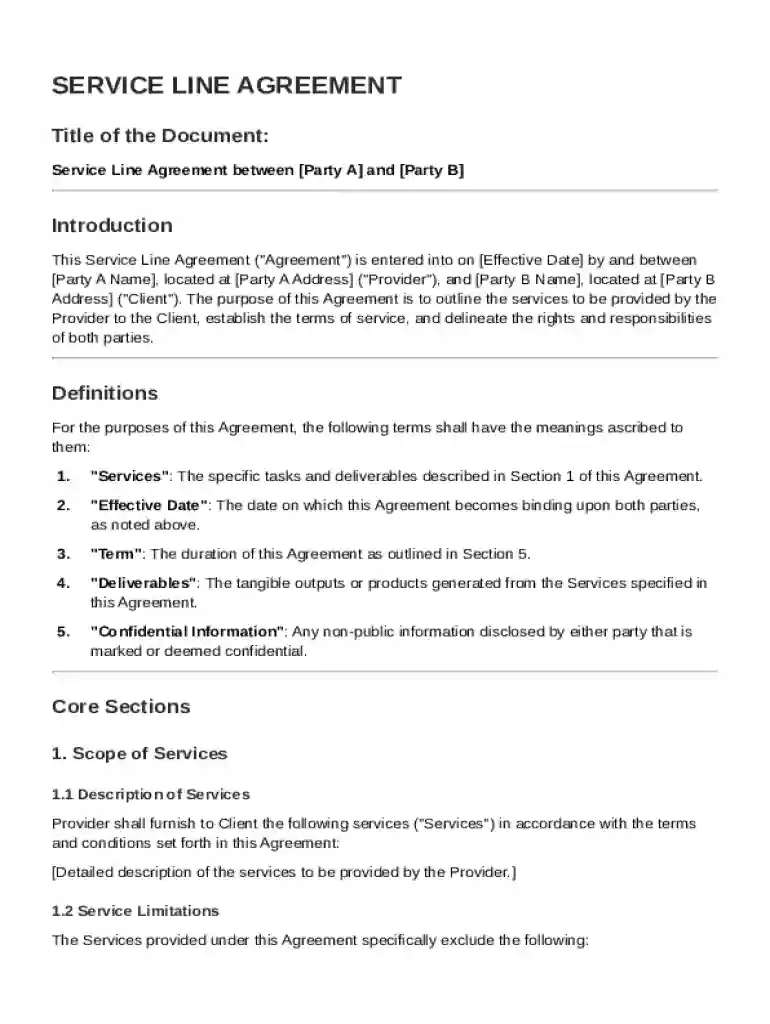
A Service Line Agreement (SLA) Template is a structured document that formalizes the contractual relationship between a service provider and a client. It outlines the specific services that will be provided, setting clear expectations for both parties involved. The primary purpose of an SLA template is to delineate responsibilities, establish performance standards, and clarify payment terms. This agreement serves as a roadmap for successful collaboration, ensuring that both parties understand their roles and obligations. The document often includes sections on confidentiality, indemnification, and dispute resolution to protect the interests of both parties and provide a framework for addressing any issues that may arise.
Utilizing a Service Line Agreement Template involves several key steps to ensure comprehensive documentation of the service terms. Begin by reviewing the template's general format to understand its sections, which may include services, payment terms, and performance standards.
Customize the Template: Tailor the content to reflect the specific details of the agreement, including service descriptions and client requirements.
Fill in the Details: Add both parties' names, contact information, and any service-specific terms.
Review and Edit: Carefully review each section for accuracy, ensuring all legal and operational terms align with the agreement's objectives.
Finalize and Approve: Once both parties have reviewed the document and agree on all terms, secure the necessary signatures to finalize the agreement.
Completing a Service Line Agreement Template involves detailed attention to each component of the document. The following steps can guide you through the process:
Identify Parties Involved: Clearly state the names and contact information for the service provider and client.
Specify Services Offered: Describe the services to be provided, including the scope, duration, and limitations of each service.
Define Payment Terms: Outline the payment structure, frequency, and conditions under which payments will be made.
Establish Performance Standards: Detail the metrics and standards for evaluating service delivery and performance.
Include Confidentiality Clauses: Protect sensitive information by specifying confidentiality obligations for both parties.
Add Indemnification and Dispute Resolution Procedures: Provide mechanisms for addressing potential claims and resolving disputes.
Review and Sign: Ensure both parties review the agreement thoroughly before signing to confirm mutual understanding and acceptance.
An effective Service Line Agreement Template contains several essential elements that ensure clarity and operational efficiency:
The Service Line Agreement Template is legally binding and should be used in compliance with applicable federal and state laws.
The Service Line Agreement Template is widely used across various industries and business contexts. Common users include:


The Service Line Agreement Template is critical for setting clear boundaries and expectations between service providers and clients.
While SLAs are generally consistent across jurisdictions, some state-specific rules may impact their formulation and execution:
At DocHub, your data security is our priority. We follow HIPAA, SOC2, GDPR, and other standards, so you can work on your documents with confidence.