






Definition and Meaning
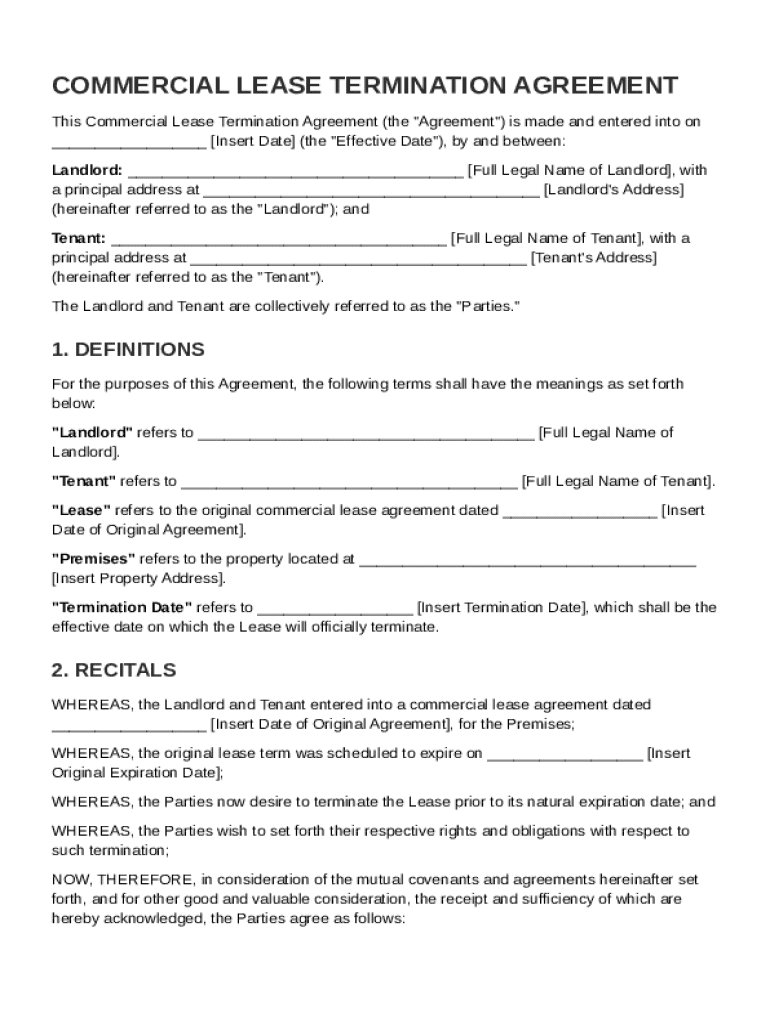
A Commercial Lease Termination Agreement is a legally binding document that articulates a mutual decision between the landlord and tenant to terminate a commercial lease before its planned expiration date. Primarily used when both parties agree to dissolve their contractual lease obligations, this document helps to prevent further disputes or misunderstandings by clearly defining the liabilities and conditions under which the lease is terminated. It often includes clauses related to the any remaining financial obligations, the return of security deposits, and the condition of the property upon exit.
Key Features of the Agreement
- Mutual Decision: The agreement explicitly states that both landlord and tenant consent to the termination, preventing any party from acting outside of this agreement.
- Financial Obligations: It details any ongoing or settled financial responsibilities, ensuring clarity on payments, fees, or compensations.
- Property Condition: Outlines the expected condition of the property upon termination, which may include cleanliness or repair responsibilities.
How to Use the Commercial Lease Termination Agreement Template
To effectively use the Commercial Lease Termination Agreement Template, follow these steps to ensure comprehensive completion and mutual understanding:
- Initial Assessment: Verify the necessity and agreement from both landlord and tenant regarding lease termination.
- Template Acquisition: Obtain your customizable template from an online platform such as DocHub.
- Template Customization: Fill out pertinent details regarding the property, parties involved, and termination date.
- Review Clauses: Both parties must read all clauses to understand each one's responsibilities post-termination.
- Signatures and Authorization: Secure signatures from all involved parties to validate the agreement's legality.
- Document Storage: Keep copies for both parties; ensure storage in a secure and accessible location.
Coordination and Communication
- Roles: Establish clear roles for tenant and landlord in obtaining approvals and preparing the physical property for handover.
- Documentation Sharing: Use electronic tools to exchange document versions for transparency and easy revisions.
Key Elements of the Commercial Lease Termination Agreement Template
This template typically includes several critical sections that ensure thorough understanding and compliance by both parties:
- Parties Involved: Names and addresses of the landlord and tenant.
- Property Details: Address and descriptive information of the leased property.
- Termination Terms: Specifies the agreed-upon date of lease termination and any conditions affecting this.
- Financial Settlement: Contains details around any final payments, damages, or security deposits.
- Indemnity and Liability Waiver: Releases both parties from future claims post-agreement.
Additional Clauses
- Dispute Resolution: Framework for managing disagreements should they arise.
- Governing Law: Identifies applicable legal jurisdictions in cases of legal queries or enforcement.
Legal Use of the Commercial Lease Termination Agreement Template
Legal use ensures that the termination is enforceable under contract law, preventing any future disputes or breaches:
- Formal Agreement: Ensures that the document is legally binding through all necessary signatures.
- Compliance with Laws: Align agreement terms with local and state laws relevant to leasing.
- Non-Compromise Clauses: State that this agreement does not impair any previous rights or responsibilities not directly addressed.
Legal Considerations
- Lawyer Consultation: Advisable, particularly for complex lease agreements with numerous stakeholders.
- Updates and Amendments: Include provisions for amendments to address possibly unforeseen issues.
Examples of Using the Commercial Lease Termination Agreement Template
In practice, various scenarios illustrate the necessity of a Commercial Lease Termination Agreement:
- Relocation: A startup company needing to relocate rapidly due to business growth may use the agreement to offset previous lease obligations.
- Financial Hardship: Tenants experiencing unexpected financial downturns can utilize the agreement to exit leases without incurring prohibitive penalties.
- Landlord-driven Terminations: A landlord intends to repurpose a property, ensuring proper procedure adherence and mutual settlements.
Real-World Case Studies
- Commercial Growth: In a city’s burgeoning tech scene, businesses often terminate leases prematurely to accommodate their expansion needs, creating a compelling case for legal agreements.
Important Terms Related to the Commercial Lease Termination Agreement Template
Understanding certain legal and technical terminology can enhance the effective use of the template:
- Lease Abatement: A temporary suspension or reduction of lease payments.
- Severability Clause: Ensures that if any part of the agreement is deemed unenforceable, the remainder still holds validity.
- Force Majeure: Protection for circumstances beyond control that might justify lease termination.
Definitions and Clarifications
- Indemnification: Common in these agreements, signifying a promise to cover potential losses or damages post-termination.
Software Compatibility
The agreement template can be integrated and managed within various digital environments:
- DocHub Integration: Allows for importing, editing, and signing the agreement online without conversion hassles.
- Cloud Storage: Use Google Drive, Dropbox, or similar platforms for streamlined sharing and version control.
- Cross-platform Accessibility: Access via any web browser, ensuring edits and storage are not confined to specific devices.
Supported File Types
- DOC: For direct editing using word processors.
- PDF: For signed, read-only versions diminishing further unwanted alterations.
Who Typically Uses the Commercial Lease Termination Agreement Template
This document caters to a specific audience that deals with commercial property leases:
- Tenants and Lessees: Business owners seeing the need to vacate or alter leased spaces.
- Landlords and Property Managers: Those who administrate or control commercial property assets.
- Legal Professionals: Attorneys who support lease negotiations and terminations.


Business Implications
- Multi-location businesses: Particularly those with branches that might frequently relocate for market expansion or consolidation purposes.