01. Edit your form online
Type text, add images, blackout confidential details, add comments, highlights and more.

Type text, add images, blackout confidential details, add comments, highlights and more.

Draw your signature, type it, upload its image, or use your mobile device as a signature pad.

Send it via email, link, or fax. You can also download it, export it or print it out.
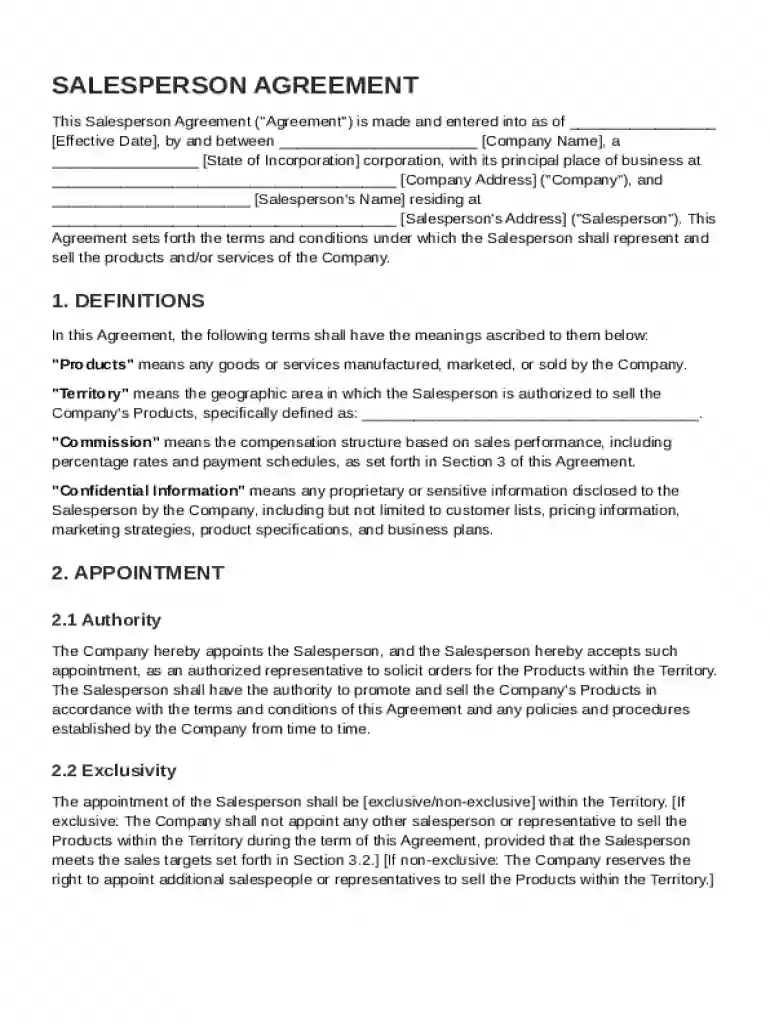
The Salesperson Agreement Template outlines the terms and conditions under which a salesperson is appointed to represent and sell a company's products or services. Its primary function is to clearly define the relationship between the salesperson and the company, including roles, responsibilities, and expectations. This document is crucial in protecting both parties by providing a legal framework for the salesperson's engagement, thus minimizing potential disputes. Key areas covered in the agreement include the scope of work, commission structure, confidentiality obligations, and termination conditions.
Utilizing the Salesperson Agreement Template involves several steps to ensure that the document is tailored to the specific needs of the business and the salesperson. To begin, download the template from your trusted document management platform like DocHub. Next, review the document thoroughly and customize sections such as the appointment details, sales territory, and commission rates to align with your business model and objectives. Once drafted, it is advisable to seek legal counsel to review and ensure that the agreement complies with applicable laws. Finally, have both parties sign the document to formalize the agreement and keep copies for future reference.
The Salesperson Agreement Template consists of several critical components that provide clarity and guidance for both the employer and the salesperson. These elements typically include:
Definitions and Roles: Clarifies essential terms and designates the role of the salesperson within the company.
Appointment and Territory: Details the scope of the salesperson’s authority and geographic areas of operation.
Commission Structure: Describes how the salesperson will be compensated and the criteria for commission eligibility.
Confidentiality and Non-Disclosure: Ensures that sensitive company information is protected from unauthorized disclosure.
Termination Conditions: Specifies the conditions under which the agreement can be terminated by either party.
Governing Law: Establishes the jurisdiction under which any disputes will be resolved.
Filling out the Salesperson Agreement Template requires a systematic approach to ensure accuracy and completeness:
Review the Template: Start by familiarizing yourself with the template’s structure and content.
Fill in Basic Information: Enter the names, addresses, and contact details of both the salesperson and the company.
Customize Agreement Terms: Adjust clauses related to responsibilities, commission, and sales targets to reflect the specific arrangement.
Include Additional Clauses: Add any additional provisions agreed upon between the parties, such as advanced commissions or expense reimbursement.
Consult Legal Counsel: Have a legal expert review the completed document to ensure compliance with relevant laws and regulations.
Review Together: Both parties should review the document carefully to confirm understanding and agreement on all terms.
Sign and Date: Once both parties are satisfied, sign and date the agreement to make it legally binding.
Understanding terminology within the Salesperson Agreement Template is crucial for both drafting and implementation. Some essential terms include:
Commission: A percentage of sales revenue paid to the salesperson as compensation.
Territory: The specific geographic area within which the salesperson is authorized to sell.
Confidential Information: Any proprietary data or business secrets that must not be disclosed to third parties.
Non-Compete Clause: A provision restricting the salesperson from engaging in similar business with competitors during or after termination.
Force Majeure: Circumstances beyond control, such as natural disasters, that may justify the temporary suspension of obligations.
In the United States, the enforceability of a Salesperson Agreement Template depends on its compliance with federal and state laws. It is important to ensure that the contract does not include overly restrictive clauses that could be deemed illegal, such as excessively broad non-compete clauses. Additionally, the document should be drafted with regard to the Uniform Commercial Code (UCC) when applicable, ensuring that goods and services are transacted legally. Businesses should also be aware of specific state laws that may influence commission payments, termination processes, and employment classification.
The Salesperson Agreement Template is widely used across various industries that involve direct sales activities. This includes:
Retail Companies: Employ salespersons to directly engage with consumers and sell products in physical or online stores.
Manufacturers: Often use salespersons to establish relationships with retailers or distributors to expand market reach.
Service Providers: Employ salespersons to promote and sell services to business clients or end-users.
Real Estate Firms: Use agreements to formalize the relationship with real estate agents overseeing property transactions.


State laws in the U.S. can significantly affect the drafting and implementation of a Salesperson Agreement Template. For instance:
Non-Compete Clauses: States like California have stringent restrictions on non-compete clauses, while others permit them under certain conditions.
Commission Payment Timing: Some states mandate specific timelines for the payment of commissions after the completion of a sale, while others allow for more flexibility.
Employment Status: Misclassification of salespersons as independent contractors rather than employees can lead to legal issues, with states having varied requirements for classification.
Companies must understand these differences and adjust the Salesperson Agreement Template to align with local regulations.
At DocHub, your data security is our priority. We follow HIPAA, SOC2, GDPR, and other standards, so you can work on your documents with confidence.