






Definition & Meaning
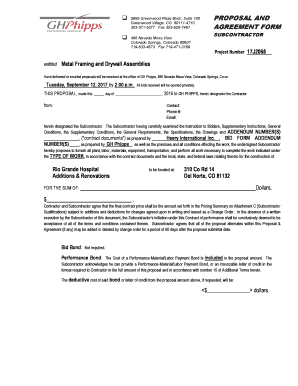
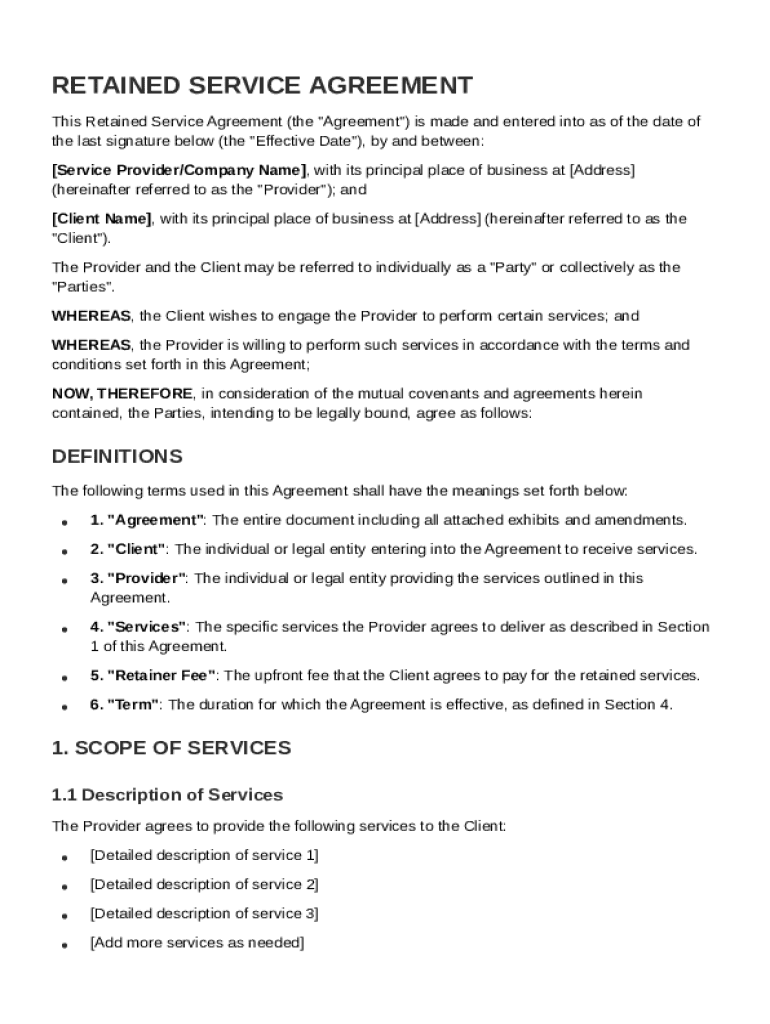
The Retained Service Agreement Template is a formal document used to outline the terms and conditions between a service provider and a client for the provision of specific services. This agreement is pivotal in setting clear expectations and responsibilities, ensuring both parties understand their roles in the service relationship. Typically, it includes various components such as definitions of service scope, compensation details, the responsibilities of each party, termination conditions, confidentiality obligations, indemnification clauses, governing law, and provisions for amendments. The document serves as a guiding framework that formalizes the collaboration between the service provider and the client, often involving the payment of a retainer fee by the client for the services rendered by the provider.
Importance of Clear Definitions
- Service Scope: Clearly outlines the nature and limits of the services provided to avoid misunderstandings.
- Compensation Details: Specifies how and when payments are to be made, including retainer fees.
- Responsibilities: Defines roles to ensure accountability and proper execution of terms.
Examples of these elements are essential for both parties to have a mutual understanding and to prevent conflicts during the contract period.
Key Elements of the Retained Service Agreement Template
The Retained Service Agreement Template is composed of several crucial sections that are fundamental to its purpose. These elements ensure that the agreement covers all necessary bases to protect the interests of both contracting parties.
Essential Components
- Definitions: Clarifies terms used throughout the agreement to eliminate ambiguity.
- Scope of Services: Delineates the specific services to be provided, including any limitations.
- Compensation and Payment Terms: Details payment schedule and method.
- Confidentiality Clauses: Protects sensitive information shared between parties.
- Termination Conditions: Outlines conditions under which the agreement may be terminated by either party.
- Indemnification: Ensures parties are shielded from certain liabilities.
- Amendments: Processes for modifying the initial agreement.
These components are vital in crafting a comprehensive agreement that is legally sound and functionally robust.
How to Use the Retained Service Agreement Template
Using the Retained Service Agreement Template involves several steps to tailor it to the specific needs of the service provider and the client. The process ensures that the agreement is relevant and enforceable.
Steps to Customize
- Identify Parties Involved: Clearly specify the service provider and client.
- Define Service Parameters: Detail the nature and extent of services provided.
- Set Payment Terms: Agree on the retainer fee, payment schedule, and conditions.
- Include Confidentiality Provisions: Decide on the information protected under confidentiality.
- Specify Termination Clauses: Clearly outline how and when the agreement can be terminated.
- Review Legal Requirements: Ensure compliance with applicable laws and regulations.
- Consult with Legal Professionals: Consider seeking legal advice to ensure the agreement's validity.
These steps aid in creating an agreement that accurately reflects the intentions and obligations of both parties.
Legal Use of the Retained Service Agreement Template
The legal use of the Retained Service Agreement Template ensures the document complies with relevant laws and provides a fair framework for the parties involved.
Compliance Considerations
- Governing Law: The agreement should specify which jurisdiction’s laws will govern the contract.
- Legally Binding Elements: Include all necessary legal elements to enhance the enforceability of the agreement.
- Clarity and Precision: Use clear language to articulate terms and conditions unambiguously.
- Modification Process: Provide a clear method for making official changes to the terms.
Understanding these legal considerations is crucial for maintaining the integrity and enforceability of the agreement.
Examples of Using the Retained Service Agreement Template
Examples of using the Retained Service Agreement Template offer insight into its applications across various scenarios.
Practical Applications
- Consulting Services: Used by consultants to formalize their engagement terms with clients.
- Freelance Work: Freelancers utilize it to delineate services and payment expectations.
- Legal Services: Law firms may use the agreement to outline retainer services for clients.
- Maintenance Services: Companies offering regular maintenance may employ the template to define service intervals and costs.
These examples highlight the versatility and necessity of the template across multiple sectors.
Important Terms Related to Retained Service Agreement Template
Understanding key terms associated with the Retained Service Agreement Template enhances comprehension and usage of the document.
Glossary of Terms
- Retainer Fee: Upfront fee paid to secure services.
- Confidential Information: Any data designated as confidential by the parties.
- Indemnification: Process of compensating for harm or loss.
- Amendment: A formal modification to the terms of the agreement.
Familiarity with these terms is essential for effectively negotiating and understanding the agreement.
State-Specific Rules for the Retained Service Agreement Template
State-specific rules may influence how a Retained Service Agreement Template is structured and enforced.
Regional Variations
- Legal Requirements: Some states may have different stipulations for what constitutes a binding agreement.
- Confidentiality and Privacy: Varying state laws on data protection may affect confidentiality clauses.
- Jurisdictional Governing Laws: The choice of governing law can affect dispute resolution mechanisms.
Awareness of these variations helps in drafting a compliant and region-appropriate agreement.
Business Types That Benefit Most from Retained Service Agreement Template
Certain businesses are more likely to benefit from a Retained Service Agreement Template due to the nature of their services.
Beneficial Business Sectors
- Professional Services: Legal, accounting, and consulting firms often utilize these agreements.
- Healthcare: Medical professionals might use them for patient service agreements.
- Creative Industries: Designers, writers, and artists benefit by clearly defining project scope and pricing.
- Technical Services: IT and software companies use these templates to formalize service offerings.
These sectors commonly require a structured approach to service provision, making the template an essential tool.