






Definition and Meaning
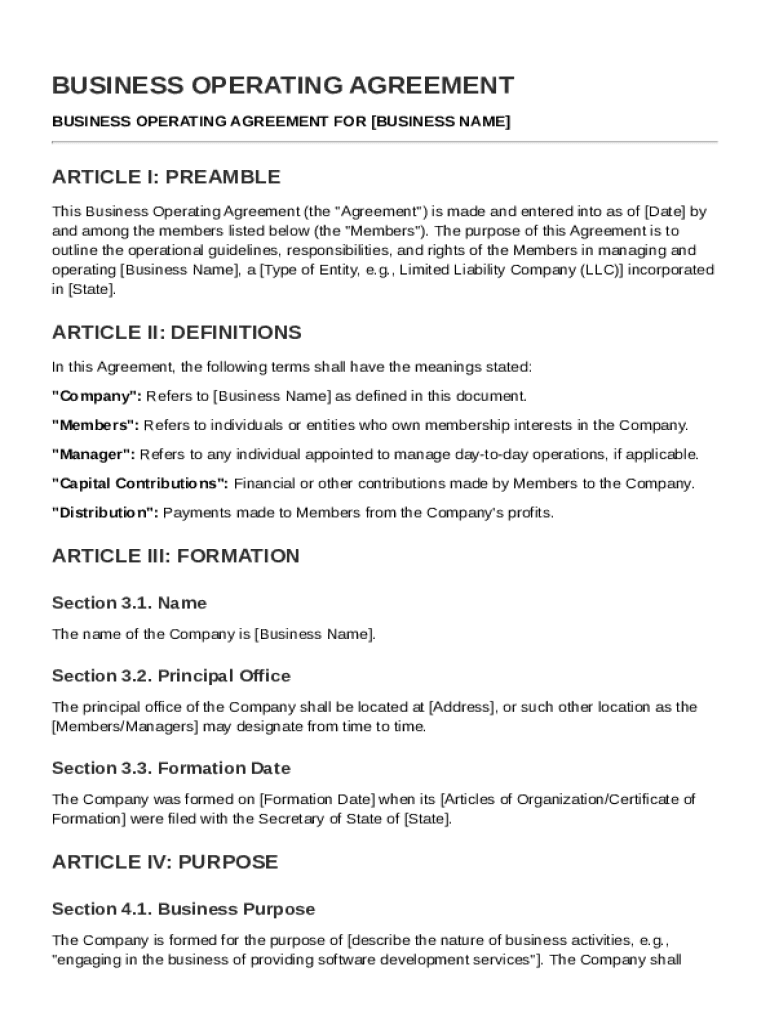
The Business Operating Agreement Template is a critical document that outlines the operational framework, responsibilities, and rights of members managing a business entity. Typically used by Limited Liability Companies (LLCs), it serves as a blueprint for how the business will be run. The agreement includes key information such as the company's objectives, membership details, management structure, profit distribution, and more. By defining these elements, the document helps to ensure smooth operations and minimize disputes among members.
How to Use the Business Operating Agreement Template
To effectively use the Business Operating Agreement Template, follow these steps:
-
Identify Business Details: Start by filling out the business name, type of entity, and state of incorporation. This information forms the foundational part of the agreement.
-
Define Membership Roles: Specify the rights and responsibilities of each member. Include details like capital contributions, voting rights, and responsibilities.
-
Establish Management Structure: Outline whether the business will be managed by members or appointed managers. Define roles and decision-making processes clearly.
-
Address Profit Distribution: Determine how profits and losses will be allocated among members, providing clarity on financial expectations.
-
Include Legal Clauses: Add sections for dispute resolution, amendment procedures, and the governing law that applies to your business.
By systematically filling out each section, businesses can create a comprehensive agreement that aligns with their operational needs.
Steps to Complete the Business Operating Agreement Template
Completing the Business Operating Agreement Template involves a detailed, step-by-step process that ensures all necessary elements are included:
-
Gather Required Information: Before you begin, collect all pertinent details about your business and its members.
-
Use the Template: Download or access the template online, and start inputting basic information such as the business name and entity type.
-
Fill in Membership Details: Clearly state the names of all members, their contributions, and ownership percentages.
-
Define Operating Procedures: Outline how the business will be managed, including meeting schedules, voting thresholds, and record-keeping practices.
-
Specify Financial Arrangements: Detail how profits and losses will be shared and any compensation arrangements for members or managers.
-
Incorporate Legal Provisions: Add clauses relating to dispute resolution procedures, amendment guidelines, and applicable state laws.
-
Review and Finalize: Have all members review the agreement, making adjustments as necessary. Once final, ensure all members sign the document.
Key Elements of the Business Operating Agreement Template
Several critical components are encompassed within the Business Operating Agreement Template, each serving a distinct purpose:
-
Formation Details: This section covers when and where the business was or will be formed.
-
Business Purpose: Explaining the primary goal and activities of the business.
-
Membership Interests: Details each member's ownership stake and entitlements.
-
Management Structure: Outlines whether management is member-managed or manager-managed, along with role definitions.
-
Capital Contributions: Specifies initial and future funding obligations of members.
-
Profit Distribution: Details how financial gains and losses will be shared.
-
Decision-Making Procedures: Provides guidelines for resolving member disputes and making significant business decisions.
Each element forms part of a robust framework designed to guide the enterprise effectively.
Legal Use of the Business Operating Agreement Template
The Business Operating Agreement Template is a legal document that, once executed, holds significant authority within the organization's governance framework. It must comply with state-specific laws regulating business operations. This document can be crucial in the event of legal proceedings, serving as evidence of agreed-upon terms. It is advisable to consult with a legal expert to ensure that the template adequately covers all necessary aspects and adheres to relevant laws.
Who Typically Uses the Business Operating Agreement Template
The template is widely used by LLCs looking to formalize their operations. It is particularly beneficial for business owners who seek to clarify roles and responsibilities within the company. Entrepreneurs, legal professionals, and business consultants often rely on this document to establish a clear operational structure for newly formed businesses or to refine existing procedures within established entities.


State-Specific Rules for the Business Operating Agreement Template
State laws can significantly influence the content and enforcement of a Business Operating Agreement. Here's how states may differ:
-
Filing Requirements: Some states require the filing of the operating agreement or a synopsis with the state authority, while others do not.
-
Mandatory Provisions: Certain jurisdictions mandate specific clauses, such as dissolution procedures or profit-sharing arrangements, which must be included.
-
Managerial Prowess: Variations exist in how member or manager-managed operations are recognized and regulated.
Businesses should tailor the agreement to reflect state-specific requirements to ensure legal compliance.
Examples of Using the Business Operating Agreement Template
Consider a growing tech startup forming an LLC in California. The Business Operating Agreement Template would guide the founders through defining their roles, capital commitments, and how decisions about new technology investments will be made. Another scenario could involve a family-owned retail business in Texas using the template to formalize succession planning and profit-sharing among multiple generations involved in the enterprise.
These examples illustrate the template's versatility, offering a structured yet customizable framework to meet diverse business needs.