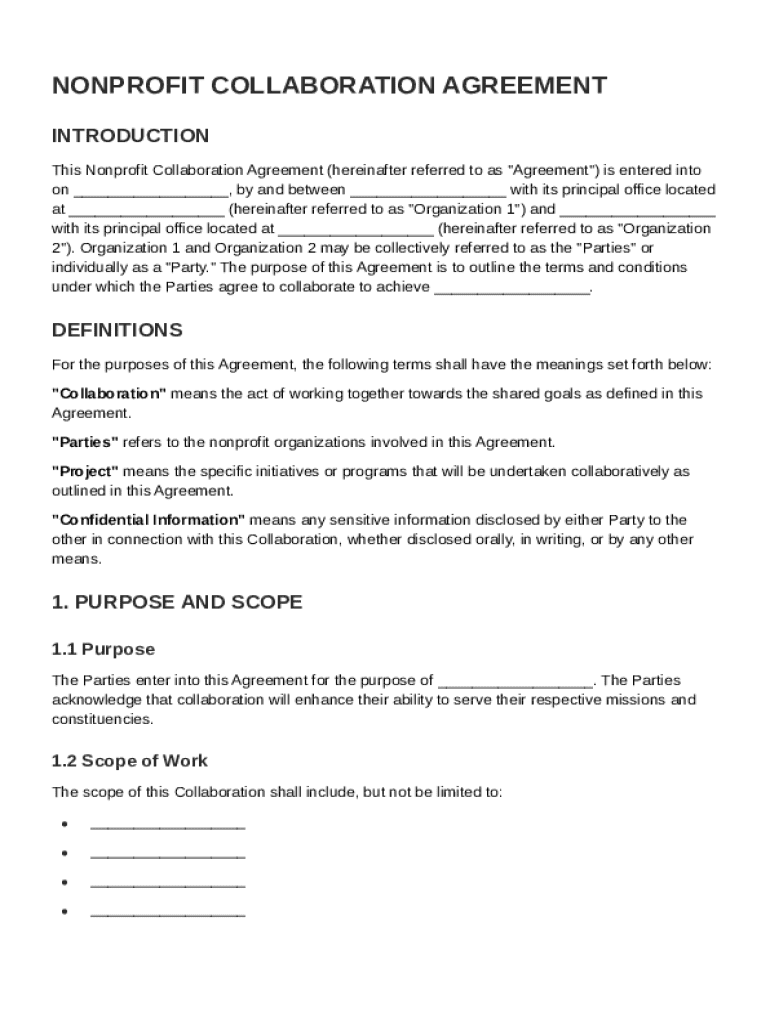







Definition and Meaning of a Nonprofit Collaboration Agreement
A Nonprofit Collaboration Agreement is a formal document that establishes the framework for cooperation between two or more nonprofit organizations. The agreement outlines critical elements such as the purpose of the collaboration, scope of work, and roles and responsibilities of the involved parties. This comprehensive arrangement ensures that each organization understands its commitments, including financial obligations and governance structure. The document is designed to prevent conflicts by clearly defining project goals and the mechanisms for decision-making. By adhering to these guidelines, nonprofits can efficiently work together towards achieving their mutual objectives while maintaining compliance with legal standards.
Steps to Complete the Nonprofit Collaboration Agreement Template
-
Identify Collaboration Goals: Clearly define what each organization aims to achieve through this partnership. This involves specifying both short-term objectives and long-term goals to ensure alignment.
-
Outline Roles and Responsibilities: Assign clear responsibilities to each organization. Identify key personnel involved in the project and detail their specific duties. Clarify how decisions will be made and who will have authority in different situations.
-
Describe the Scope of Work: Provide detailed information on the activities and tasks each organization will undertake. Include timelines and deliverables for each phase of the project to track progress effectively.
-
Establish Financial Arrangements: Outline the financial commitments of each party. Include details on funding sources, budget allocations, and payment schedules. Clarify any provisions for revenue sharing or expense reimbursement.
-
Set Governance and Communication Protocols: Define how the collaborating organizations will communicate. Include the frequency and format of meetings, decision-making processes, and conflict resolution mechanisms.
-
Address Confidentiality and Data Security: Specify how sensitive information will be handled and protected. Outline any confidentiality obligations and security measures to safeguard data integrity.
-
Include Liability and Termination Conditions: Clearly state each organization's liabilities and the process for handling any disputes. Include conditions under which the agreement can be modified or terminated.
Key Elements of the Nonprofit Collaboration Agreement Template
-
Purpose of Collaboration: A succinct statement that captures the project's main goals and what the organizations hope to achieve by working together.
-
Scope of Work: Detailed description of the tasks and responsibilities divided amongst the signed parties. It includes timelines and anticipated outcomes.
-
Financial Arrangements: Information about funding requirements, financial contributions from each party, and any profit-sharing agreements.
-
Governance Structure: Details on how the project will be managed, including leadership roles, policy-making processes, and oversight responsibilities.
-
Communication Protocols: Guidelines for regular updates, conflict resolution, and meeting schedules.
-
Confidentiality Obligations: Rules and obligations to protect sensitive information shared between the organizations.
-
Liability Provisions: Legal responsibilities in cases of breach of agreement, damages, or unforeseen events.
-
Termination Conditions: Clearly defined terms and procedures for ending the collaboration before its intended conclusion if necessary.
Legal Use of the Nonprofit Collaboration Agreement Template
The Nonprofit Collaboration Agreement Template serves as a legally binding document that formalizes the terms of collaboration between the involved organizations. It helps ensure that each party is protected under the law by specifying roles, responsibilities, and expectations. The formal language used in the document meets legal standards, offering clear records that can be referenced in the case of disputes. It also ensures compliance with federal and state laws relevant to nonprofit operations, making it an essential tool for legal accountability and operational transparency.
Who Typically Uses the Nonprofit Collaboration Agreement Template
Nonprofit organizations working on joint projects often utilize this template to streamline partnerships. This includes charities, educational institutions, advocacy groups, and international NGOs collaborating on missions requiring diverse expertise and resources. The template is also used by organizations involved in grant-funded projects that require clearly outlined partnerships. Legal advisors and consultants assisting nonprofits with their contractual agreements may also employ this template to draft comprehensive and legally sound documents.


State-Specific Rules for the Nonprofit Collaboration Agreement Template
While the template provides a general framework applicable across the United States, organizations must consider state-specific regulations governing nonprofit collaborations. Certain states may have unique requirements for reporting joint ventures or specific tax implications based on the type of collaboration. Some states may also mandate distinct provisions in collaboration agreements to ensure compliance with local nonprofit laws. It is advisable to consult with legal professionals familiar with state legislation to tailor the agreement to regional requirements.
Software Compatibility with Nonprofit Collaboration Agreement Template
DocHub ensures that its Nonprofit Collaboration Agreement Template is compatible with various file formats such as PDF, DOC, PPT, and XLS. This compatibility allows users to work seamlessly with documents stored in diverse formats, making it convenient to integrate into existing workflows. The platform's integration with Google Workspace enhances productivity further by allowing users to manage and store documents easily. These features guarantee that users can effortlessly utilize and customize the template according to their organization's needs, leveraging digital tools for effective collaboration.
Digital vs. Paper Version of the Nonprofit Collaboration Agreement Template
The digital version of the Nonprofit Collaboration Agreement Template offers several advantages over its paper counterpart. With digital tools like DocHub, organizations can efficiently collaborate in real-time, making necessary edits and updates accessible to all parties instantly. Electronic signatures simplify the signing process, ensuring legal compliance and saving time. Meanwhile, a paper version may require manual distribution and signing, resulting in increased time and cost. Digital versions also offer secure data protection through encryption, making it a preferred choice for safeguarding sensitive information.