
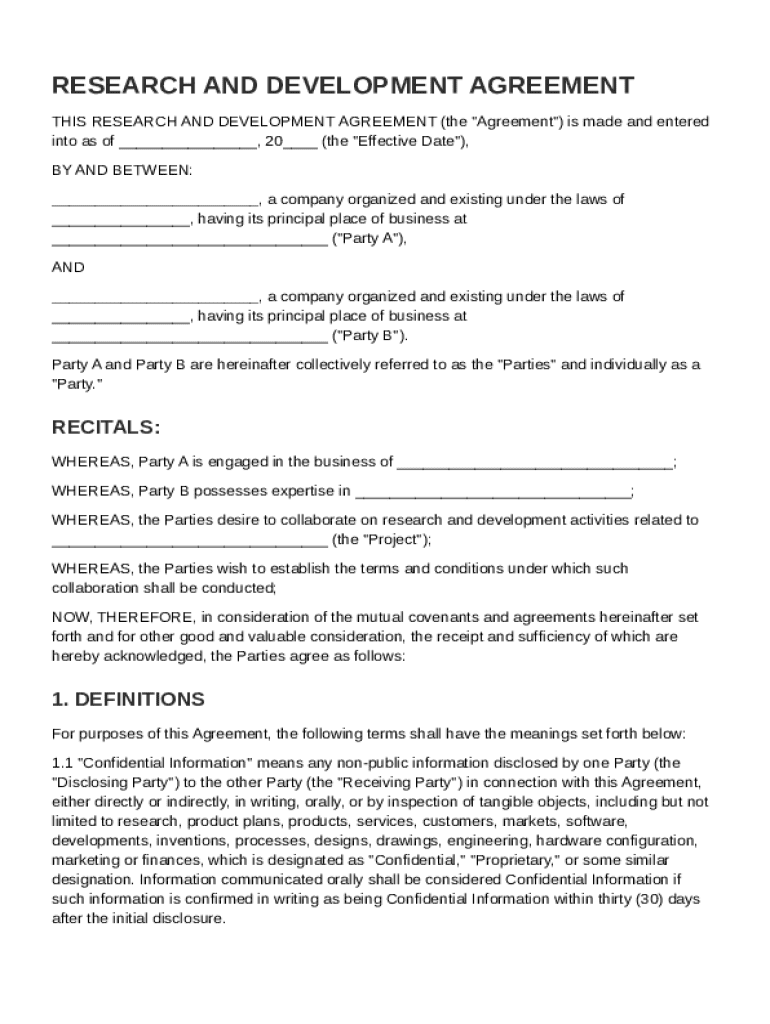







Definition and Meaning of the Research and Development Agreement Template
A Research and Development Agreement Template is a contractual document used to outline terms and conditions between two or more parties engaged in collaborative research and development (R&D) projects. This template serves as a blueprint for the collaboration, detailing essential elements such as project objectives, scope of work, funding arrangements, intellectual property rights, confidentiality obligations, and termination conditions. By clearly defining each aspect, the agreement ensures that all parties understand their roles, responsibilities, and rights, facilitating a smooth and efficient collaborative process. The template is widely used in industries where innovation and research are critical, providing a systematic approach to manage joint R&D efforts.
Key Elements of the Research and Development Agreement Template
Project Objectives and Scope of Work
To effectively manage an R&D project, the agreement must clearly define the objectives and scope of work. This section outlines the specific goals the parties seek to achieve and the detailed tasks or activities required to reach those goals. It ensures that all parties have a mutual understanding of what the project entails, preventing scope creep and misalignment.
- Objectives: Clearly stated end-goals the collaboration aims to achieve.
- Scope of Work: Detailed description of activities, timelines, and deliverables.
Funding Arrangements
Funding arrangements in the agreement specify how the project will be financed. This includes the contribution of each party, funding schedules, and payment terms. By clearly detailing these arrangements, the agreement helps avoid financial disputes and ensures adequate resources are available throughout the project lifecycle.
- Contributions: Breakdown of financial commitments from each party.
- Payment Terms: Clear timeline and conditions for funds release.
Intellectual Property Rights
Intellectual property (IP) rights are a crucial aspect of R&D agreements, protecting innovations developed during the collaboration. This section explains how IP rights are shared, transferred, or licensed between the parties. It ensures that all parties understand ownership rights, usage limitations, and revenue-sharing from commercialization of the jointly developed IP.
Confidentiality Obligations
Confidentiality obligations protect sensitive information exchanged between parties. The agreement outlines the types of information considered confidential, exceptions to confidentiality, and the duration of these obligations. Ensuring clear confidentiality terms is vital to maintain trust and protect competitive advantages derived from proprietary research.
Who Typically Uses the Research and Development Agreement Template
Research and development agreements are versatile tools employed by various entities involved in innovative projects. Typical users include:
- Corporations: Engage in R&D to gain competitive edges through new product development.
- Academic Institutions: Collaborate with industry partners to translate research into practical applications.
- Start-ups: Partner with established firms to leverage additional expertise and funding.
- Government Agencies: Foster public-private partnerships to advance technology and innovation.


Important Terms Related to Research and Development Agreement Template
Understanding key terms is essential to utilizing the agreement effectively. Important terms include:
- Indemnification: Protection against financial loss due to third-party claims.
- Force Majeure: Conditions under which parties are excused from obligations due to unforeseeable events.
- Termination Clause: Grounds and procedures for ending the agreement before completion.
Steps to Complete the Research and Development Agreement Template
Completing the Research and Development Agreement Template involves several important steps, each ensuring that the agreement is comprehensive and legally sound:
- Define Parties: Clearly identify all involved parties, including their legal names and contact information.
- Outline Project Details: Document the project's scope, including objectives, timelines, and deliverables.
- Detail Financial Arrangements: Specify the financial commitments, sources of funding, and payment schedules.
- Set IP Terms: Clearly articulate intellectual property rights, including ownership, usage, and licensing.
- Establish Confidentiality Terms: Define what constitutes confidential information and set terms for its protection.
- Draft Termination Conditions: Set out the conditions under which the agreement may be terminated by either party.
Legal Use of the Research and Development Agreement Template
The legal use of the Research and Development Agreement Template ensures that collaborations are bound by enforceable terms. It is critical for protecting each party's legal interests and ensuring compliance with applicable laws. The agreement should be reviewed by legal counsel to confirm that it adheres to relevant statutory and regulatory requirements, particularly concerning intellectual property and confidentiality. Proper legal oversight during drafting minimizes the risk of disputes and maximizes enforceability.
Examples of Using the Research and Development Agreement Template
Real-world applications of the Research and Development Agreement Template span various sectors:
- Tech Industry: A technology firm partners with a university to co-develop new software, detailing IP rights and shared revenues.
- Pharmaceuticals: A biotech company collaborates with a medical research institution to develop a new drug, specifying funding sources and clinical trial responsibilities.
- Automotive: An automotive manufacturer joins forces with an engineering startup to innovate electric vehicle technologies, outlining joint ownership of resulting patents.




