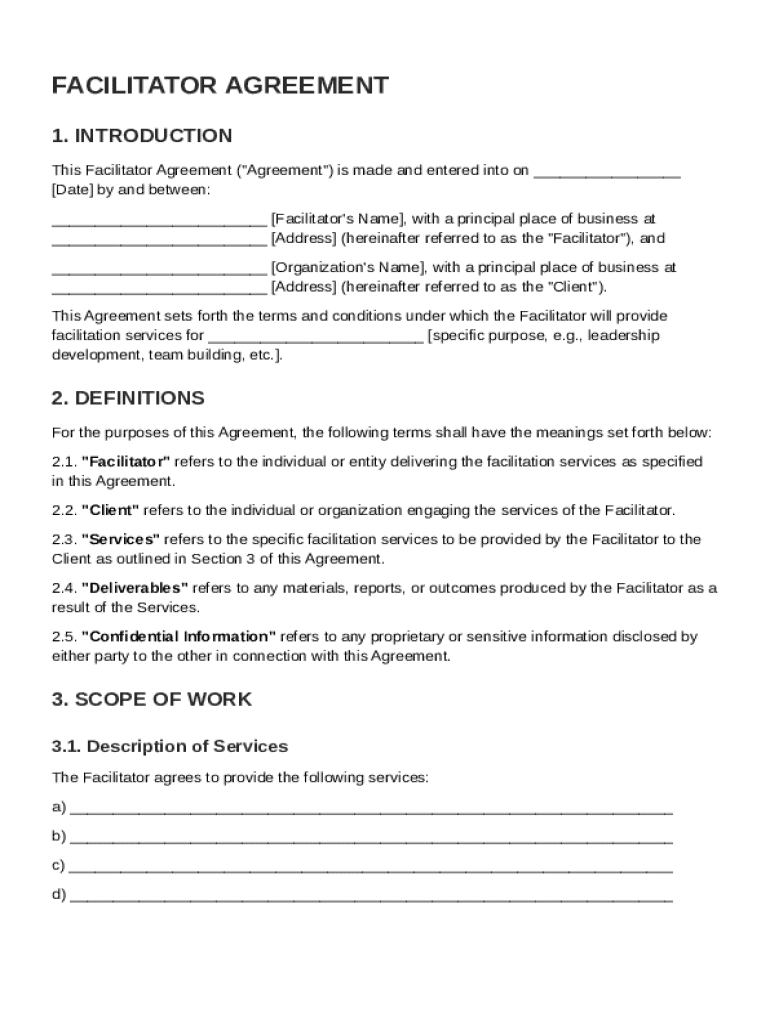







Definition and Purpose of the Facilitator Agreement Template
The Facilitator Agreement Template is a fundamental document outlining the terms and conditions under which facilitation services are provided by a Facilitator to a Client. This template serves as a comprehensive guide to defining the roles, responsibilities, and expectations of both parties involved in the facilitation process. Key provisions typically included in the template are definitions of terms, scope of work, and compensation details. By clearly establishing these elements, the document aids in preventing misunderstandings and ensuring that all parties are aligned with the agreed terms.
Key Elements Included in the Agreement
- Scope of Work: Defines the specific services the Facilitator will provide, ensuring both parties have a clear understanding of duties.
- Compensation: Outlines the payment terms, including method, schedule, and amount, providing transparency and financial clarity.
- Confidentiality: Establishes confidentiality obligations to protect sensitive information shared during the facilitation.
- Termination Conditions: Details circumstances under which either party can terminate the agreement, safeguarding interests if things go awry.
- Liability Limitations: Limits the Facilitator's liability, contributing to a well-balanced agreement.
- Dispute Resolution: Specifies how disputes will be managed, promoting a structured approach to conflict resolution.
Steps to Complete the Facilitator Agreement Template
To effectively utilize the Facilitator Agreement Template, follow these comprehensive steps:
-
Review and Understand the Template: Thoroughly read the template to understand its components.
-
Identify Parties Involved: Clearly document the Facilitator and Client’s details, ensuring accuracy.
-
Define the Scope of Work: Detail the services to be provided, ensuring both parties have a mutual understanding.
-
Establish Compensation Details: Specify the payment terms, including rates, schedules, and acceptable forms of payment.
-
Clarify Confidentiality Clauses: Agree on what constitutes confidential information and how it should be handled.
-
Determine Termination Terms: Specify conditions under which the agreement can be terminated by either party.
-
Include Legal Provisions: Define governing law, liability limitations, and dispute resolution processes.
-
Finalize and Sign: After agreeing on all terms, both parties should sign the document to formalize the agreement.
Practical Examples of Template Usage
- Corporate Training Sessions: Organizations engaging facilitators for employee workshops will benefit from using the Facilitator Agreement Template to outline the session's objectives and deliverables.
- Community Mediation Services: Facilitators working in community settings can use this template to establish peaceable conflict resolution terms.
- Educational Programs: Schools and universities employing facilitators for seminars can use the template for clarity on lecture topics and expected outcomes.
Who Typically Uses the Facilitator Agreement Template
The Facilitator Agreement Template is particularly useful across various sectors, providing structure and clarity in any facilitation arrangement:
- Educational Institutions: Schools and training centers engaging facilitators for lectures or educational programs.
- Corporations: Businesses using facilitators for corporate training, workshops, or strategy meetings.
- Non-Profit Organizations: NGOs may employ facilitators for community programs or internal development projects.
- Government Agencies: Utilized in sessions aiming to build consensus or mediate community discussions.


Benefits for Different Business Types
- LLCs and Corporations: Offers a framework for large-scale training sessions, ensuring clarity in roles and compensation.
- Partnerships and Small Businesses: Provides a cost-effective solution for contractual agreements with minimal legal fees.
- Freelancers and Solopreneurs: Helps to formalize agreements with clients, often providing a competitive edge in securing projects.
Important Terms Related to the Facilitator Agreement Template
Understanding specific legal and contractual terms within the Facilitator Agreement Template is crucial for effective execution:
- Facilitator: The individual or entity providing facilitation services, responsible for executing the scope of work.
- Client: The party receiving services, often responsible for providing certain resources and compensation.
- Compensation: The payment agreed upon for services rendered, essential for maintaining the professional relationship.
- Confidentiality: Keeps sensitive information shared during the facilitation process secure.
- Termination Clause: Outlines how and under what conditions an agreement can be ended prematurely.
Legal and Compliance Aspects
- Governing Law: Specifies the jurisdiction's laws which govern the agreement, often critical for dispute resolution.
- Intellectual Property Rights: Determines ownership of work products and materials created during facilitation sessions.
Legal Use and Compliance Within the United States
The Facilitator Agreement Template must comply with legal standards throughout the U.S., incorporating such measures is crucial to validity:
- Governing Law: Often detailed within the template, it must be specific to ensure compliance with relevant state laws.
- Electronic Signatures: Legally binding under the ESIGN Act, ensuring that electronic agreements carry the same weight as written signatures.
- Confidentiality and Privacy Compliance: Adherence to privacy laws to protect confidential information shared during sessions.
Risks of Non-Compliance
- Legal Disputes: Without a binding agreement, disputes over services provided can lead to time-consuming and costly legal battles.
- Confidentiality Breaches: Failing to protect confidential information can lead to reputational damages and legal liabilities.
- Financial Losses: Misaligned compensation expectations can result in disputes and non-payment for services rendered.
State-Specific Rules and Variations
While the Facilitator Agreement Template provides a general framework applicable across the U.S., certain elements may require customization based on state-specific laws:
- Contract Law Variations: Each state may have differing requirements regarding contract formation and enforcement.
- Consumer Privacy Laws: Especially relevant in states with stricter privacy regulations like California.
Examples of State-Specific Customizations
- California: May require additional privacy clauses under the California Consumer Privacy Act (CCPA).
- New York: Certain clauses might need to adhere to specific labor laws pertaining to independent contractors.
By incorporating these comprehensive insights and nuanced details, users can effectively navigate and utilize the Facilitator Agreement Template to foster successful partnerships and engagements.