




01. Edit your form online
Type text, add images, blackout confidential details, add comments, highlights and more.

Type text, add images, blackout confidential details, add comments, highlights and more.

Draw your signature, type it, upload its image, or use your mobile device as a signature pad.

Send it via email, link, or fax. You can also download it, export it or print it out.
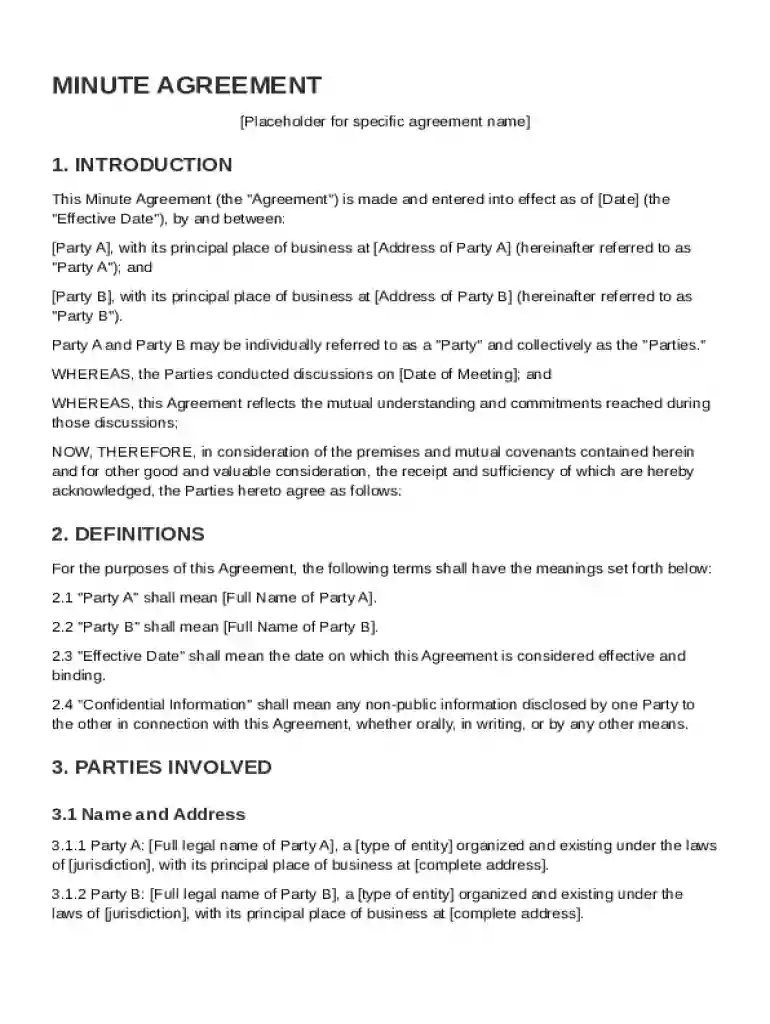
A Minute Agreement Template serves as an essential document that outlines the key terms and agreements reached between parties during a meeting. Typically used in business settings, it includes definitions, objectives, action items, and resolutions agreed upon by the stakeholders involved. The Minute Agreement acts as a legally binding contract or record that ensures all parties have a clear understanding of what was decided, thus holding them accountable for executing their responsibilities. For instance, during a corporate board meeting, the template might capture decisions on budget allocations, strategic initiatives, and voting outcomes.
Completing the Minute Agreement Template requires attention to detail to ensure that all critical points are accurately documented. Follow these steps for comprehensive and clear documentation:
Start with Basic Information:
Document the Agenda:
Capture Discussions and Decisions:
Outline Action Items:
Include Additional Sections:
A well-drafted Minute Agreement Template consists of several key elements that ensure it meets legal and operational standards:
Definitions and Terms: Clearly define any specific terms used within the agreement to avoid ambiguity.
Objectives: Articulate the primary goals and purpose of the meeting.
Action Items: Detailed list of tasks, including deadlines and accountable individuals or departments.
Confidentiality Obligations: Terms protecting sensitive information shared during the meeting.
Dispute Resolution Procedures: Steps to be followed in case disagreements arise related to the agreement.
Duration and Termination Provisions: Define how long the agreement is valid and the conditions under which it can be terminated.
The Minute Agreement Template can be legally binding, making it critical for all parties involved to understand its implications:
Adheres to the ESIGN Act: Electronic signatures are recognized as legally binding, ensuring compliance with U.S. federal law.
Document Retention: Maintain copies as part of official records for legal and compliance purposes.
Utilized in Litigation: Can be used as evidence in court to demonstrate agreed terms and establish accountability.
Privacy and Security Measures: Incorporate necessary steps to protect sensitive information per legal requirements.
The Minute Agreement Template is a vital tool for businesses and organizations for several reasons:
Facilitates Clarity and Transparency: Ensures all parties have a consistent understanding of agreements reached.
Improves Accountability: Clearly documented action items and responsibilities help hold individuals and teams accountable.
Prevents Misunderstandings: Reduces the risk of disputes by providing a clear record of discussions and decisions.
Supports Organizational Memory: Helps to preserve corporate knowledge and provides a reference for future decision-making processes.
There are various forms and variations of the Minute Agreement Template that cater to specific needs. Alternatives include:
Board Meeting Minutes: A tailor-made version for documenting corporate board meetings.
Committee Meeting Minutes: Used for recording decisions within specific committee sessions.
Conference Minutes: Suitable for capturing agreements and actions from large multi-stakeholder conferences.
Virtual Meeting Agreements: Adapted for digital platforms, incorporating specific needs for online meetings.
Using the Minute Agreement Template with DocHub offers seamless document workflow integration:
Google Workspace Integration: Directly import and export documents to and from Google Drive and Gmail.
Broad File Compatibility: Supports formats like DOC, PPT, XLS, and TXT, eliminating the need for format conversions.
Real-Time Collaboration: Multiple users can simultaneously work on and sign the template, ensuring up-to-date documentation.
Security Compliance: Utilizes 256-bit SSL encryption and OAuth 2.0 for secure file access and transfer.
Practical applications of the Minute Agreement Template include:
Corporate Strategic Planning: Annotating and tracking decisions and strategic goals discussed in executive board meetings.
Non-Profit Organization Meetings: Documenting outcomes of fundraising strategy sessions or community planning meetings.
Governmental Agency Sessions: Capturing policy discussions and resolutions in municipal or federal agency meetings.
Educational Institution Gatherings: Recording curriculum development discussions or faculty committee decisions for future reference.
These examples highlight the versatility of the template across various sectors and organizational structures.
At DocHub, your data security is our priority. We follow HIPAA, SOC2, GDPR, and other standards, so you can work on your documents with confidence.




This Agreement contains the entire understanding of the parties as to the Production, and supersedes all other written and oral agreements between the parties
In general, in a civil case a Stipulation is a voluntary agreement made between the parties during the case to shorten or simplify the process. For example,Read more


