




01. Edit your form online
Type text, add images, blackout confidential details, add comments, highlights and more.

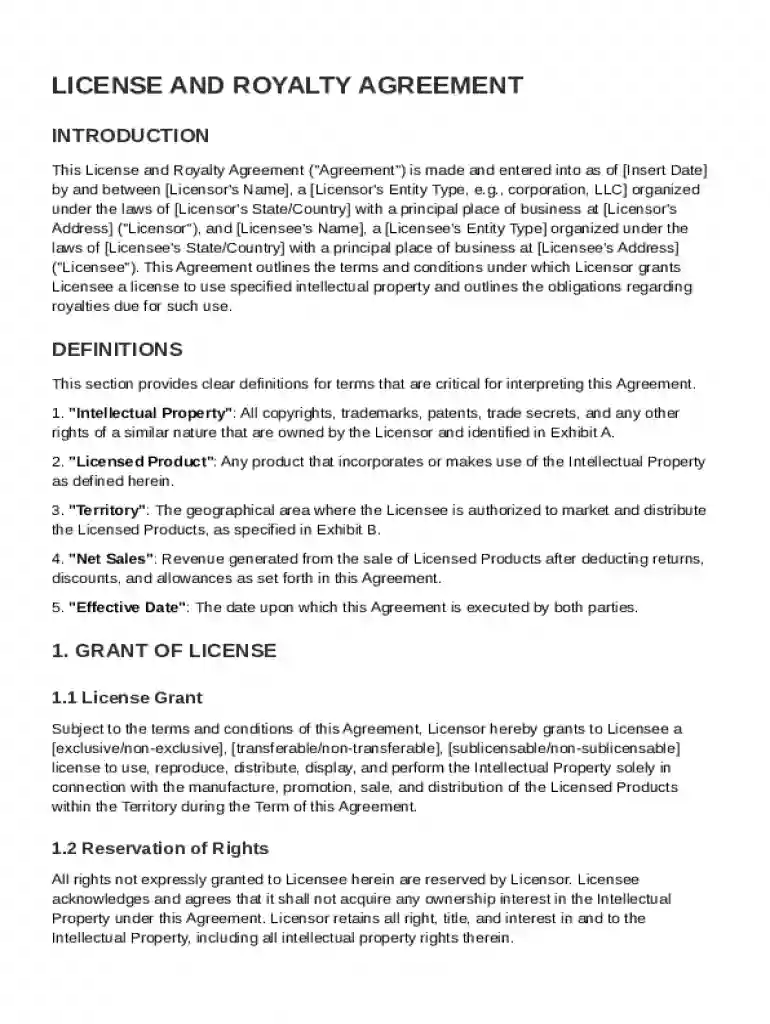
Type text, add images, blackout confidential details, add comments, highlights and more.

Draw your signature, type it, upload its image, or use your mobile device as a signature pad.

Send it via email, link, or fax. You can also download it, export it or print it out.
A License and Royalty Agreement Template is a contract that outlines the terms under which a licensor grants usage rights to a licensee for specific intellectual property (IP), in exchange for royalties. This document is crucial in defining the relationship between the parties involved, including their rights, responsibilities, and financial arrangements. The agreement typically includes definitions of key terms to ensure clarity, such as "net sales" and "intellectual property." It also specifies the scope of the license, detailing exactly what rights have been granted to the licensee and any limitations to those rights.
To effectively use the License and Royalty Agreement Template, start by identifying all parties involved, ensuring that their respective roles are clearly defined. Carefully review each section of the template, tailoring the terms to fit the specifics of your licensing arrangement. Key areas to customize include royalty rates, payment schedules, and any geographical or temporal restrictions on the license. After drafting the agreement, both parties should have their legal representatives review the document to ensure compliance with relevant laws and to address any ambiguities. Once finalized, the agreement should be signed by all parties to become legally binding.
The template encompasses several critical components that must be meticulously addressed to ensure a legally sound agreement:
For the agreement to be enforceable, it must comply with U.S. contract law principles. The document should clearly articulate the mutual consent of both parties, a valid offer and acceptance, with ample consideration (royalties as payment) exchanged. Legal provisions should address the ownership of IP and ensure compliance with federal and state regulations. This includes adherence to the ESIGN Act for electronic signatures if the agreement is executed digitally. Legal counsel should be consulted to tailor the agreement according to specific jurisdictional requirements and to safeguard against potential legal disputes.
Though primarily governed by federal IP laws, state laws can influence the enforceability and interpretation of some contract provisions. For instance, states like California have strict rules about non-compete clauses, which can affect exclusivity terms. Additionally, tax obligations related to royalty payments can vary by state, impacting how parties report and remit dues to local authorities. Parties should verify compliance with state-specific requirements by consulting legal professionals knowledgeable in the applicable jurisdiction.
An electronics company (the licensor) might license technology patents to a manufacturer (the licensee), specifying royalty payments based on the number of units sold. Alternatively, an author may license film adaptation rights to a production studio, with royalties contingent upon box office performance. Each example illustrates how the template enables diverse IP applications across industries, emphasizing flexibility in terms and adaptation to reflect different business models and arrangements.
At DocHub, your data security is our priority. We follow HIPAA, SOC2, GDPR, and other standards, so you can work on your documents with confidence.




Each contributor grants you a non-exclusive, worldwide, royalty-free patent license under the contributors essential patent claims, to make, use, sell, offerRead more
Licensee shall pay to [University] a noncreditable, nonrefundable upfront license royalty of $ upon execution of the Agreement.


