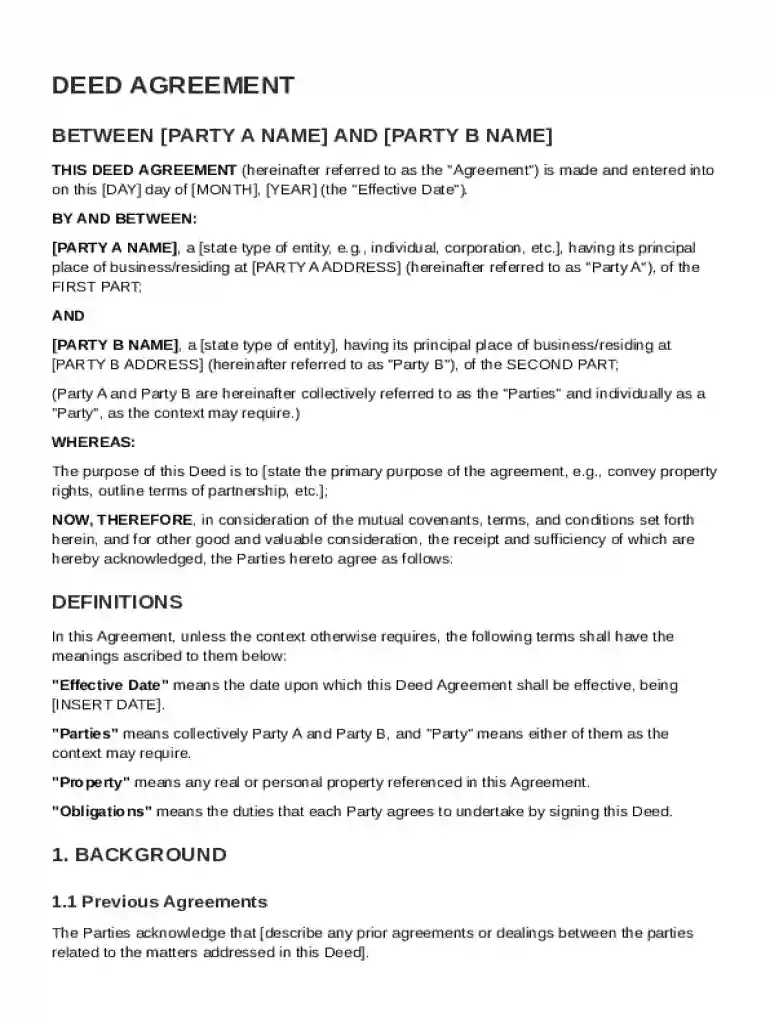
Deed Agreement Template 2026

Get Form
Deed Agreement Template Preview on Page 1

Here's how it works

01. Edit your form online
Type text, add images, blackout confidential details, add comments, highlights and more.

02. Sign it in a few clicks
Draw your signature, type it, upload its image, or use your mobile device as a signature pad.

03. Share your form with others
Send it via email, link, or fax. You can also download it, export it or print it out.

Definition and Meaning of Deed Agreement Template

A Deed Agreement Template is a formal legal document used to outline the terms and conditions agreed upon by two or more parties. It details the obligations, rights, and responsibilities of each party involved. Often used in property transactions or partnership agreements, the template provides a structured format for documenting the conveyance of property rights or the terms of a business partnership. The document covers various aspects such as the effective date, payment terms, governing law, duration, and termination conditions. By using a standardized template, parties can ensure that all necessary legal details are included, promoting clarity and reducing the risk of disputes.

How to Use the Deed Agreement Template

To effectively use a Deed Agreement Template, follow a systematic approach to ensure accuracy and compliance with legal standards. Begin by gathering all pertinent information about the parties involved, such as names, addresses, and roles. Next, identify the core elements of the agreement, including the subject matter, specific duties and rights of each party, and any pertinent legal requirements. Carefully fill out each section of the template, ensuring that each clause reflects the agreed-upon terms. Once completed, review the document with legal counsel to verify its validity. All parties should sign and date the agreement to solidify its enforcement.

Key Elements of the Deed Agreement Template

A comprehensive Deed Agreement Template includes several critical components:

  • Parties Involved: The full legal names and contact information.
  • Property or Subject Matter Description: Detailing what is being conveyed or agreed upon.
  • Terms and Conditions: In-depth description of duties, rights, and responsibilities.
  • Effective Date: When the agreement becomes active.
  • Duration: Timeframe the agreement covers.
  • Termination Conditions: What can cause the agreement to end.
  • Payment Terms: Financial considerations associated with the transaction or partnership.
  • Governing Law: The jurisdiction that oversees the agreement.
  • Miscellaneous Provisions: Additional clauses for specific circumstances.

Ensuring that each of these elements is accurately filled out can help prevent misunderstandings and potential disputes.

Steps to Complete the Deed Agreement Template

Filling out a Deed Agreement Template requires careful attention to detail. Follow these steps:

  1. Gather Information: Collect all necessary data from involved parties.
  2. Detail Subject Matter: Clearly articulate the property rights or partnership terms.
  3. Outline Terms and Conditions: Specify roles, obligations, and rights.
  4. Insert Effective Date: Establish when the agreement takes effect.
  5. Define Duration and Termination Clauses: Set timeframe and conditions for termination.
  6. Specify Payment Terms: Detail any financial obligations and schedules.
  7. Identify Governing Law: State the legal jurisdiction.
  8. Include Additional Provisions: Add clauses for special conditions.

After completing, all participants should review and confirm the accuracy of the information, followed by signing and dating the document.

Legal Use of the Deed Agreement Template

In the U.S., Deed Agreement Templates are legally binding when properly executed. They are commonly used to convey property rights, form business partnerships, or formalize agreements between parties. For legal validity, the template must be fully completed, signed by all parties, and comply with applicable state laws. Supplementary legal advice is recommended to ensure compliance with jurisdictional requirements and prevent potential issues during execution. The template should reflect all critical details to uphold enforceability in legal disputes or claims.

State-Specific Rules for Deed Agreement Template

While Deed Agreement Templates provide a standard framework, be aware of state-specific rules that may influence their execution. Different jurisdictions may have unique requirements regarding notarization, witness signatures, or filing with local registry offices. For instance, some states necessitate the presence of a notary public to validate the signing process, while others might require additional documentation for specific transactions. It's critical to review the specific legal standards within your state and adjust the template accordingly to ensure legality and enforceability.

Examples of Using the Deed Agreement Template

Deed Agreement Templates are versatile and widely employed across various scenarios:

  • Real Estate Transactions: Outlining the transfer of property ownership between buyers and sellers.
  • Business Partnerships: Establishing roles, investments, and profit-sharing between partners.
  • Lease Agreements: Detailing terms for tenants and landlords regarding property usage.
  • Intellectual Property Transfer: Conveying rights from a creator to an organization or individual.

These examples highlight the diverse utility of the template in formalizing agreements across different sectors and contexts.

Required Documents for Completing a Deed Agreement

When completing a Deed Agreement Template, gather essential documents to ensure compliance and accuracy:

  • Identification Documents: Valid IDs for all parties involved.
  • Proof of Ownership: Necessary for property conveyance agreements.
  • Previous Agreements or Contracts: To understand and reference prior obligations.
  • Financial Records: Confirm payment terms and any financial history relevant to the agreement.

Having these documents readily available will facilitate a smoother completion process and provide verifiable evidence of the agreed terms.

be ready to get more

Complete this form in 5 minutes or less

Get form

Got questions?

We have answers to the most popular questions from our customers. If you can't find an answer to your question, please contact us.
Contact us
A formal arrangement made by an individual (not a company) with their creditors in place of bankruptcy. This arrangement has largely been replaced by individual voluntary arrangements.
What is a Deed? A deed of agreement is a binding promise to do something. In commercial terms, the signing of a deed indicates a serious commitment by the person or company executing it to perform certain duties and obligations.
Deeds: To validly execute a deed, two methods are permitted. The individual may: sign in the presence of a witness to evidence the execution; or. direct another person to sign the deed in the individuals presence and in the presence of two witnesses to evidence execution.
The contract is typically executed by both parties (or authorised representatives thereof) and will be binding and in effect from the date of the document. Deeds on the other hand do not need consideration to have changed hands between the parties for the agreement to be legally binding and enforceable.
What is an example of deed? A warranty deed is the most common example of a deed. A warranty deed is a deed that indicates that the property has been fully researched, and the grantor guarantees (warrants) that the grantor has full legal rights to sell the property with no liens or other encumbrances.

Security and compliance

At DocHub, your data security is our priority. We follow HIPAA, SOC2, GDPR, and other standards, so you can work on your documents with confidence.

Learn more
ccpa2
pci-dss
gdpr-compliance
hipaa
soc-compliance

People also ask

A deed is a much more formal and intricate type of contract than an agreement and has more stringent legal requirements. What are the benefits of a deed? The formalities of a deed can provide more legal certainty to parties when they are transferring large property and other valuable assets.
Contract for deed is a contract for the sale of land which provides that the buyer will acquire possession of the land immediately and pay the purchase price in installments over a period of time; but, the seller will retain legal title until all payments are made.

Related links