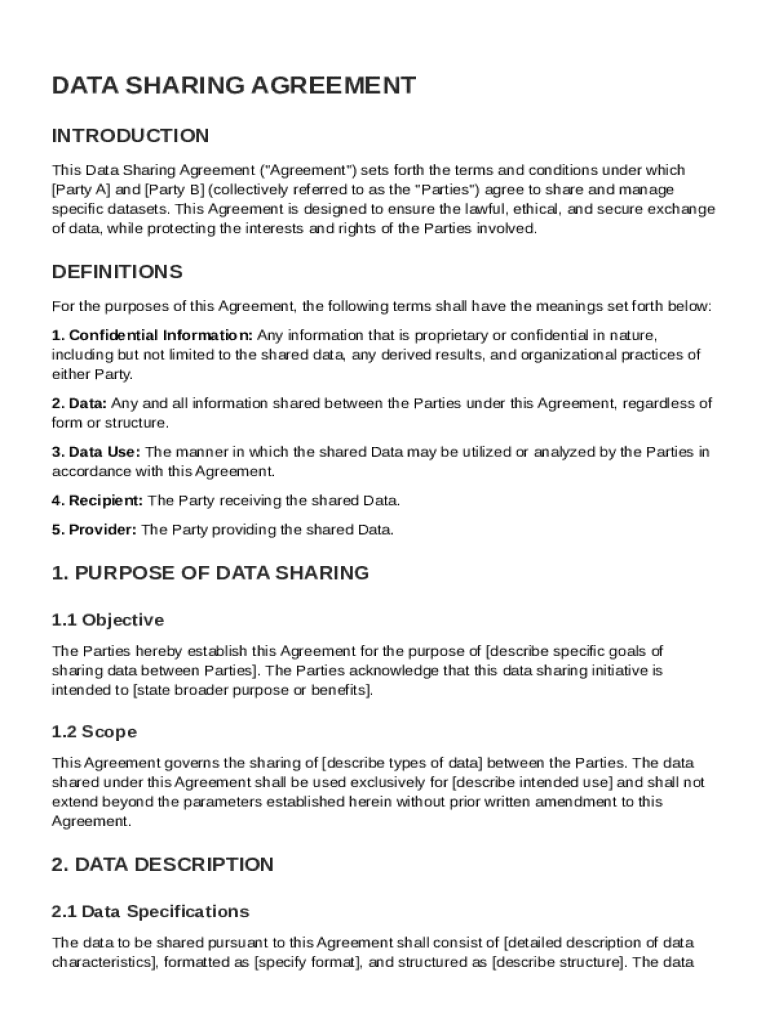







Definition & Importance of a Data Sharing Agreement Template
A Data Sharing Agreement Template serves as a structured blueprint designed to outline the terms, conditions, and specifics involved in the exchange of data between two or more parties. This template is essential for ensuring that data sharing is conducted legally, ethically, and securely. It defines critical elements such as the scope of the data exchange, the responsibilities of the parties involved, and the protocols for data security and compliance with applicable laws like HIPAA or GDPR. By providing a clear framework, the template helps mitigate misunderstandings and disputes by detailing each party's role in managing shared data.
Essential Components
- Purpose and Scope: Clearly outlines why the data is being shared and the extent of this sharing.
- Roles and Responsibilities: Specifies duties for data management and compliance.
- Security Protocols: Details the regulations governing data protection.
- Compliance Requirements: Covers adherence to relevant laws such as HIPAA in the U.S.
- Termination and Disposal: Describes procedures for data disposal when the agreement ends.
How to Use the Data Sharing Agreement Template
To effectively utilize a Data Sharing Agreement Template, both parties should first identify their needs concerning data sharing. The template then acts as a fill-in-the-blank guide where users can insert specifics such as the names of involved parties, the type of data being shared, and the conditions of use. Parties should collaborate to customize sections relevant to security measures, data retention timelines, and dispute resolution. Legally binding signatures signify each party's agreement to the terms, making consulting with legal professionals critical to ensure completeness and compliance.
Steps
- Identify Parties Involved: List all entities sharing and receiving data.
- Define Data Parameters: Specify what data will be shared and for what purpose.
- Customize Security Protocols: Adjust according to specific needs and regulatory requirements.
- Complete with Legal Counsel: Engage with legal experts to ensure validity.
- Finalize with Signatures: Authenticate with signatures from all parties involved.
Key Elements of the Data Sharing Agreement Template
A well-structured Data Sharing Agreement Template incorporates several key elements crucial for a comprehensive understanding and robust agreement. These include:
- Data Description: Detail the types and categories of data to be shared.
- Usage Limitations: Outline restrictions on data usage to prevent misuse.
- Data Quality Assurance: Ensure the shared data meets quality standards.
- Auditing Rights: Allow periodic checks to verify compliance.
- Indemnification Clauses: Protect parties against data breaches and misuse.
Security and Compliance
Security and compliance are paramount. The agreement should integrate:
- Encryption Standards: The use of technology such as 256-bit SSL to protect data.
- Compliance with National Laws: Adherence to acts like the U.S. Stored Communications Act.
- Data Breach Protocols: Steps to follow in case of a data breach.
Examples of Using a Data Sharing Agreement Template
Examples of a Data Sharing Agreement Template in practice provide deeper insights into its utility across different scenarios:
- Healthcare Industry: Hospitals using agreements to share patient information securely for research without violating HIPAA.
- Academic Collaborations: Universities exchanging student and faculty information for joint research initiatives.
- Business Partnerships: Companies in a merger sharing customer data whilst ensuring compliance with privacy laws.
Case Studies
- University Research Collaboration: A consortium of educational institutions uses an agreement to share academic performance data while maintaining individual privacy.
- Retail Merger Data Exchange: Two merging retailers utilize the template to harmonize customer data for efficiency while adhering to consumer protection laws.
Legal Use of the Data Sharing Agreement Template
Legal robustness is crucial. The Data Sharing Agreement Template should incorporate:
- Legal Compliance: Ensuring alignment with federal laws such as HIPAA or international frameworks like GDPR.
- Contractual Obligations: Including indemnity clauses to outline liability in cases of data breaches.
- Record Keeping: Steps for proper documentation and archiving for legal discoverability.
Mitigating Legal Risks
To mitigate legal risks:
- Seek Legal Guidance: It is advisable to have the agreement reviewed by legal experts.
- State-Specific Adaptations: Modify contracts to comply with specific state laws where applicable.
- Regular Updates: Revise and update agreements to reflect changes in laws or business circumstances.
Versions or Alternatives to the Data Sharing Agreement Template
There are different variations and alternatives to the standard Data Sharing Agreement Template depending on the industry and specific needs:
- Sector-Specific Templates: Tailored versions for healthcare, finance, or research sectors.
- International Agreements: Templates incorporating rules for cross-border data sharing.
- Simplified Versions: For smaller businesses needing less complex data sharing agreements.
Related Templates
- Non-Disclosure Agreements (NDAs): For confidential information not covered in general data sharing.
- Memorandum of Understanding (MOU): Less formal than contracts, more flexible.
State-by-State Differences in Data Sharing Agreements
Data sharing agreements may differ from state to state within the U.S. due to varying local regulations around privacy and data protection:
- California (CCPA): Requires specific consumer rights disclosures.
- New York: Emphasizes cybersecurity, affecting data protocols.
- Virginia and Other States: Follow their specific privacy laws impacting agreement content.
Adapting to Different States
To ensure compliance, parties must:
- Research Local Laws: Stay informed about state-specific privacy laws.
- Modify Templates Accordingly: Adjust agreements based on the regional legal framework.
- Consult Legal Professionals: Seek state-specific legal advice during template adaptation.
Software Compatibility and Integration with DocHub
The Data Sharing Agreement Template can be seamlessly integrated and managed through platforms like DocHub, which offers critical features for document workflow optimization:
- Supported Formats: Compatible with PDFs, DOCs, and more for easy modifications.
- Cloud Integration: Connectivity with Google Drive and other storage solutions for efficient file management.
- Electronic Signatures: Legally binding electronic tools to facilitate remote signing.
Benefits of Using DocHub
Using DocHub enhances the data sharing process by:
- Simplifying Editing and Management: Offers intuitive interface and tools.
- Ensuring Security: Encrypts documents, ensuring compliance with privacy laws.
- Enhancing Collaboration: Allows multiple users to access and work on documents together.