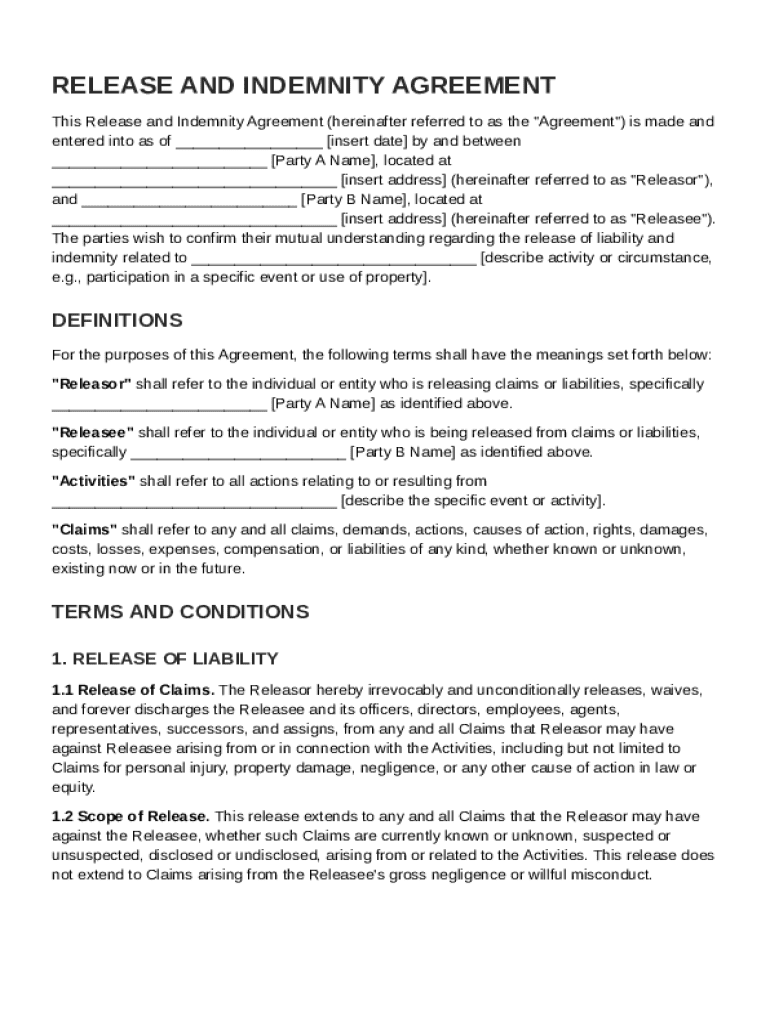







Definition and Meaning of Release and Indemnity Agreement Template
A Release and Indemnity Agreement Template is a legal document used to outline the conditions under which one party, known as the Releasor, releases another party, known as the Releasee, from any liabilities or claims related to specific activities or events. This template serves as a foundational tool for mitigating potential legal risks and uncertainties by clearly defining the obligations and rights of both parties involved. These agreements are instrumental in various fields, such as business transactions, sports and recreational activities, and employment contexts where one party needs protection against future claims or damages resulting from an agreed-upon activity.
- Purpose and Scope: The primary purpose of this agreement is to manage risk and prevent disputes by documenting the consent of the Releasor to waive claims against the Releasee.
- Legal Framework: It includes clauses that adhere to relevant state and federal laws, providing an essential legal layer to support the enforceability and validity of the agreement.
Key Elements of the Release and Indemnity Agreement Template
A comprehensive Release and Indemnity Agreement Template contains several critical components that ensure its effectiveness and legality.
- Parties Involved: Clearly identifies the Releasor and Releasee, outlining their roles and relationships.
- Definitions: Provides precise definitions of important terms used throughout the document to avoid ambiguity.
- Assumption of Risk: Describes the Releasor's acknowledgment of participating in activities at their own risk.
- Indemnification Clause: Details the obligations of the Releasor to indemnify and hold the Releasee harmless from any claims.
- Governing Law: Specifies the jurisdiction whose laws will apply to the agreement to resolve disputes.
- Severability: Ensures that if any part of the agreement is found invalid, the remainder still stands.
Steps to Complete the Release and Indemnity Agreement Template
Filling out a Release and Indemnity Agreement Template requires careful attention to detail to ensure all necessary information is captured accurately.
- Identify the Parties: Enter the full legal names and contact information of the Releasor and Releasee.
- Outline the Activity or Event: Clearly describe the activities or events under which the release is applicable.
- Detail the Release Conditions: Specify the circumstances and limitations of the release.
- Include Risk Acknowledgment: Have the Releasor confirm acknowledgment of any associated risks.
- Finalize Legal Clauses: Review indemnification and governing law clauses to ensure compliance.
- Sign and Date: Both parties must sign and date the agreement to make it binding.
Important Terms Related to Release and Indemnity Agreement Template
Understanding key terms is crucial for the effective use and interpretation of the Release and Indemnity Agreement Template.
- Releasor and Releasee: Parties to the agreement where the Releasor relinquishes the right to make claims against the Releasee.
- Liability: Legal responsibility owed by one party to another.
- Waiver: The voluntary relinquishment of a legal right or claim.
- Indemnification: Compensation for harm or loss, ensuring that the Releasee is not financially liable.
- Breach: Failure to comply with terms of the agreement, potentially leading to legal consequences.
How to Use the Release and Indemnity Agreement Template
Utilizing the Release and Indemnity Agreement Template effectively requires understanding its context and application.
- Review Local Laws: Make sure the agreement adheres to the legal requirements of relevant jurisdictions.
- Customization: Tailor the template to suit specific activities or events by including unique terms or conditions as needed.
- Consult Legal Counsel: Engage a lawyer for a thorough review to ensure that the document is airtight and mitigates risk appropriately.
- Distribution: Share the completed agreement with all involved parties, retaining copies for record-keeping.
Legal Use of the Release and Indemnity Agreement Template
The legal enforceability of the Release and Indemnity Agreement Template is dependent on several factors.
- Consent and Voluntariness: The agreement must be entered voluntarily by both parties for it to be legally binding.
- Capacity: Both parties should have the legal capacity to enter into an agreement, meaning they are of sound mind and, if applicable, legally of age.
- Consideration: In some jurisdictions, the agreement must involve some form of consideration, such as compensation or a benefit, to be valid.
- Compliance: Ensure all clauses comply with existing federal and state laws to increase enforceability.
State-Specific Rules for the Release and Indemnity Agreement Template
State laws can significantly influence how a Release and Indemnity Agreement is interpreted and enforced.
- Jurisdictional Differences: Key elements such as indemnification clauses and liabilities can vary by state.
- Notarization Requirements: Some states require notarization of the agreement for it to be legally valid.
- Minor Participation: Additional consent, such as that from a guardian, might be required for agreements involving minors.
- State-Specific Terms: Some states may mandate specific language or terms within such agreements to ensure transparency and clarity.
Examples of Using the Release and Indemnity Agreement Template
The Release and Indemnity Agreement Template can be effectively utilized in various scenarios to mitigate risk.
- Recreational Activities: Sports clubs and recreational facilities use these agreements to manage liability associated with physical activities.
- Business Transactions: Companies employ these templates in mergers or service agreements to protect against future claims.
- Volunteering Events: Nonprofits may require volunteers to sign an indemnity agreement to cover potential liabilities during events.
- Construction Projects: Contractors and subcontractors might use these agreements to delineate liability boundaries on job sites.