






Definition and Meaning of a Financial Binding Agreement Template
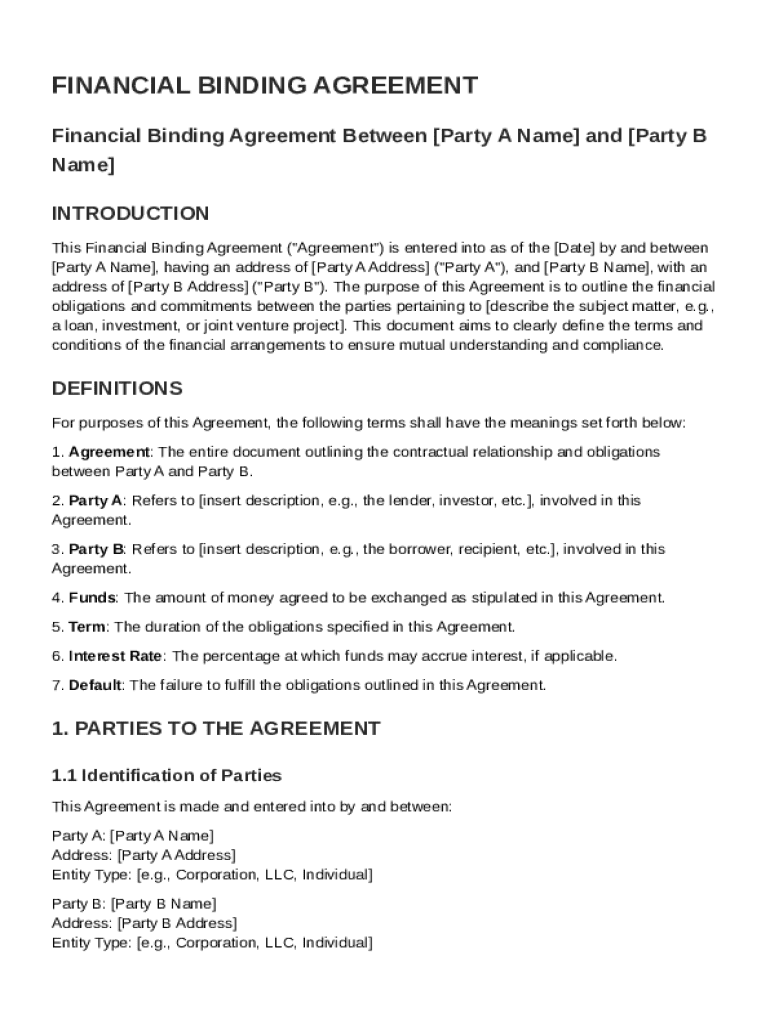
A Financial Binding Agreement Template is a pre-structured document that delineates the financial commitments and obligations between involved parties — typically referenced as Party A and Party B. This template serves as a framework for establishing the terms of financial transactions, such as loans, investments, or other monetary agreements. Key components typically encapsulated within this template include definitions of pertinent terms, responsibilities of each party, interest rates, payment schedules, conditions for default, confidentiality clauses, and governing laws. This blueprint ensures that all parties have a clear and mutual understanding regarding the financial transaction, enhancing compliance and reducing ambiguities.
How to Use the Financial Binding Agreement Template
The utilization of the Financial Binding Agreement Template begins with importing or downloading the template into a document editing platform such as DocHub. Users then modify the placeholder information — typically present in the template — to suit specific transaction needs. Here’s a step-by-step approach:
- Review the Template: Begin by thoroughly examining the template to understand its sections and components.
- Fill in Personal and Transaction Information: Enter the full legal names and contact details of the parties involved, alongside specific transaction information like loan amounts or investment figures.
- Tailor Clauses as Necessary: Adjust the provided clauses to align with the agreed-upon terms between both parties, such as negotiation points on confidentiality or payment schedules.
- Insert Signatures: Utilize electronic signature functionalities to ensure the document is legally binding and achieve completion efficiently.
- Save and Distribute: After finalizing the content, save the template and share it with the other party for review and signature.
Key Elements of the Financial Binding Agreement Template
The Financial Binding Agreement Template integrates several critical elements to ensure comprehensive protection and clarity for all parties. These elements are:
- Definitions and Interpretations: Clearly outlines the terminology used throughout the document.
- Payment Terms and Schedule: Detailed description of how and when payments are to be made.
- Interest and Penalties: Specifics on interest rates applicable to borrowed sums and penalties in case of payment default.
- Confidentiality Obligations: Protocols for keeping shared or exchanged information private.
- Amendment Procedures: Prescribes how adjustments can be legally made to the agreement.
- Legal Framework: Identification of the governing laws under which the agreement operates.
Each section plays a pivotal role in safeguarding the interests of involved parties and provides clear guidance on the procedure and expectations throughout the financial transaction.
Steps to Complete the Financial Binding Agreement Template
Fulfilling the template requirements involves precise actions aimed at tailoring it to specific transaction requirements. Follow these steps for achieving proper completion:
- Gather Required Information: Collect the necessary details relevant to the agreement, including parties’ details and financial terms.
- Edit the Template: Modify the template sections to reflect the actual agreement terms, making sure that all placeholder text is properly substituted with applicable data.
- Review for Accuracy: Thoroughly check for any errors or omissions that could lead to misunderstandings.
- Incorporate Signatures: Use electronic signature tools within document management software to obtain signatures from all parties involved.
- Finalize and Archive: Store the completed agreement in a secure location for future reference, ensuring all parties have access to the final version.
Legal Use of the Financial Binding Agreement Template
In the United States, the Financial Binding Agreement Template serves as a legally enforceable contract when correctly executed. This document complies with legal standards, such as the ESIGN Act, wherein electronic signatures are recognized as valid. Parties must ensure:
- The agreement comprehensively covers all essential elements.
- All parties accurately understand and consent to the terms.
- The document version used is up-to-date and meets applicable legal standards.
Legal validity is achieved by ensuring clarity, mutual consent, and proper execution using electronic or handwritten signatures as applicable.
State-Specific Rules for the Financial Binding Agreement Template
The U.S. legal framework requires awareness of state-specific regulations regarding financial agreements. Key considerations include:
- Governing Law Clauses: Must stipulate which state’s laws govern the interpretation and enforcement of the agreement.
- State Interest Caps: Many states impose caps on interest rates that vary, impacting loan terms.
- Disclosure Requirements: Some states may require additional disclosures to ensure the protection of consumer rights.
Verify that all state-specific requirements are met to ensure enforceability, consulting with a legal advisor if necessary.
Examples of Using the Financial Binding Agreement Template
There are numerous scenarios where the Financial Binding Agreement Template is instrumental. For instance:
- Business Loans: A loan agreement between a lender and a small business where terms for repayment and interest rates are explicitly stated.
- Investment Contracts: Detailing an agreement between an investor and a startup, outlining investment sums and expected returns.
- Personal Loans: An arrangement between two individuals formalizing loan terms such as repayment schedules and collateral requirements.
These examples illustrate the adaptability and critical role of the template in ensuring structured, clear, and legally binding financial transactions.
Software Compatibility for the Financial Binding Agreement Template
Platforms like DocHub enhance the functionality and accessibility of the Financial Binding Agreement Template. Key compatibility features include:
- Cross-Platform Accessibility: Accessible via both desktop and mobile web browsers without requiring additional software.
- Format Support: Compatibility with various file formats like PDF, DOC, PPT, and more, facilitating seamless editing and sharing.
- Integration with Cloud Services: Direct integration with services like Google Drive, enabling easy import and export of documents back to cloud storage without additional conversion steps.
This compatibility allows users to focus on inputting accurate contractual information, while leveraging technology for efficient document management and security.