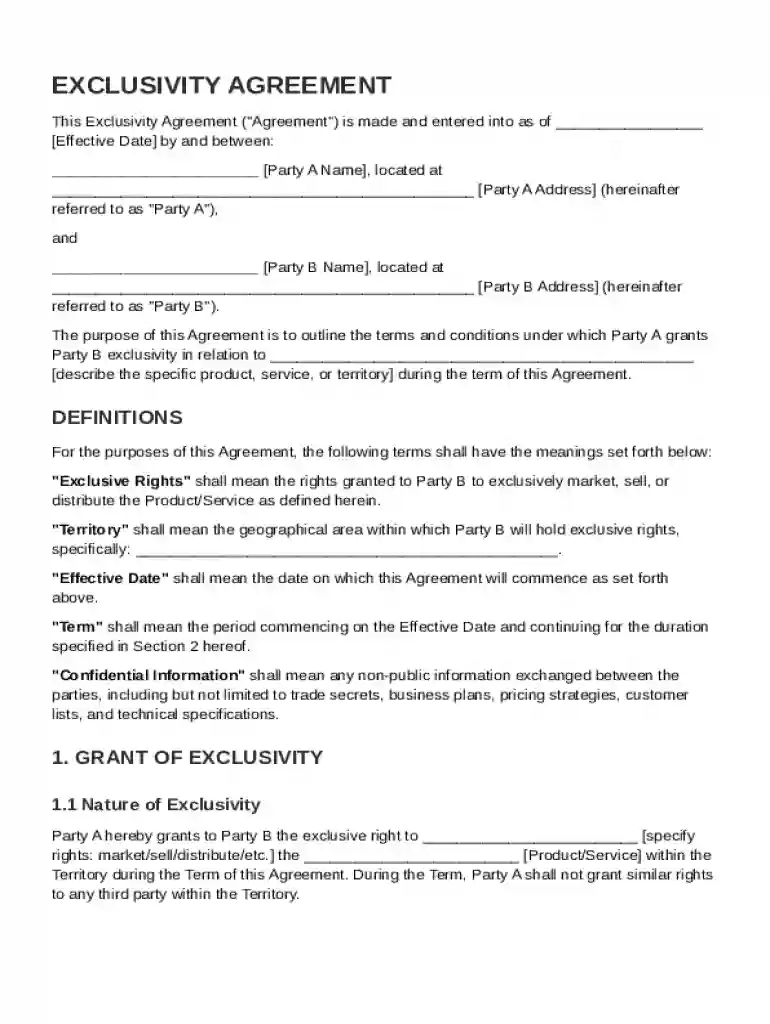
Definition and Meaning of the Exclusivity Agreement Template
An Exclusivity Agreement Template is a legal document that establishes a contractual relationship between two parties, where one party grants the other exclusive rights to market, sell, or distribute a specific product or service within a defined territory and time frame. It is an instrumental tool in setting the foundation for business dealings that require a degree of monopolistic privilege for effective market presence. This document includes critical components such as confidential information clauses, payment terms, responsibilities of involved parties, dispute resolution mechanisms, and intellectual property protections.
- Exclusive Rights: The agreement outlines the exclusive rights provided to the second-party, ensuring that no other competitors are given the same privileges within the stipulated conditions.
- Defined Territory and Duration: Specifies the geographical region and the period during which the exclusivity will be effective.
- Obligations and Responsibilities: Details the specific duties each party must adhere to under the agreement, ensuring compliance and minimizing disputes.
- Protection of Intellectual Property: Incorporates clauses that safeguard intellectual property, ensuring creations and innovations remain protected.
How to Use the Exclusivity Agreement Template
Using the Exclusivity Agreement Template involves several steps to ensure that it serves the intended purpose effectively. It must be tailored to the specific needs of the parties involved, taking into consideration legal, strategic, and operational factors.
Customization:
- Adjust the template to match the specifics of your business relationship and objectives.
- Include the exact nature of the exclusivity being granted, with clear definitions of terms.
Legal Review:
- Engage with a legal professional to ensure that the document complies with local laws and accurately reflects the intended agreement.
- Review all clauses thoroughly to avoid ambiguity or potential conflicts.
Implementation:
- After both parties sign the agreement, ensure all relevant teams (sales, legal, operations) understand and implement their respective duties as outlined.
- Keep a record of the agreement and track its duration, renewals, or terminations.
Steps to Complete the Exclusivity Agreement Template
Filling out the Exclusivity Agreement Template requires precision and attention to detail. Here's a step-by-step guide:
Identify Parties:
- Clearly list the names and roles of the parties involved in the contract.
- Include contact details for clarity.
Define Rights and Obligations:
- Explicitly outline the exclusive rights being granted and specify any territorial or temporal limitations.
- Document obligations for each party, ensuring mutual understanding.
Establish Payment Terms:
- Describe the financial arrangements, including payment schedules, amounts, and any conditions tied to financial transactions.
Insert Confidentiality Clauses:
- Add sections that protect sensitive information exchanged during the agreement.
Include Termination Conditions:
- Define circumstances under which the agreement can be terminated and the steps required for lawful termination.
Key Elements of the Exclusivity Agreement Template
The Exclusivity Agreement Template comprises various components that define its structure and enforceability:
- Parties and Purpose: Identifies those involved and the intention behind granting exclusivity.
- Scope of Exclusivity: Describes the range of rights and services covered by the agreement.
- Compensation Details: Includes payment structures, obligations, and any bonuses or incentives.
- Policing Clauses: Covers procedures for ensuring compliance and addressing any breaches or disputes.
- Term and Termination: Specifies the length of the agreement and conditions for its extension or termination.
Legal Use of the Exclusivity Agreement Template
In the U.S., the Exclusivity Agreement Template is used to formalize business relationships under the legal framework that upholds business contracts. Its primary legal purpose is to prevent parties from entering into similar agreements with competitors within the specified terms, thereby providing a competitive advantage:
- Contract Enforceability: Ensures both federal and state laws are taken into account when drafting to enhance binding capabilities.
- Dispute Resolution: Outlines methods such as arbitration or mediation for resolving conflicts, reducing the recourse to litigation.
- Intellectual Property Rights: Protects proprietary information and formulations, potentially essential in innovation-driven industries.
Important Terms Related to Exclusivity Agreement Template
Understanding legal jargon contained within the Exclusivity Agreement Template is paramount:
- Non-Compete Clause: Restricts the ability of both parties to engage in competing enterprises during the duration of the contract.
- Conditional Obligation: Encompasses scenarios where party obligations are activated upon the occurrence of specific events outlined in the agreement.
- Performance Guarantee: Requires parties to meet pre-defined performance benchmarks in order to uphold the agreement.
Examples of Using the Exclusivity Agreement Template
This template is particularly beneficial in scenarios requiring exclusive distribution or representation rights:
- Market Launch: A U.S.-based tech company may use this agreement when launching a new product in Europe, granting a distributor sole rights to sell within that region.
- Service Agreements: An entertainment company may engage an advertising agency with exclusive rights to promote a forthcoming event or series.
- Franchise Operations: A restaurant chain may grant a franchisee exclusive rights to open its stores in a new city.
Business Entity Types That Benefit Most from the Exclusivity Agreement Template
Different business entities leverage exclusivity agreements for various strategic reasons:
- Corporations: Use them to protect new product lines and ensure loyal distribution channels.
- Partnerships: Engage in exclusive agreements to delineate roles and responsibilities firmly.
- Limited Liability Companies (LLCs): Employ these contracts to solidify strategic alliances and protect intellectual property.
By understanding and utilizing the Exclusivity Agreement Template, businesses can strategically navigate market entry, expansion, and consolidation efforts with legal certainty.