
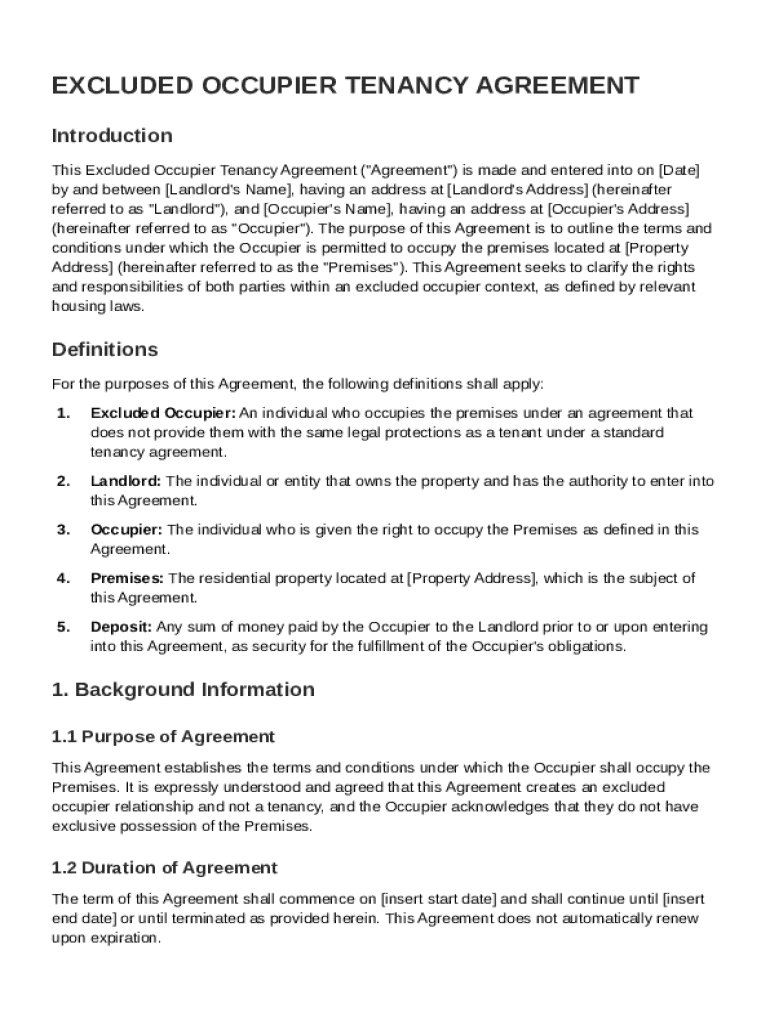







Definition & Meaning
An Excluded Occupier Tenancy Agreement is a legal document outlining the terms under which an occupier, who does not have the full legal protection of a traditional tenancy, can live in a residential property. This agreement is typically used when the landlord also resides in the property and shares common spaces with the occupier, such as in lodger arrangements. Unlike standard tenancy agreements, this type offers limited security and rights to the occupier.
Key Elements of the Excluded Occupier Tenancy Agreement Template
The template for an Excluded Occupier Tenancy Agreement includes several critical components:
Identifying Information
- Full names and contact information of both the landlord and the occupier
- Address of the property
Occupancy Terms
- Duration of occupancy: fixed term or periodic tenancy
- Payment terms, including rent amount, due date, and payment method
Responsibilities and Rights
- Maintenance obligations for both parties
- Use of shared facilities and areas
Termination Conditions
- Notice period for either party to terminate the agreement
- Conditions under which immediate termination is possible
Additional Clauses
- Provisions related to pets, guests, smoking, and utilities
- Deposit details and refund conditions
- Dispute resolution methods
How to Use the Excluded Occupier Tenancy Agreement Template
Step-by-step Guide
- Understand the Legal Context: Familiarize yourself with the rights and responsibilities that apply under the 'excluded occupier' arrangement.
- Customize the Template: Enter specific details related to your arrangement, such as names, property address, and occupancy period.
- Review Essential Clauses: Ensure all relevant clauses about maintenance, payment, and termination are included and understood.
- Discuss with the Other Party: Both parties should discuss and agree on all terms to avoid disputes later.
- Finalize and Sign: Once both parties are satisfied, sign the document. Consider notarizing for additional legal weight.
Steps to Complete the Excluded Occupier Tenancy Agreement Template
Detailed Process
- Gather Necessary Information: Collect all essential details and documents required to complete the agreement.
- Fill Out the Template: Carefully input all information into the template, ensuring accuracy.
- Consult with Legal Advisor: For complex situations, seek advice from a legal professional to ensure compliance.
- Make Copies: Produce signed copies for both landlord and occupier to maintain clear records.
Legal Use of the Excluded Occupier Tenancy Agreement Template
- Compliance with Local Laws: Ensure that the agreement complies with state and local regulations governing residential occupancies.
- Documentation: Provides a formal record of the terms agreed upon by both parties, reducing the risk of legal disputes.
- Limited Security of Tenure: Understand that this form provides less protection compared to standard tenancy agreements, reflecting the temporary and flexible nature of the arrangement.
Why Use the Excluded Occupier Tenancy Agreement Template
Using this template ensures that both landlord and occupier clearly understand their rights and obligations, minimizing potential misunderstandings. It provides a structured approach to legally documenting occupancy terms, offering a reference point should disputes arise.
Important Terms Related to Excluded Occupier Tenancy Agreement
Common Terms Explained
- Excluded Occupier: A person who resides in a property but does not have full tenant rights, generally sharing living space with the landlord.
- Lodger: Another term often used interchangeably with excluded occupier in residential sharing scenarios.
- Notice Period: The legally required timeframe within which a party must notify the other regarding the termination of the agreement.
Who Typically Uses the Excluded Occupier Tenancy Agreement Template
This agreement is commonly employed by:
- Homeowners: Who rent out a room in their residence while continuing to live there.
- Renters: Who sublease part of their rented space with the landlord's permission.
- Occupiers: Looking for flexible living arrangements without long-term commitments.


Examples of Using the Excluded Occupier Tenancy Agreement Template
Practical Scenarios
- A homeowner renting out a basement suite while residing in the upper portion of the house.
- An individual leasing a room in a shared apartment with the head tenant’s agreement.
- Students renting rooms in a shared house managed by a live-in landlord.




