
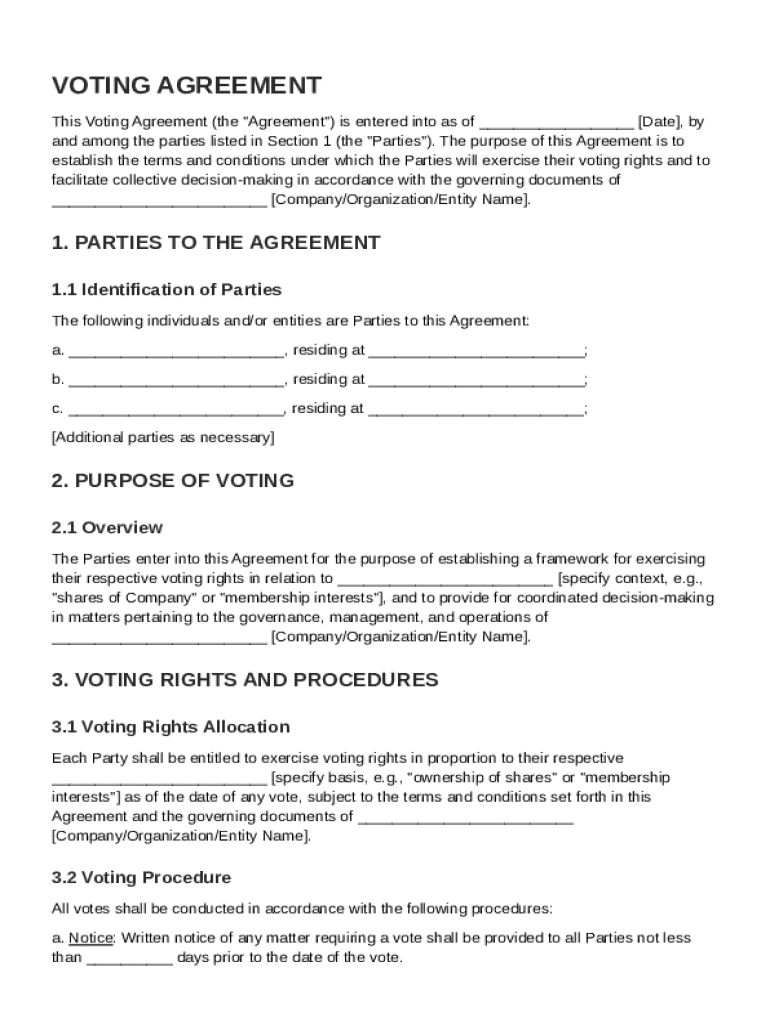







Definition & Meaning
A Voting Agreement Template is a document that outlines the terms and conditions under which multiple parties agree to exercise their voting rights in a coordinated manner concerning the governance of a specific company or organization. This legal form is crucial for defining the voting rights allocation and procedures to ensure that all parties have a clear understanding of their roles and responsibilities. It typically includes sections detailing quorum requirements, majority and supermajority vote stipulations, and guidelines for amending the agreement. The overall goal is to facilitate organized decision-making among the participating entities.
Key Components of a Voting Agreement
- Identification of Participants: Clearly lists all parties involved in the agreement, including their roles and voting rights.
- Voting Rights Allocation: Details on how votes are distributed among parties and any conditions attached to the voting process.
- Quorum Requirements: Defines the minimum number of participants needed for the vote to be valid.
- Amendment Procedures: Explanation of how changes to the voting agreement can be proposed, reviewed, and implemented.
- Governance Law: Statements regarding the legal framework governing the agreement, typically determined by the location of the entity.
Importance of Using a Voting Agreement Template
A Voting Agreement Template is significant for businesses and organizations aiming to streamline their decision-making processes. By providing a structured format, it ensures that all parties understand the voting process and are committed to the decisions made collectively. Utilizing a standard template helps prevent disputes by providing clear guidelines and agreed-upon procedures.
Advantages of Structured Voting
- Clarity and Consistency: Ensures that all parties follow the same rules and procedures, reducing confusion and inconsistencies.
- Dispute Prevention: Mitigates potential conflicts by clearly defining voting processes and responsibilities.
- Legal Protection: Offers a formal agreement that parties can refer to in legal situations, protecting individual and collective rights.
How to Use the Voting Agreement Template
Using a Voting Agreement Template involves several key steps to ensure that it effectively serves its purpose.
Step-by-Step Instructions
- Gather Information: Collect details about the parties involved, including names, roles, and the shares or votes they hold.
- Review the Voting Terms: Carefully evaluate the terms related to quorum requirements, voting thresholds, and amendment processes.
- Customize the Template: Adjust the template to fit the specific needs of the organization, including any unique provisions or clauses.
- Legal Review: Consult a legal advisor to ensure that the document complies with applicable laws and accurately reflects the intentions of all parties.
- Finalize and Execute: Once reviewed and approved by all parties, the agreement should be signed to make it official.
Steps to Complete the Voting Agreement Template
To complete the Voting Agreement Template, it is vital to follow a structured approach:
- Identify Key Participants: List each party involved and their respective roles and voting rights.
- Define Voting Procedures: Specify how votes will be conducted and what constitutes a valid vote.
- Establish Quorum Requirements: Clearly state the minimum number of participants required for decision-making.
- Detail Amendment and Termination Processes: Expound on how the agreement can be amended or terminated if necessary.
- Set Governing Law: Include the legal jurisdiction governing the agreement, typically based on the organization’s location.
Who Typically Uses the Voting Agreement Template
Voting Agreement Templates are commonly employed by a variety of entities that require a structured approach to decision-making.

Common Users
- Corporations and Partnerships: Businesses that need to coordinate voting among multiple stakeholders.
- Joint Ventures: Collaborative projects that involve shared decision-making authority.
- Nonprofit Organizations: Entities that require agreement among board members or committees for governance decisions.

Legal Use of the Voting Agreement Template
A Voting Agreement is a legally binding document ensuring that all parties adhere to set regulations and procedures for voting. It is important that users understand the legal implications of the document and adhere to state-specific laws.
Key Legal Considerations
- Binding Nature: Once signed, all parties are legally bound to uphold the terms of the agreement.
- State Laws: Compliance with the laws of the state where the entity is registered is mandatory.
- Enforcement: Breaches of the agreement can lead to legal consequences or dissolution of the agreement.
Key Elements of the Voting Agreement Template
Voting Agreements contain several crucial elements that are fundamental to their purpose.
Essential Sections
- Participant Information: A list of all voting members and their respective roles.
- Voting Framework: Specification of voting methods, including electronic or in-person options.
- Majority and Supermajority Requirements: Conditions under which a simple majority or supermajority is needed to pass a vote.
- Amendment Clauses: Guidelines for making changes to the agreement as needed.
- Termination and Exit Strategies: Provisions for how and when parties can exit the agreement.
State-specific Rules for the Voting Agreement Template
Different states have varying regulations regarding the implementation of voting agreements.
Examples of State Variations
- Quorum Requirements: Some states may mandate specific quorum levels for certain types of decisions.
- Legal Compliance: States might have differing requirements for the formation and execution of voting agreements.
- Dispute Resolution Mechanisms: Certain states might encourage or require mediation or arbitration processes.
Understanding these components and how they apply within the specific state of operation is crucial for ensuring compliance and minimizing legal challenges.
Examples of Using the Voting Agreement Template
Voting Agreement Templates can be applied in a range of scenarios where collective decision-making is required.
Practical Applications
- Corporate Decisions: Implemented by boards to make decisions about mergers, acquisitions, or major financial outlays.
- Joint Ventures: Used to define voting rights and decision-making procedures when multiple companies collaborate.
- Partnership Agreements: Help partners agree on voting processes regarding operational changes or strategic directions.
These examples highlight the versatility and necessity of Voting Agreement Templates in managing collective decision-making processes within diverse organizational settings.




