




01. Edit your form online
Type text, add images, blackout confidential details, add comments, highlights and more.

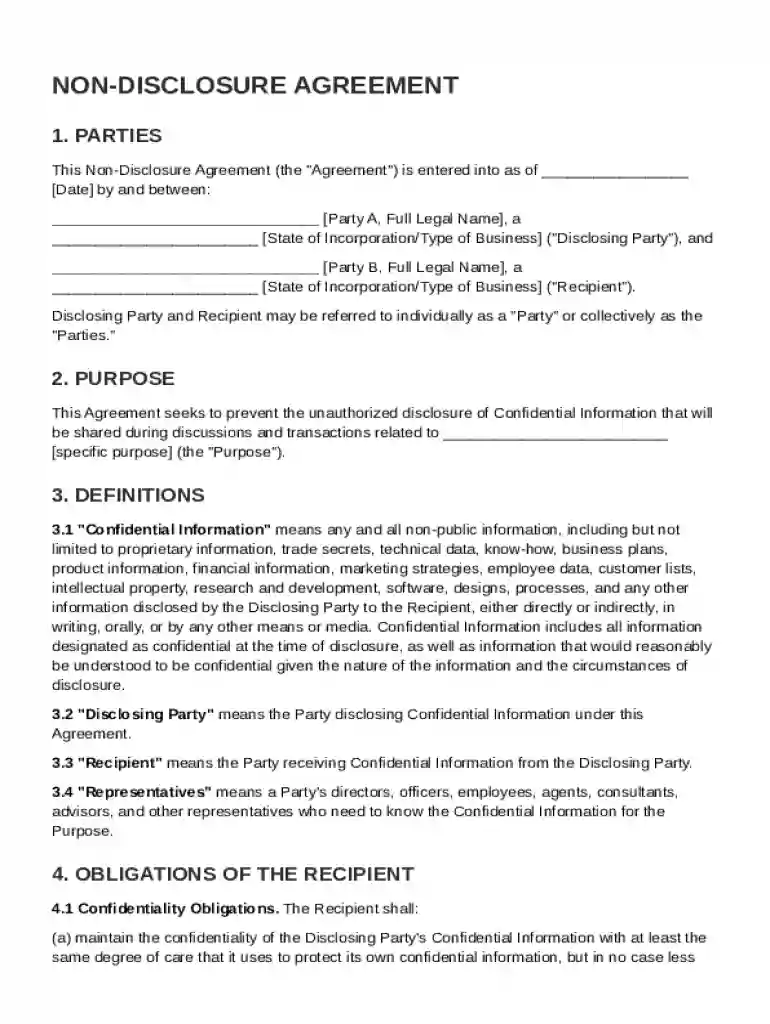
Type text, add images, blackout confidential details, add comments, highlights and more.

Draw your signature, type it, upload its image, or use your mobile device as a signature pad.

Send it via email, link, or fax. You can also download it, export it or print it out.
A Non-Disclosure Agreement (NDA) is a legally binding contract designed to establish a framework for confidentiality between parties discussing sensitive business information. This document is essential for protecting proprietary information, ideas, or plans during negotiations or collaborations. By clearly defining 'Confidential Information,' the NDA ensures that the recipient is aware of the information's nature and value, ensuring its security. The template includes crucial elements such as exclusions, which describe what does not fall under confidentiality, and outlines the responsibilities of the parties involved. Moreover, the NDA stipulates the duration of confidentiality and the consequences of any breach, reinforcing the agreement's importance in safeguarding business interests.
The Non-Disclosure for Business Agreement Template includes specific key elements designed to protect confidential information:
These components ensure both parties understand their roles and the expectations of confidentiality within a business context.
Completing these steps ensures a comprehensive understanding and mutual respect for confidentiality.
Non-Disclosure Agreements are utilized in various scenarios. For instance, two companies discussing a potential merger would use an NDA to protect sensitive financial data. Similarly, startups seeking investments might require potential investors to sign an NDA to safeguard their business models and innovative concepts. Another example could be a company engaging in joint research, where shared proprietary technology and research data need protection. These scenarios illustrate the template's versatility in safeguarding information across different business interactions.
The Non-Disclosure for Business Agreement Template is widely used by:
These users rely on NDAs to maintain confidentiality and protect their competitive edge in the marketplace.


The legality of an NDA ensures that the agreement is enforceable by law. In the United States, NDAs are governed by state-specific laws, requiring adherence to contract principles such as offer, acceptance, and consideration. The agreement must not contravene public policy or include illegal activities. Furthermore, they need comprehensible language and realistic terms to be upheld in court. Businesses should consult legal professionals when drafting NDAs to ensure compliance with relevant legal frameworks and enhance their enforceability.
The Non-Disclosure for Business Agreement Template can be effectively managed using DocHub's software tools. Users can easily edit, send, and sign the document online, ensuring efficiency and accuracy. The platform supports various file formats, allowing the importation of NDAs directly from different sources like Google Drive or Dropbox. The digital signing feature ensures that signatures are legally binding under the ESIGN Act. Utilizing an online platform provides a streamlined process, secure storage, and the ability to track changes and updates in real-time.
The NDA template benefits multiple business entity types:
Each entity type benefits by maintaining the confidentiality of their strategic and operational information, which is vital for maintaining competitive advantage and trust among stakeholders.
At DocHub, your data security is our priority. We follow HIPAA, SOC2, GDPR, and other standards, so you can work on your documents with confidence.


Sample Confidentiality/Non-Disclosure Agreement. Samples, Templates Rates. Sample Confidentiality/Non-Disclosure Agreement. Phone: (337) 482-5811 research@
A Non-Disclosure Agreement (NDA) or Confidentiality Agreement is a legal Contract that requires involved parties to keep certain information between themRead more


