






Definition & Meaning
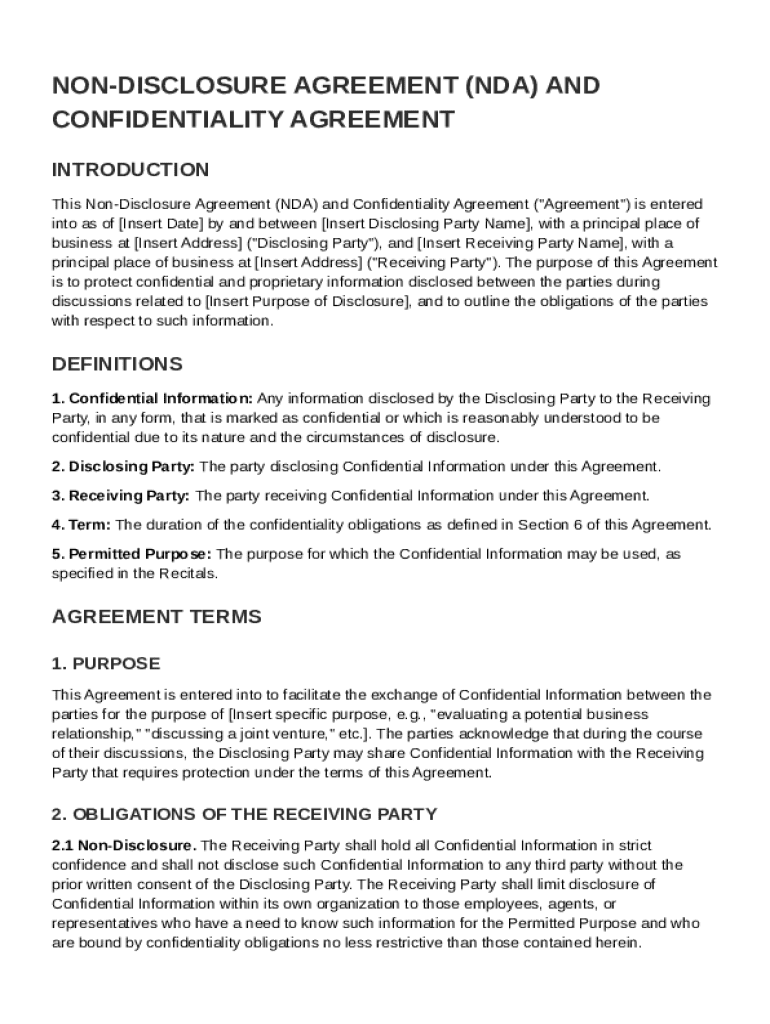
The NDA and Confidentiality Agreement Template is a structured document that facilitates the protection of confidential information exchanged between a Disclosing Party and a Receiving Party. The template plays a crucial role in securing sensitive information during discussions or negotiations, whether they are business-oriented or otherwise. By clearly defining what constitutes confidential information, it sets the stage for specifying the obligations of the Receiving Party, thus preventing unauthorized disclosure or misuse.
Components of the Template
- Disclosing Party and Receiving Party: These roles specify which entity shares the information and which receives it, respectively.
- Purpose of the Agreement: Details the context or specific discussions for which the NDA is used.
- Obligations: Outlines the responsibilities of the Receiving Party in terms of non-disclosure and how the information can be used, ensuring that information is only used for the intended purpose.
Practical Examples
- Business Acquisitions: Used extensively during mergers or acquisitions where proprietary methods and insights are shared.
- Employee Contracts: Frequently employed in employment agreements to protect company secrets and intellectual property.
Steps to Complete the NDA and Confidentiality Agreement Template
Completing an NDA and Confidentiality Agreement Template is a straightforward process that requires careful attention to detail. The following step-by-step guide will help you execute an NDA effectively and ensure all parties are properly informed and protected.
- Identify the Parties: Clearly detail who the Disclosing and Receiving Parties are. Include legitimate business names and contact information.
- Define Confidential Information: Specify the types of information that are considered confidential. This could include data, documents, financial information, etc.
- State the Purpose: Clarify why the information is being shared and how it should be used.
- Set Term and Duration: Establish how long the agreement will be in effect and any specific start or end dates.
- Specify Obligations: Outline the Receiving Party’s responsibilities in handling the information.
- Include Exclusions: Detail any information that is not considered confidential, such as information that is already public knowledge.
- Finalize with Signatures: Ensure both parties review the clauses, make adjustments if necessary, and sign the document for it to take effect.
Additional Considerations
- Review by Legal Counsel: It is advisable to have a legal expert review the document before signing, particularly if the agreement involves complex or significant business transactions.
- Digital Signing: Utilize DocHub's platform for legally binding electronic signatures, which are compliant with the ESIGN Act.
Key Elements of the NDA and Confidentiality Agreement Template
An effective NDA and Confidentiality Agreement Template should cover several critical elements to ensure comprehensive protection of information.
Essential Clauses
- Confidentiality Clause: Defines the obligation not to disclose information to third parties.
- Use Clause: Specifies restrictions on how confidential information can be used.
- Return or Destruction of Information: Details the process for returning or destroying confidential information once the term ends.
Enforcement Mechanisms
- Governing Law: Specifies which state's laws will govern the agreement, which is crucial for legal proceedings.
- Remedies for Breach: Lists potential legal consequences if a breach of the agreement occurs.
Additional Protections
- Non-Compete Clauses: Sometimes included to prevent the Receiving Party from entering into competition with the Disclosing Party.
- Non-Solicitation Clauses: Prevents the Receiving Party from soliciting business or employees from the Disclosing Party.
Legal Use of the NDA and Confidentiality Agreement Template
The legal integrity of an NDA and Confidentiality Agreement Template ensures that it serves its purpose without infringing upon the rights of any party involved.
Compliance with U.S. Law
- ESIGN Act Compliance: Guarantees that electronic signatures are legally binding.
- Trade Secrets Act: Protects against the misappropriation of trade secrets, which is vital in business negotiations.
Common Legal Challenges
- Ambiguity in Terms: Ensure all terms are clearly defined to avoid disputes over interpretation.
- Overbroad Restrictions: Limit restrictions to only what is necessary to protect the interests of the Disclosing Party.
Real-World Application
- Tech Industry: Used to protect intellectual property during collaborations.
- Healthcare: Involves the non-disclosure of sensitive patient information.
Who Typically Uses the NDA and Confidentiality Agreement Template
A wide range of individuals and organizations engage these agreements to protect their interests.


Target Users
- Businesses and Corporations: Corporations often use NDAs when entering new markets or partnerships.
- Entrepreneurs and Startups: Protect novel business ideas and proprietary information.
- Employees and Contractors: Common in employment contracts to protect company trade secrets.
Sector-Specific Utilization
- Technology Firms: Use NDAs to safeguard software development and other technological advancements.
- Clinical Research Organizations: Protect proprietary medical research data.
Important Terms Related to NDA and Confidentiality Agreement Template
Understanding the terminology is vital for drafting or engaging with an NDA and Confidentiality Agreement Template.
Key Terms
- Confidential Information: Any data, documents, or knowledge that is not publically known and is proprietary.
- Disclosing Party: The entity that shares the information.
- Receiving Party: The entity that receives the information.
- Breach: Any unauthorized disclosure or misuse of confidential information.
Terminology in Context
- Proprietary Information: Specific to the Disclosing Party and not meant for public or competitor knowledge.
- Residuals: Information that can be used or retained inadvertently without breaching the agreement.
Software Compatibility for NDA and Confidentiality Agreement Template
Seamlessly managing NDA and Confidentiality Agreement Templates using various software tools can streamline the process.
Compatible Platforms
- DocHub: Fully compatible for editing and signing NDAs.
- Google Workspace: Direct integration allows modifications and sharing from Google Drive and Gmail.
Benefits of Digital Tools
- Automatic Backups: Cloud services ensure your documents are secure and retrievable.
- Real-Time Collaboration: Allows multiple stakeholders to edit and review documents simultaneously.
Practical Scenarios
- Remote Teams: Ideal for international teams where physical document exchange is impractical.
- Fast-Paced Industries: Enables rapid drafting, adjustment, and execution of agreements.
By leveraging this comprehensive guide, users can confidently draft and execute NDA and Confidentiality Agreement Templates with a deep understanding of their components, processes, and legal implications.