






Definition & Meaning
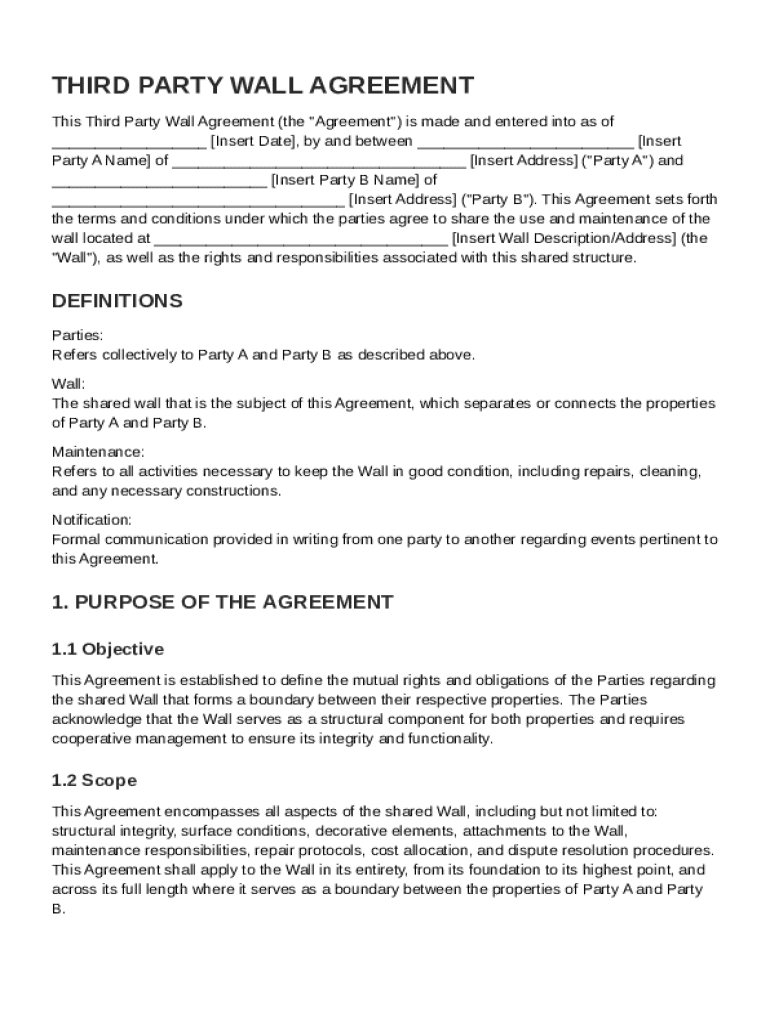
A Third Party Wall Agreement is a legal document that outlines the shared usage and responsibilities concerning a wall that separates properties owned by two distinct parties. It is essential in establishing the rights and obligations regarding the wall's structural maintenance, financial responsibilities for any repairs, as well as protocols for notifying other parties in case of necessary actions affecting the wall. This agreement serves to prevent disputes by clearly outlining each party’s duties and the processes for addressing issues related to the shared wall, ensuring compliance with relevant legal standards.
Key Elements of the Third Party Wall Agreement Template
The Third Party Wall Agreement Template typically includes several critical components to ensure clarity and comprehensive coverage:
- Parties Involved: Clearly identifies the involved parties, referred to as Party A and Party B, with their respective property addresses.
- Purpose: Outlines the primary objective of the agreement, which is to establish a cooperative approach to managing and maintaining the shared wall.
- Responsibilities: Details the rights and obligations of each party, including the agreement on maintenance and repair duties.
- Financial Provisions: Specifies how costs are to be shared between the parties for repairs and maintenance.
- Notification Procedures: Describes the process for informing the other party of any intended work on the wall.
- Dispute Resolution: Details mechanisms for resolving conflicts that may arise, such as mediation or arbitration.
- Termination Conditions: Lists the circumstances under which the agreement can be dissolved.
How to Use the Third Party Wall Agreement Template
To effectively utilize the Third Party Wall Agreement Template, follow these steps:
- Identify the Parties: Clearly specify the names and addresses of the two parties involved in the agreement.
- Detail the Terms: Customize the terms to fit the specific circumstances and requirements of the shared wall, ensuring each party’s roles are clear.
- Specify Financial Arrangements: Outline how expenses related to wall maintenance or repairs will be divided.
- Legal Review: Have the draft reviewed by a legal professional to ensure all terms comply with local laws.
- Signatures: Ensure both parties sign the agreement, acknowledging their understanding and acceptance of the terms outlined.
- Documentation: Keep a copy of the signed agreement for future reference.
Steps to Complete the Third Party Wall Agreement Template
Completing this template involves several key steps to guarantee completeness and accuracy:
- Gather Information: Collect necessary details about each property owner and the wall in question.
- Specify Details: Fill in all sections of the template, ensuring no vital areas are left blank.
- Review Terms: Verify that the terms comply with any applicable statutory requirements and reflect both parties’ intentions.
- Legal Validation: Seek a legal professional’s input to confirm that the agreement follows local property laws.
- Finalize the Document: After both parties review and agree on the conditions, sign the document in the presence of a witness if required.
Important Terms Related to Third Party Wall Agreement Template
Understanding specific terms within the Third Party Wall Agreement is critical:
- Party A/Party B: Denotes the two individuals or entities with ownership interests in the wall.
- Maintenance Obligation: Refers to the responsibility each party has in ensuring the wall remains in good condition.
- Shared Costs: The financial contributions by each party toward repairs and upkeep.
- Notice Period: The time frame in which one party must inform the other of planned works affecting the wall.
- Structural Integrity: The condition of the wall being sound and safe for both properties.
Legal Use of the Third Party Wall Agreement Template
The Third Party Wall Agreement Template is legally significant in ensuring both parties clearly understand their rights and duties related to shared walls. Using this template, parties can minimize disputes and provide a framework for amicable resolutions should conflicts arise. This agreement, once executed, becomes a legally binding document, ensuring compliance with local laws and serving as a reference point in case of disagreements.
State-Specific Rules for the Third Party Wall Agreement Template
In the United States, regulations regarding wall agreements can differ by state. Some states may require specific provisions or adherence to unique legal standards:
- California: May enforce specific seismic requirements for shared structures.
- New York: Could need adherence to historical preservation laws if the wall is part of a landmarked building.
- Texas: Might have guidelines on dispute resolution processes due to distinct real estate practices.
Examples of Using the Third Party Wall Agreement Template
In practice, consider scenarios where the Third Party Wall Agreement Template can be beneficial:
- Residential Properties: When constructing a fence that divides two backyards.
- Commercial Spaces: For walls that run between two business properties which might house shared utilities.
- Renovation Projects: If one party plans extensive renovations that could impact the structural integrity of a shared wall.
By establishing a clear Third Party Wall Agreement, each party can avoid misunderstandings and ensure the collaborative management of shared structures.