






Definition & Meaning
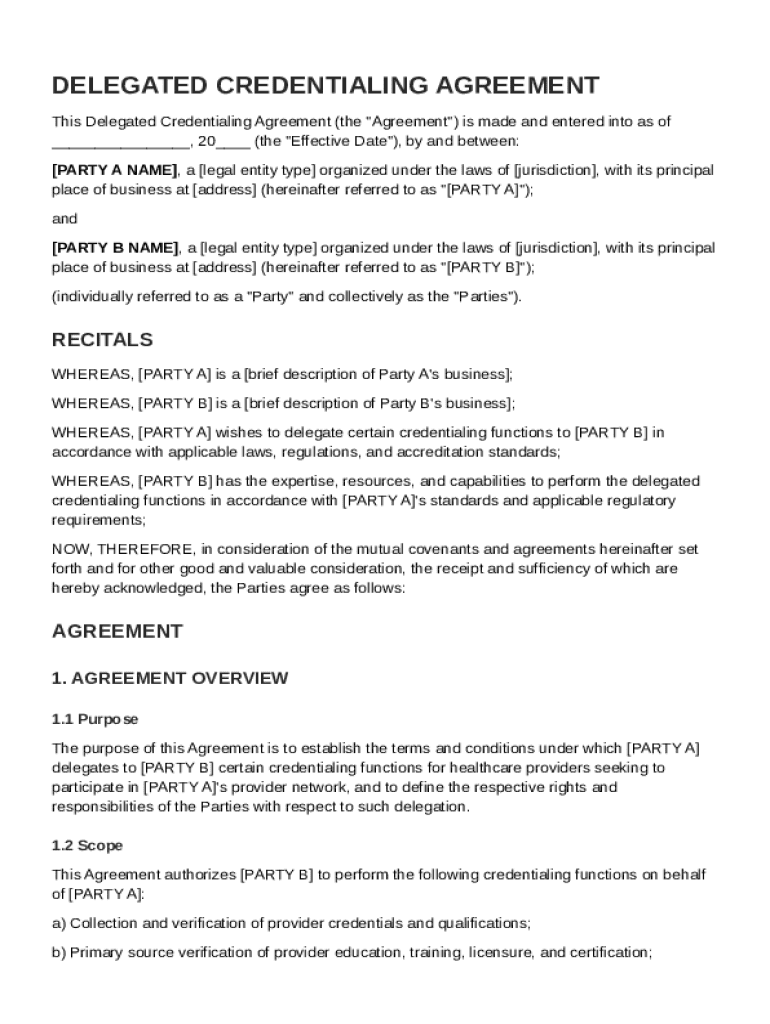
The Delegated Credentialing Agreement Template is a structured document used primarily in the healthcare industry. It formalizes the arrangement in which one party, typically a healthcare organization (Party A), delegates the credentialing functions of healthcare providers to another entity (Party B). This delegation allows Party B to handle the verification process with healthcare providers in Party A's network. The template outlines the responsibilities, processes, and compliance standards both parties must adhere to, ensuring that credentialing is conducted effectively and in accordance with applicable laws and regulations.
Key Responsibilities
- Party A: Retains ultimate oversight responsibility. Ensures that Party B follows all legal and regulatory standards.
- Party B: Manages day-to-day credentialing processes, including verifying the qualifications and licensure of healthcare providers.
- Compliance: Both parties must adhere to industry standards and regulations to maintain legal integrity.
Credentialing Process
- Verification: Party B verifies healthcare provider credentials such as licenses, certifications, and education.
- Monitoring: On-going monitoring and auditing to ensure continued compliance with standards.
- Documentation: Ensures all credentialing documentation is accurate, complete, and accessible.
Key Elements of the Delegated Credentialing Agreement Template
The Delegated Credentialing Agreement Template includes several core components that define the scope and obligations of the agreement.
Compliance and Standards
- Regulatory Compliance: Specific clauses that require adherence to federal and state laws.
- Auditing Procedures: Defined methods for regular performance audits to ensure compliance.
Confidentiality Obligations
- Data Protection: Ensures that all parties protect sensitive information, incorporating modern data protection standards.
- Non-Disclosure: Binding agreements that prevent sharing of proprietary information.
Termination Conditions
- Mutual Termination: Both parties can agree to terminate based on predefined conditions.
- Breach of Agreement: Defines actions that constitute a breach, allowing for immediate cancellation of the agreement.
How to Use the Delegated Credentialing Agreement Template
Understanding how to effectively utilize the Delegated Credentialing Agreement Template is crucial for aligning with best practices in healthcare credentialing.
Step-by-Step Usage
- Review the Template: Read through the entire document to become familiar with its terms and conditions.
- Customize Information: Enter specific details about Party A and Party B, including the scope of delegated functions.
- Identify Key Personnel: Specify individuals responsible for overseeing the credentialing process from both parties.
- Set Compliance Criteria: Include any state-specific rules or additional requirements pertinent to the agreement.
Practical Application
- Training: Provide training sessions for personnel involved in the credentialing process.
- Regular Updates: Regularly update the agreement to reflect changes in laws and internal procedures.
Steps to Complete the Delegated Credentialing Agreement Template
Filling out the Delegated Credentialing Agreement Template requires a methodical approach to ensure all aspects of the agreement are precisely documented.
Detailed Steps
- Gather Initial Data: Collect information required to fill in the basic details of the agreement, such as party names and addresses.
- Consult Legal Counsel: Work with legal advisors to ensure all terms comply with applicable laws.
- Define Roles and Responsibilities: Clearly outline who is responsible for what in the credentialing process.
- Set a Review Schedule: Plan for periodic reviews to ensure the agreement remains relevant and effective.
Avoid Common Mistakes
- Incomplete Information: Ensure all fields in the template are addressed to avoid legal loopholes.
- Lack of Signatures: Both parties must sign the document to make it legally binding.
Important Terms Related to Delegated Credentialing Agreement Template
A clear understanding of the terminology within the Delegated Credentialing Agreement Template contributes to a more effective credentialing process.
Common Terms
- Credentialing: The process of verifying healthcare providers' qualifications.
- Delegation: Assigning credentialing tasks to a third-party entity.
- Compliance: Adhering to applicable industry standards and laws.
Explanation of Key Terms
- Monitoring: Ongoing supervision required to maintain compliance and quality assurance.
- Audit: An official inspection of records and processes to ensure adherence to agreements.
Legal Use of the Delegated Credentialing Agreement Template
Understanding the legal implications of the Delegated Credentialing Agreement Template is necessary for ensuring the agreement is both enforceable and compliant.
Legal Compliance
- Federal Law: The agreement must comply with Health Insurance Portability and Accountability Act (HIPAA) standards and other federal regulations.
- State Law: Consideration of relevant state-specific legislation impacting healthcare credentialing.
Enforcement
- Dispute Resolution: Should any disputes arise, the agreement includes mechanisms for legal arbitration or mediation.
- Legal Recourse: Specifies the rights and responsibilities of each party should the agreement be violated.
Who Typically Uses the Delegated Credentialing Agreement Template
Understanding the typical users of the Delegated Credentialing Agreement Template can clarify its scope and application.


Primary Users
- Healthcare Organizations: Hospitals and clinics that outsource credentialing.
- Managed Care Organizations (MCOs): Entities that align healthcare providers for specific network coverage.
Secondary Users
- Credentialing Agencies: Third-party firms specializing in healthcare provider verification.
- Legal Departments: Attorneys involved in healthcare compliance and contracts.
State-Specific Rules for the Delegated Credentialing Agreement Template
Given the diverse regulatory environments across states, certain adjustments may be necessary in the Delegated Credentialing Agreement Template.
Variations by State
- California: Strict privacy regulations may require additional clauses.
- Florida: May mandate specific credentialing timelines distinct from other states.
Considerations
- Adjustable Clauses: Include flexible legal language to accommodate varying state regulations.
- Consultation with State Authorities: Engage with local authorities for verification and compliance guidance.
Examples of Using the Delegated Credentialing Agreement Template
Practical examples of using the Delegated Credentialing Agreement Template provide context and insights into its real-world applications.
Scenario Examples
- Large Hospital Networks: Utilizing the agreement template to streamline extensive provider networks.
- Rural Clinics: Engaging third-party credentialing for efficiency in managing fewer resources.
Case Studies
- Midsize Health Maintenance Organization: Example of improved operations and compliance through effective delegation.
- Regional Health System: Demonstrated reductions in credentialing errors by using a well-structured agreement.
Each of these sections provides detailed insight and guidelines on how to effectively use a Delegated Credentialing Agreement Template to ensure compliant and efficient credentialing processes.