
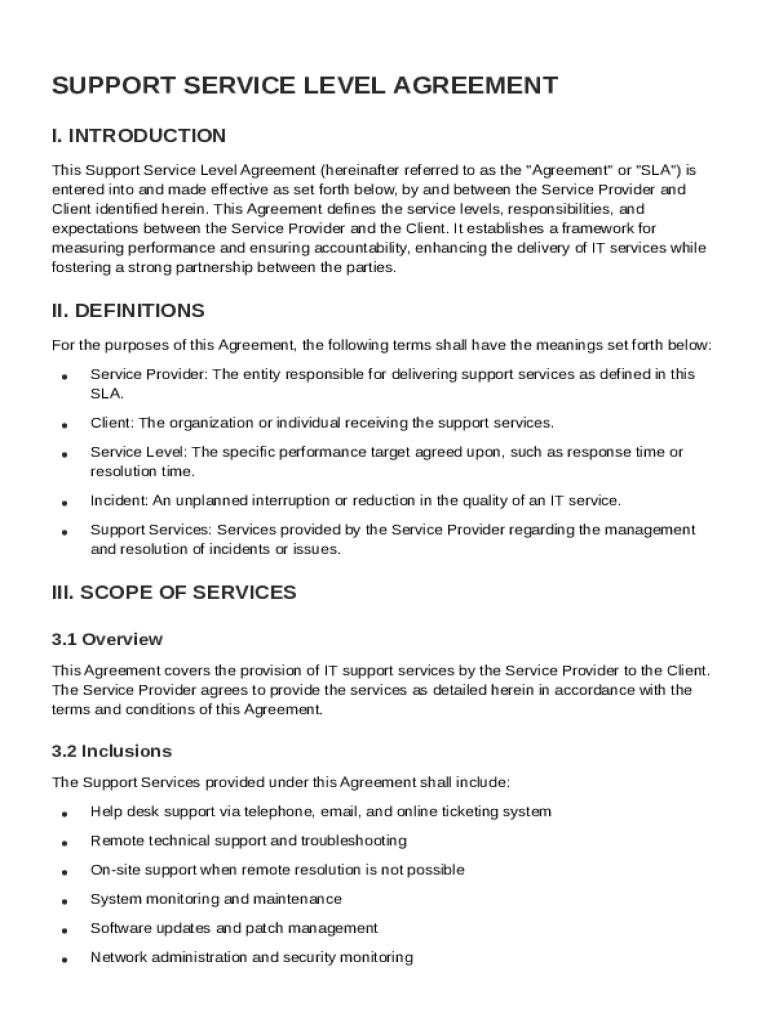







Definition & Meaning
The Support Service Level Agreement (SLA) Template is a critical document outlining the terms, conditions, roles, responsibilities, and expectations between a service provider and a client regarding IT support services. It defines measurable metrics like service levels, response and resolution times, performance metrics, and outlines penalties for non-compliance. The SLA is designed to enhance service delivery while ensuring accountability and fostering a strong partnership between the parties involved.
- Key Components:
- Roles and responsibilities of each party.
- Service levels, including performance metrics.
- Incident management, detailing response and resolution times.
- Penalties for failing to meet agreed service levels.
Key Elements of the Support Service Level Agreement Template
A comprehensive SLA should include several key elements that ensure both parties are aligned on expectations and deliverables. These elements serve as the backbone of the agreement, making it understandable and enforceable.
-
Service Scope:
- Specifies the supported services and any exclusions.
- Defines service availability and operating hours.
-
Performance Metrics:
- Includes specific targets such as response time, resolution time, and uptime.
- Utilizes metrics like Mean Time to Repair (MTTR) and First Response Time.
-
Roles and Responsibilities:
- Clearly outlines the duties of the service provider and the client.
- Defines escalation paths and contact information for urgent issues.
How to Use the Support Service Level Agreement Template
Utilizing a Support SLA Template effectively requires understanding its structure and customizing it to suit specific needs. Here's a guide on how to leverage this document:
-
Customization:
- Tailor the template to match the specific services provided.
- Ensure that all service metrics and definitions align with the business requirements.
-
Implementation:
- Review the draft with all stakeholders, including legal, technical, and operational teams.
- Conduct regular reviews and updates to the SLA as services or requirements evolve.
Steps to Complete the Support Service Level Agreement Template
Completing the SLA Template involves several steps to ensure accuracy and relevance. Following a step-by-step process can help maintain consistency and comprehensiveness.
- Initial Review: Begin by understanding the template's structure and required sections.
- Define Terms: Clearly articulate all technical terms, measurement units, and any acronyms used.
- Set Objectives: Establish what the SLA aims to achieve, including specific service levels.
- Draft Clauses: Fill in each section with accurate data and expectations that align with service offerings.
- Stakeholder Feedback: Share the draft with relevant parties and incorporate their feedback.
- Approval: Obtain agreement from all involved parties before finalizing.
Who Typically Uses the Support Service Level Agreement Template
This template is widely used by businesses across various sectors that rely heavily on IT services. Understanding who uses this template can reveal insights into its practical applications.
-
Service Providers:
- IT companies offering technical support, cloud services, and managed services.
- SaaS providers needing to define support parameters for their software solutions.
-
Clients / Businesses:
- Organizations seeking third-party IT support.
- Enterprises aiming to ensure optimal performance from their service providers.


Important Terms Related to Support Service Level Agreement Template
Understanding certain technical terms is crucial when dealing with an SLA Template to ensure accurate interpretation and application.
- Uptime: The percentage of time a system is operational and available.
- Downtime: Periods when services are unavailable, potentially incurring penalties.
- Service Credits: Compensation for unachieved SLA metrics.
- Escalation Procedures: Steps to take when initial support resolutions fail.
Legal Use of the Support Service Level Agreement Template
Employing the SLA Template within legal boundaries is essential to protect both parties and to create an enforceable document.
-
Compliance:
- Ensure alignment with applicable laws and industry standards to avoid legal disputes.
- Incorporate any necessary disclaimers and limitation of liability clauses.
-
Enforceability:
- Clearly define terms to allow for enforceability in case of non-compliance.
- Include signature lines for authorized representatives from each party.
Examples of Using the Support Service Level Agreement Template
Examining practical examples of SLA implementation can provide clearer insights into its utility and benefits.
- Case Study 1: An IT service provider implements an SLA with a healthcare organization, stipulating 99.9% system uptime to ensure patient data availability.
- Case Study 2: A fintech company uses an SLA with its cloud provider to guarantee round-the-clock technical support, helping maintain uninterrupted financial services.
These examples illustrate the SLA's versatility and importance in various industries, emphasizing the necessity for clear, tailored agreements.




