






Definition & Meaning
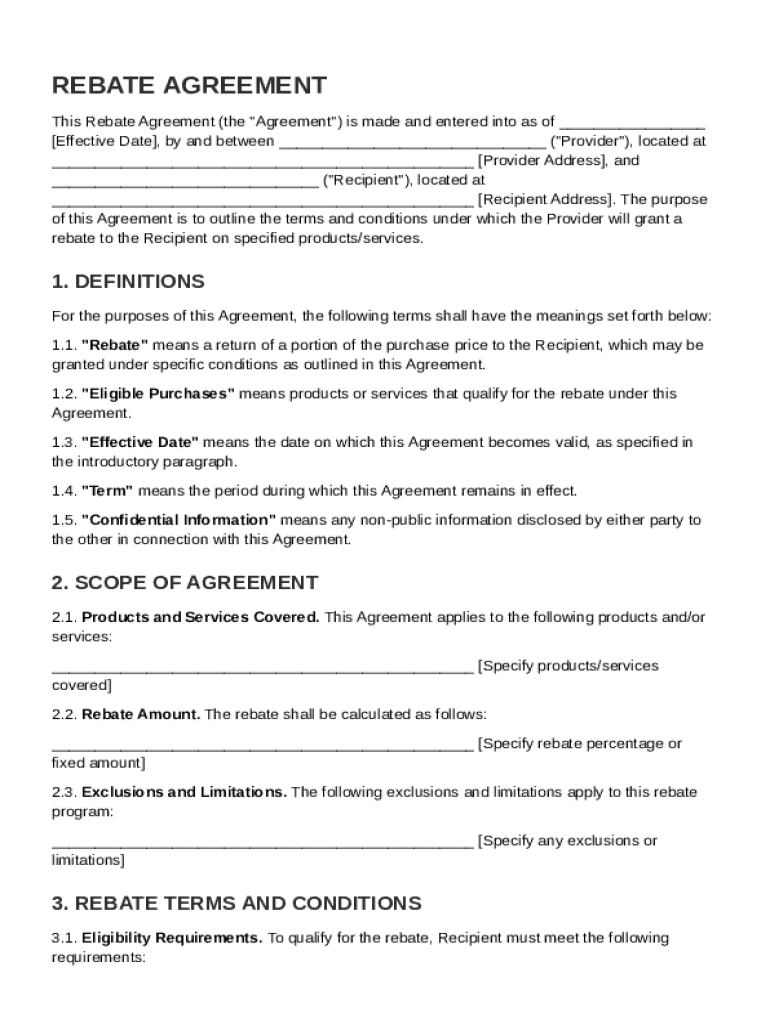
A Rebate Agreement outlines the specific terms and conditions under which a provider, such as a manufacturer or supplier, grants a monetary rebate to a recipient, often a retailer or distributor, for purchasing certain amounts or types of products or services. This agreement serves as a contractual framework that ensures both parties understand their responsibilities, the eligibility criteria for rebates, and the calculation methods involved. It's crucial for managing financial incentives in business transactions and helps in fostering long-term relationships between the parties.
Key Components
- Provider and Recipient Identification: Clearly outlines the parties involved in the agreement.
- Rebate Terms: Specifies the criteria and conditions for receiving a rebate.
- Payment Terms: Details how and when rebate payments will be made.
- Responsibilities: Defines the obligations of both provider and recipient.
Key Elements of the Rebate Agreement Template
Eligibility Requirements
To qualify for a rebate under the agreement, the recipient must meet specific criteria set by the provider. These often include purchasing a minimum quantity or value of goods and services within a predefined timeframe.
- Minimum Purchase Levels: Defined thresholds that must be reached to trigger the rebate.
- Qualified Products/Services: Specific items or services eligible for rebates.
Rebate Calculation Methods
The agreement must detail how rebates are calculated, ensuring transparency and preventing disputes.
- Percentage-Based Rebates: Often a percentage of total purchases.
- Flat-Rate Rebates: Predetermined amounts based on criteria.
Confidentiality and Data Protection
Provisions should ensure that any shared data remains confidential, allowing competitive business strategies and sensitive information protection.
- Non-Disclosure Clauses: Protect sensitive information.
- Data Usage Policies: Guidelines on how information can be used.
Legal Use of the Rebate Agreement Template
Compliance and Regulations
Rebate agreements must comply with applicable laws and regulations, which may vary depending on location and industry.
- ESIGN Act Compliance: Ensures electronic signatures are legally binding.
- Federal and State Laws: Comply with commercial and contractual law.
Dispute Resolution
Clauses should be included to handle disagreements, including mediation and arbitration processes.
- Arbitration Clauses: Faster than court processes.
- Mediation Options: Helps cooperatively resolve issues.
Steps to Complete the Rebate Agreement Template
- Identify the Parties: Clearly fill in the names and contact details of both the provider and recipient.
- Outline Rebate Details: Specify the terms, conditions, and qualified products or services.
- Define Payment Terms: Include details on calculation methods and payment schedules.
- Include Legal Clauses: Ensure the inclusion of confidentiality, data protection, and dispute resolution clauses.
- Review and Sign: Both parties should review the entire agreement to ensure clarity and mutual understanding before signing.
State-Specific Rules for the Rebate Agreement Template
Varying Legal Requirements
States might have particular rules for rebate agreements, especially concerning financial transactions and tax implications.
- State Tax Laws: Some states have specific tax treatments for rebates.
- Contractual Variations: State-specific legal frameworks may impact the agreement terms.
Business-Specific Considerations
In states where industries have unique regulations, these must be harmonized within the rebate agreement to ensure enforceability.
Examples of Using the Rebate Agreement Template
Real-World Scenarios
Consider a manufacturing company incentivizing retailers through rebates based on quarterly sales thresholds. Retailers benefit from reduced cost prices."
- Retail Scenarios: Large retailer chains obtaining rebates for bulk purchasing.
- Supplier Networks: Distributors benefiting from increased order volumes.
Important Terms Related to Rebate Agreement Template
Common Terminology
Understanding essential terms ensures clarity and minimizes misunderstandings in negotiations and execution.
- Provider vs. Recipient: Clarify the roles and expectations.
- Eligible Transactions: Qualifies what purchases or services count towards rebates.
Legalese Simplified
Explain legal terms in layman's language for non-legal professionals involved in agreement creation or execution.
Business Types That Benefit Most from Rebate Agreement Template
Targeted Businesses
Certain industries and business types can leverage rebate agreements more effectively.
- Manufacturers and Suppliers: Offer rebates to retailers and distributors.
- Retail Chains: Benefit from cost reductions through bulk purchasing agreements.
Strategic Advantages
Utilizing rebate agreements strategically can foster long-term partnerships and stabilize revenue streams.
Understanding these elements allows businesses to craft agreements that clearly delineate expectations, protect interests, and align with legal standards.
This comprehensive presentation of the rebate agreement template provides detailed insights into its purpose, application, and strategic advantages. The information is organized to offer maximum value, aligning with external scenarios relevant to potential users in various industries.