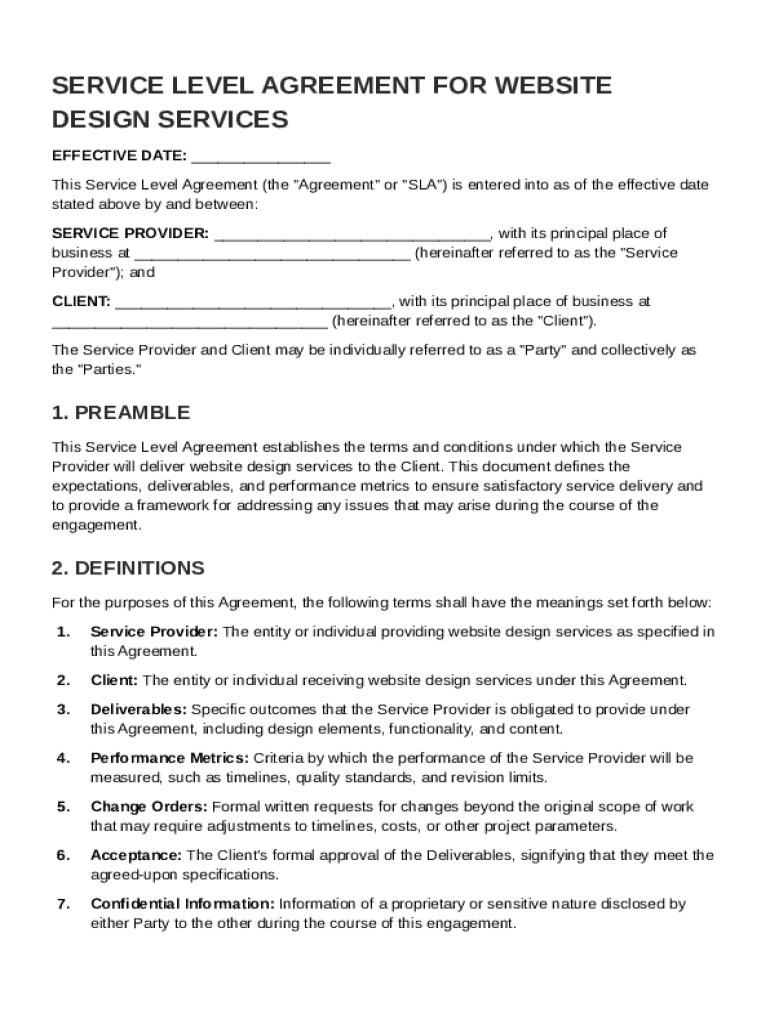







Definition & Meaning
The Service Level for Website Design Agreement Template is a formal document that specifies the terms and conditions under which website design services are provided. This template serves as a contractual agreement between a service provider and a client, detailing responsibilities, expected deliverables, performance metrics, and other key aspects of the service level agreement (SLA). It sets clear expectations for both parties, ensuring that the website design services are delivered to meet the agreed-upon standards and timelines.
How to Use the Service Level for Website Design Agreement Template
To effectively use the Service Level for Website Design Agreement Template, follow these steps:
-
Review the Template: Understand each section and its purpose. Pay close attention to clauses detailing service deliverables, timelines, and performance metrics.
-
Customize Sections: Tailor the template to fit the specific requirements of your project. This includes filling in details such as project timelines, contact information, and any specific deliverables or milestones.
-
Consult Stakeholders: Discuss the SLA with relevant stakeholders to ensure all parties agree on the terms. This may involve legal advisors, project managers, and other team members.
-
Finalize the Document: After customization and review, finalize the document. Ensure that all changes are clearly documented and agreed upon by both parties.
-
Sign and Share: Obtain signatures from both the service provider and the client. Share signed copies with all relevant parties to ensure transparency and accountability.
Key Elements of the Service Level for Website Design Agreement Template
This template typically includes several crucial components to ensure comprehensive coverage:
-
Parties Involved: Identifies the service provider and the client, including contact details and business addresses.
-
Scope of Services: Details the website design services to be provided, including any specific design elements, functionalities, and platform requirements.
-
Performance Metrics: Outlines measurable deliverables and benchmarks that define successful service delivery. These may include design standards, loading times, and user experience criteria.
-
Project Timelines: Specifies deadlines for each phase of the website design process, from initial design concepts to final delivery.
-
Change Management: Establishes procedures for handling changes to the original service agreement, including how requests are to be submitted and approved.
-
Confidentiality and Privacy: Details provisions for maintaining the confidentiality of proprietary information, ensuring compliance with data protection laws.
-
Termination and Dispute Resolution: Explains the conditions under which the agreement can be terminated and the processes for resolving disputes.
Important Terms Related to the Service Level for Website Design Agreement Template
Understanding terminology is crucial for interpreting the SLA effectively. Key terms include:
-
Deliverables: The specific outputs or products that the service provider agrees to deliver to the client.
-
Service Credits: Compensation provided to the client if the service provider fails to meet agreed-upon performance standards.
-
Escalation Procedures: Steps to be taken if performance issues arise, including levels of authority and timelines for resolution.
-
Benchmarks: Standards against which service quality and performance are measured.
Legal Use of the Service Level for Website Design Agreement Template
Legally, the SLA serves as a binding contract that holds both parties accountable for fulfilling their respective obligations. Legal considerations include:
-
Compliance: Ensuring the agreement adheres to relevant state and federal laws regarding contracts and service delivery.
-
Intellectual Property Rights: Specifying ownership of the website design and associated content once the project is completed.
-
Liability Limitations: Clearly defining the extent of each party's liability in cases of breach or failure to meet performance standards.
Examples of Using the Service Level for Website Design Agreement Template
Consider the following practical scenarios where this template proves beneficial:
-
Startup Collaboration: A new technology startup hires a design agency to develop their website. The SLA ensures the agency delivers on key design elements within a specified timeframe.
-
Corporate Website Redesign: A corporation utilizes the template to manage a comprehensive website redesign, involving multiple teams and strict timelines to update their online presence.
-
E-commerce Platform Development: An online retailer works with a developer under an SLA that outlines performance metrics critical for ensuring optimal site speed and user navigation during high traffic periods.
Software Compatibility
Understanding software compatibility is essential for using the Service Level for Website Design Agreement Template effectively:
-
DocHub Integration: The template can be easily managed through platforms like DocHub to facilitate digital signing and sharing.
-
Document Formats: Compatible with various software solutions such as Microsoft Word or Google Docs, allowing for easy customization and distribution.
-
Cloud Services: Integration with cloud storage options like Google Drive or Dropbox ensures that the SLA is accessible to all stakeholders and remains secure.
Business Types That Benefit Most from the Service Level for Website Design Agreement Template
Different business types find unique benefits from using this SLA template:
-
Small Businesses and Startups: Streamlines project management for limited resources, clearly defining expectations without extensive legal resources.
-
Digital Agencies: Ensures client-agency relationships are grounded in transparent communication, enabling efficient and effective project execution.
-
Corporates and Enterprises: Manages large-scale projects involving cross-functional teams and ensures deliverables align with strategic objectives.
-
E-commerce Businesses: Guarantees optimal website performance during peak sales events by setting performance metrics for site functionality.