
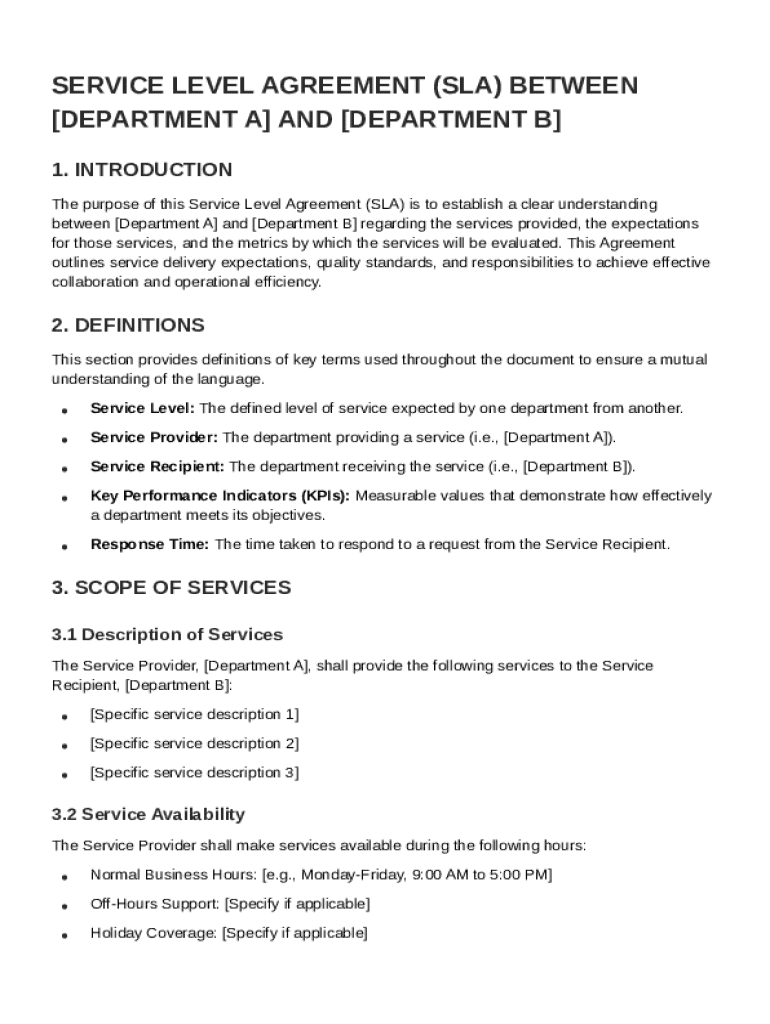







Definition and Meaning
A Service Level Agreement (SLA) between departments is a formal document that outlines the expectations, roles, and responsibilities between two internal groups within an organization. This template serves as a comprehensive guide to establishing clear service delivery standards, ensuring both parties have a mutual understanding of their commitments. By formalizing the service terms, the agreement facilitates smoother operations and mitigates misunderstandings. This SLA template is tailored to foster cooperation, improve efficiency, and support accountability between departments, enhancing overall organizational performance.
Key Elements of an SLA
- Scope of Services: Define what services will be provided, including detailed descriptions and any exclusions.
- Performance Metrics: Establish clear Key Performance Indicators (KPIs) to measure service quality and efficiency.
- Roles and Responsibilities: Clearly delineate responsibilities for each department to avoid overlaps and omissions.
- Communication Protocols: Set guidelines for regular meetings, updates, and feedback mechanisms.
- Issue Management Process: Outline the procedure for identifying, reporting, and resolving issues efficiently.
How to Use the Service Level Between Departments Agreement Template
Utilizing the Service Level Between Departments Agreement Template involves several strategic steps to customize and implement it effectively:
- Determine Requirements: Both departments should discuss and outline their specific needs and expectations.
- Draft the Agreement: Use the template to draft an initial proposal, incorporating all relevant details tailored to the departments involved.
- Collaborate on Revisions: Engage key stakeholders to review the draft and suggest amendments for clarity and accuracy.
- Finalize the Document: Agree on the final version after incorporating feedback and gaining consensus from both departments.
- Secure Signatures: Obtain signatures from authorized representatives to formalize the agreement and commence implementation.
Real-World Application
- Case Scenario: A marketing department partnering with an IT department to enhance digital communication platforms, clearly defining service specifications and support requirements.
Steps to Complete the Service Level Between Departments Agreement Template
Completing the Service Level Between Departments Agreement Template requires a structured approach to ensure accuracy and completeness:
- Identify Departments Involved: Clearly state the names and functions of the departments entering the agreement.
- Establish Service Objectives: Define the primary goals for the services provided, aligning with organizational objectives.
- Detail Service Components: Specify the deliverables and any conditions attached to each service component.
- Set Performance Standards: Establish measurable criteria for evaluating service effectiveness and quality.
- Outline Support and Escalation Procedures: Create a detailed process for handling service issues, including escalation paths.
- Finalize and Review: Verify all sections for completeness and accuracy, ensuring alignment with organizational policies.
- Approval and Signage: Obtain the necessary approvals and signatures from department heads or authorized personnel.
Practical Example
- Implementation: Human Resources and Finance departments agreeing on timelines and accuracy for payroll processing and employee benefits administration.
Important Terms Related to Service Level Between Departments Agreement Template
Understanding the key terms associated with the Service Level Between Departments Agreement Template is crucial for clear communication:
- Service Level Objectives (SLOs): Targets set to achieve desired service quality.
- Key Performance Indicators (KPIs): Metrics used to assess the performance of service delivery.
- Delivery Timeframes: Specified periods within which services are expected to be delivered.
- Escalation Pathways: Steps to follow when resolving critical issues.
- Compliance Requirements: Regulatory or policy standards that must be adhered to during service execution.
Clarification of Terms
- Example: Differentiating between SLOs and KPIs to ensure both service expectations and measurement criteria are explicitly defined.
Key Elements of the Service Level Between Departments Agreement Template
The Service Level Between Departments Agreement Template comprises fundamental elements crucial for operational success:
- Service Description: Comprehensive overview of the services offered, including scope and limitations.
- Responsibilities Matrix: Assigns roles to ensure accountability and clarity in service delivery.
- Monitoring and Reporting: Defines how performance metrics will be tracked and reported.
- Amendment Procedures: Guidelines on how modifications to the agreement should be handled.
- Termination Clauses: Conditions under which the agreement can be dissolved by either party.
Detailed Examples
- Illustration: A matrix illustrating how a customer support department shares responsibilities with a technical services department for seamless customer issue resolution.
Legal Use of the Service Level Between Departments Agreement Template
The Service Level Between Departments Agreement Template must adhere to legal standards to ensure enforceability:
- Compliance with Laws: Ensure all services and processes comply with relevant national and local regulations.
- Data Protection: Implement measures for safeguarding sensitive information in line with privacy laws.
- Liability Clauses: Define the extent of liability for each party in case of non-compliance or service failures.
- Amendment and Termination Procedures: Adhere to legal frameworks when changing or terminating the agreement.
Practical Legal Considerations
- Scenario: Requiring legal review for an SLA involving data processing activities to ensure alignment with privacy legislation such as the GDPR or the California Consumer Privacy Act (CCPA).
Who Typically Uses the Service Level Between Departments Agreement Template
Various organizational roles utilize the Service Level Between Departments Agreement Template:
- Department Heads: To facilitate cross-departmental collaboration and service alignment.
- Operations Managers: To ensure process efficiency and resolve inter-departmental service delivery issues.
- Project Managers: To establish clear service expectations and timelines during project execution.


Roles and Responsibilities
- Example: How a project manager ensures timely IT support for marketing campaigns by using the SLA template to set clear expectations with the IT department.
State-Specific Rules for the Service Level Between Departments Agreement Template
Understanding any state-specific rules applicable to internal Service Level Agreements is essential to maintain compliance:
- Regional Regulations: Some states may have unique privacy regulations impacting how data is handled in inter-departmental agreements.
- Sector-specific Guidelines: Variations in legislation based on departmental functions (e.g., healthcare, finance) that could affect SLA terms.
State Compliance Examples
- Illustration: A health department incorporating specific data handling standards required by state health privacy regulations into their SLA.




