Definition & Meaning
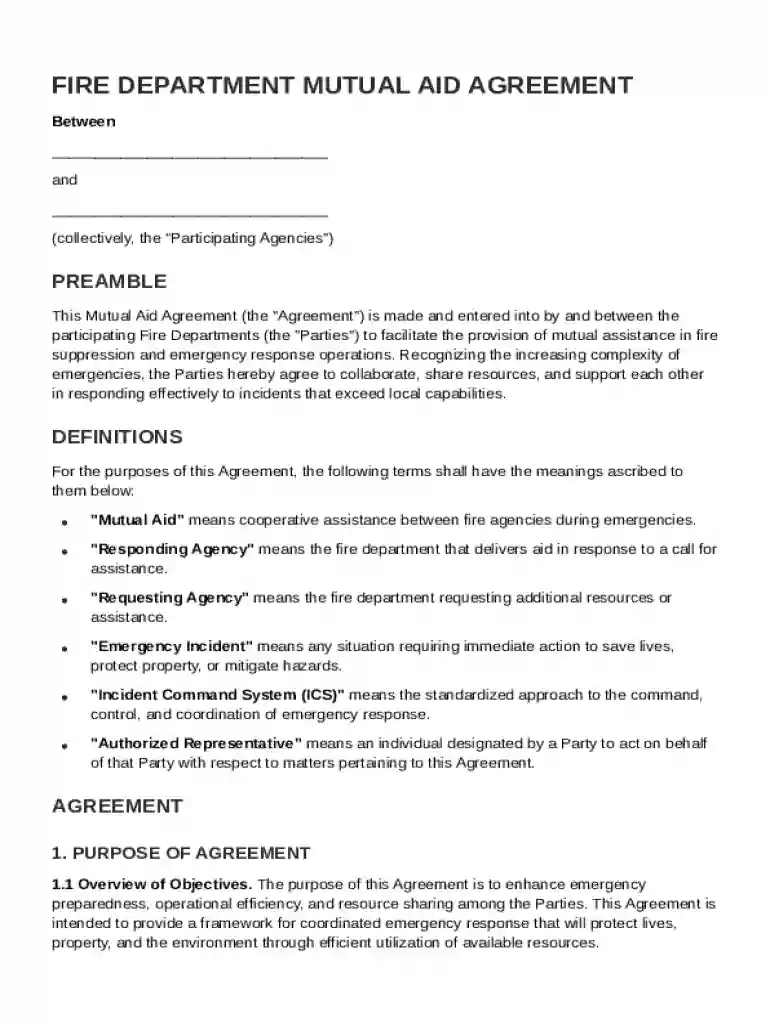
The Fire Department Mutual Aid Agreement Template establishes a structured framework for collaboration among fire departments. It defines the agreement's purpose, outlining the protocols for providing mutual support during emergencies. The purpose is to enhance firefighting efficiency by allowing departments to pool resources and personnel when incidents exceed local capacities.
Framework for Collaboration
- Mutual Support: Departments agree to assist each other.
- Resource Sharing: Involves equipment and personnel allocation.
- Efficiency: Streamlines emergency responses.
Purpose
- Preparedness: Enhances readiness through shared resources.
- Response Coordination: Promotes organized and unified actions.
Key Elements of the Fire Department Mutual Aid Agreement Template
The template includes several critical components to ensure that all parties understand their responsibilities and the procedures involved.
Scope of Assistance
- Types of Assistance: Details the types of emergencies covered.
- Activation Process: Describes how departments will request aid.
Responsibilities
- Participating Agencies: Defines roles and expectations for each department.
- Incident Command: Establishes which department leads during joint operations.
Financial Considerations
- Cost Recovery: How expenses are managed and shared.
- Budget Coordination: Defines financial commitment and compensation.
How to Use the Fire Department Mutual Aid Agreement Template
Adopting the template involves several straightforward steps to tailor it to your specific needs and circumstances.
Steps to Customize
- Identify Needs: Assess what mutual aid focuses are necessary for your department.
- Review Template: Examine clauses for relevance and modify as needed.
- Consult Stakeholders: Engage with contributing agencies for feedback.
- Finalize Agreement: Make agreed-upon changes official.
Practical Suggestions
- Simulations: Conduct drills to test the agreement's effectiveness.
- Periodic Review: Regular updates ensure continued relevance over time.
Important Terms Related to the Fire Department Mutual Aid Agreement Template
Understanding specific terminology is essential for executing the agreement correctly.
Key Terms
- Mutual Aid: Cooperation between emergency services to provide assistance.
- Incident Command: The designated leader during joint operations.
- Cost Recovery: Financial terms detailing reimbursement for services.
Legal Use of the Fire Department Mutual Aid Agreement Template
The agreement must comply with relevant U.S. laws to be legally binding and enforceable.
Legal Compliance
- ESIGN Act: Ensures that electronic signatures are legally recognized.
- Liability Provisions: Clarifies indemnification and limits of responsibility.
Jurisdiction
- State Laws: Compliance varies by state, requiring thorough legal review.
State-Specific Rules for the Fire Department Mutual Aid Agreement Template
Variations in state laws can affect the execution and enforcement of mutual aid agreements.
Examples of Differences
- Activation Protocols: Some states have unique requirements for initiating aid.
- Funding Mechanisms: State-level mandates on how financial matters are handled can vary.
Recommendations
- State Guidelines: Consult local legal counsel to align the agreement with state-specific requirements.
Steps to Complete the Fire Department Mutual Aid Agreement Template
Completing the form entails a series of procedural steps that ensure thorough and correct preparation.
Step-by-Step Process
- Gather Required Information: Collect contact info and resources available.
- Fill Out Template Sections: Complete each part accurately.
- Legal Review: Have all components reviewed by legal experts.
- Sign and Execute: Obtain necessary signatures and implement the agreement.
Documentation
- Records: Maintain records as proof of the agreement's terms and validity.
Examples of Using the Fire Department Mutual Aid Agreement Template
Real-life scenarios demonstrate the effectiveness and necessity of mutual aid agreements.
Case Studies
- Wildfire Management: Multiple departments coordinated efforts through the agreement.
- Urban Rescues: Collaborative support shortened response times during crises in metropolitan areas.
Lessons Learned
- Enhanced Readiness: Regular use leads to better-prepared departments for future incidents.
- Improved Resource Allocation: Fine-tuned responses with optimal resource distribution.
These sections provide a comprehensive overview of the Fire Department Mutual Aid Agreement Template, ensuring that users understand its components, applications, and importance.