




01. Edit your form online
Type text, add images, blackout confidential details, add comments, highlights and more.

Type text, add images, blackout confidential details, add comments, highlights and more.

Draw your signature, type it, upload its image, or use your mobile device as a signature pad.

Send it via email, link, or fax. You can also download it, export it or print it out.
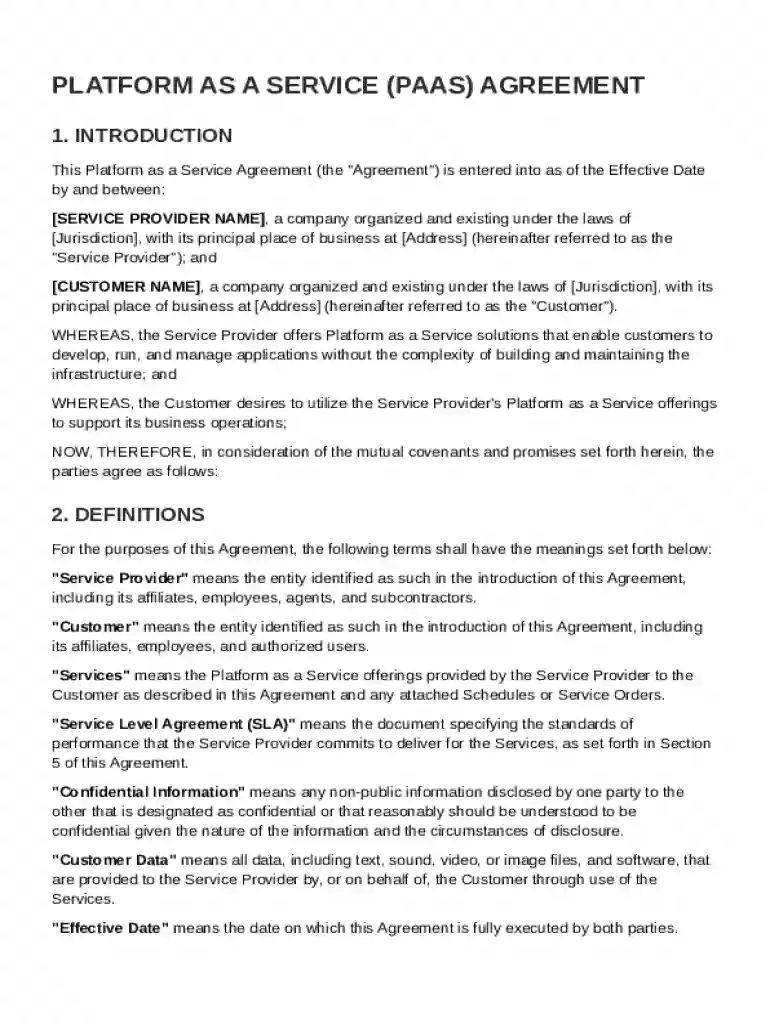
The Platform as a Service (PaaS) Agreement Template serves as a foundational document outlining the contractual relationship between a service provider and a customer. This template formalizes the terms and conditions under which cloud-based platform services are provided, clearly stating the scope of services and responsibilities of both parties. It ensures mutual understanding and compliance with legal standards, enhancing the management of platform services.
Key components of the PaaS Agreement Template include definitions, the scope of service, responsibilities, service level agreements, and fees. These sections collectively enable customers to grasp the full implications and expectations of using the services offered by the provider, guaranteeing that the agreed-upon service quality and security measures are maintained.
Using the PaaS Agreement Template involves several steps designed to customize and execute the document effectively. Initially, review all sections to familiarize yourself with the standard terms provided. This template is structured to be adaptable, ensuring you can tailor specific clauses to meet your organizational requirements or address unique business needs.
Begin by filling in the necessary business details for both the provider and the customer in the identification section. Adjust the scope of services to reflect the specific solutions offered. It is vital to specify any customization of terms relating to service levels, responsibilities, and payment terms to avoid misunderstandings. Once modifications are complete, review the document thoroughly to ensure accuracy and completeness before proceeding to final sign-off.
Completing the PaaS Agreement Template requires a systematic approach:
The PaaS Agreement Template is composed of several essential elements critical to its functionality:
The legal use of the PaaS Agreement Template ensures compliance with statutory obligations and protects the rights of both parties. It must be drafted in accordance with applicable laws to be enforceable in court. Consideration of intellectual property rights and indemnification clauses helps prevent disputes and legal challenges related to data breaches or service failures.
Furthermore, this agreement should include a liability cap and a governing law clause to specify which jurisdiction’s legal framework applies. Regular legal review keeps the document up-to-date with changes in legislation, safeguarding against unintended liabilities.
Various business entities can leverage the advantages presented by a PaaS Agreement Template:
Each business can tailor the PaaS Agreement to suit their operational needs while maintaining service integrity and security.
State-specific legal nuances can impact the PaaS Agreement Template, necessitating careful adaptation based on location. Each state may have unique regulations concerning data privacy, consumer protection, and electronic contracts. Businesses must consult legal experts to understand relevant state laws and ensure compliance.
These rules might influence how intellectual property is managed or how disputes are resolved. Therefore, incorporating state-specific considerations will help safeguard the interests of both the provider and the customer, ensuring the agreement’s enforceability.
Real-world applications of the PaaS Agreement Template illustrate its practical utility across various sectors:
These examples underscore the template’s adaptability in addressing diverse industry needs, reinforcing the importance of a thoroughly developed PaaS Agreement.
At DocHub, your data security is our priority. We follow HIPAA, SOC2, GDPR, and other standards, so you can work on your documents with confidence.



