



01. Edit your form online
Type text, add images, blackout confidential details, add comments, highlights and more.

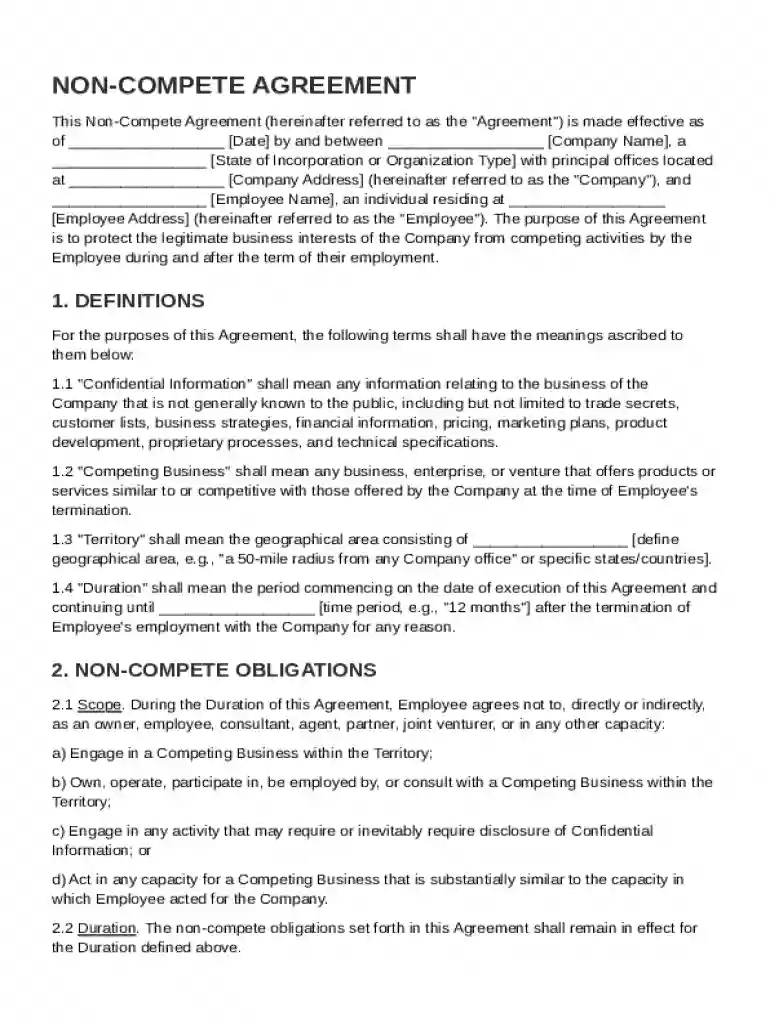
Type text, add images, blackout confidential details, add comments, highlights and more.

Draw your signature, type it, upload its image, or use your mobile device as a signature pad.

Send it via email, link, or fax. You can also download it, export it or print it out.
A Company Non-Compete Agreement is a legally binding document in which an employee agrees not to engage in any business activities that directly compete with their employer, either during or after their employment. The agreement safeguards the company's confidential information and competitive advantage by restricting the employee's future actions related to competitor businesses. Key components of this agreement include definitions of 'Confidential Information,' 'Competing Business,' and 'Territory,' which set clear boundaries and expectations.
Using a Company Non-Compete Agreement Template involves several steps to tailor the document for individual needs. First, use the template to outline the scope of non-compete obligations, such as geographic limitations and timeframes. Next, customize sections about the handling of confidential information and any specific business activities that are restricted. It's crucial to ensure that all clauses comply with applicable state laws to avoid invalidation. Finally, both employer and employee should thoroughly review the document before signing to confirm mutual understanding and agreement.
This agreement's primary legal function is to protect a company's proprietary interests by setting employment terms that mitigate risks of unfair competition. It is essential for companies to craft the agreement carefully to ensure enforceability, as some states impose strict limitations on such contracts. For instance, courts may scrutinize duration and territorial scope to ensure they are reasonable and not overly restrictive to the employee's ability to earn a livelihood. Legal counsel should be involved to tailor the agreement to the jurisdictions where it will be used.
Many states have specific statutes governing non-compete agreements. For example, California largely prohibits non-compete clauses, while Florida enforces them stringently if terms are fair. Companies must tailor agreements to align with the specific state laws where the agreements are executed to ensure enforceability. It's critical to understand local requirements such as maximum allowable durations, permitted reasons for enforceability, and any required compensation for time under non-compete constraints.
Non-compete agreements are commonly employed by businesses concerned with protecting competitive advantage and confidential information. They are particularly prevalent in industries where proprietary technology, client relationships, or trade secrets are crucial, such as technology firms, financial services, and healthcare providers. Companies facing strategic hiring of individuals with access to sensitive data or valuable industry knowledge often implement these agreements to ensure loyalty and mitigate risks associated with employee turnover.

Consider a tech start-up with proprietary software entering a competitive market. Here, a non-compete agreement is used to ensure that key developers cannot join a rival company within a year of leaving. Similarly, a marketing firm might use an agreement to prevent departing sales executives from taking critical client leads to a competitor. Each scenario exemplifies how the agreement acts as a barrier against business risks associated with employee departures and competitive industry shifts.
At DocHub, your data security is our priority. We follow HIPAA, SOC2, GDPR, and other standards, so you can work on your documents with confidence.


A noncompetition agreement, also called a noncompete or a covenant not to compete, is an agreement where one party promises not to engage in conduct
Jul 4, 2026 Find your signed offer letter, appointment letter, employee handbook, and any separate confidentiality or non-compete agreement you signed.Read more


