
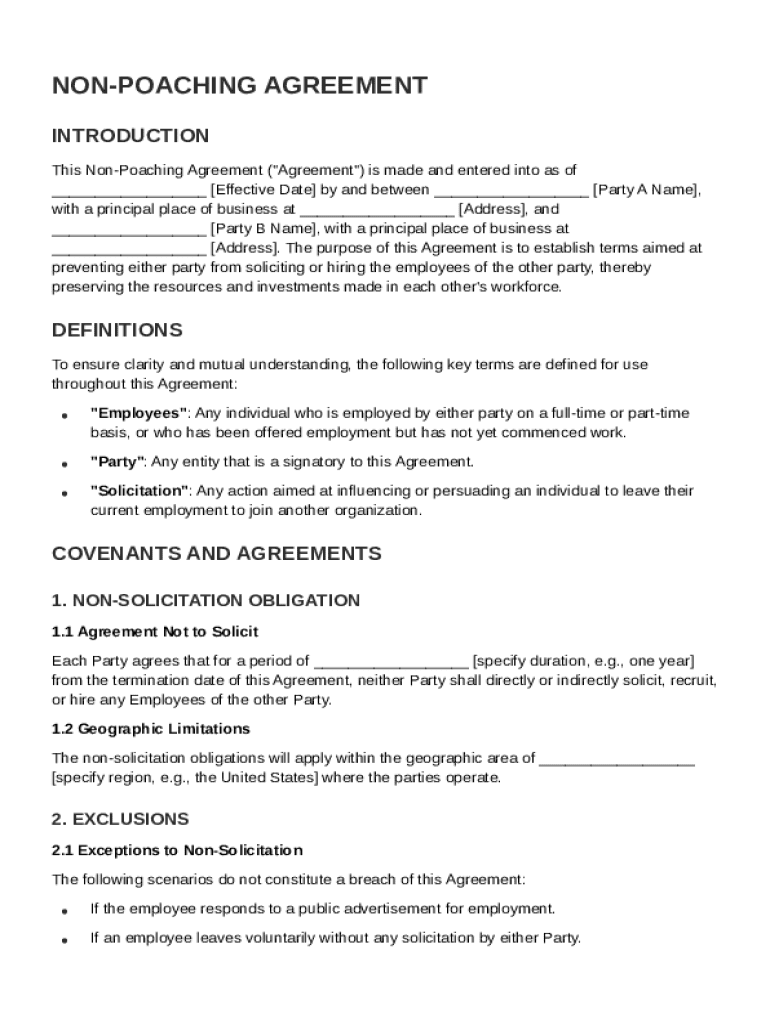







Definition and Meaning
A Non-Poaching Agreement Template is a formal document used to establish terms between two or more parties to prevent them from soliciting or hiring each other's employees for a specific duration within a designated geographic area. This type of agreement is often employed to protect a company's investments in its workforce, preventing competitors or former partners from luring away valuable personnel. It typically includes definitions of key terms, non-solicitation obligations, exceptions, confidentiality requirements, and remedies for any breaches of the agreement. This template serves as a standard framework to ensure that all parties mutually understand and agree to the terms laid out.
Key Elements of the Non-Poaching Agreement Template
A comprehensive Non-Poaching Agreement Template includes several critical components:
- Definitions: Clarifies key terms used throughout the agreement, such as "employees," "solicitation," and "competing business."
- Non-Solicitation Clause: Specifies the obligations of each party to refrain from actively recruiting or hiring employees from the other party.
- Exceptions: Identifies any circumstances under which solicitation might be permissible, such as when an employee independently seeks employment without any prompting.
- Confidentiality Provisions: Ensures that confidential information shared during the execution of the agreement remains protected.
- Breach and Remedies: Outlines the consequences of breaching the agreement, including potential legal actions or financial penalties.
- Governing Law: Defines which state or federal laws will govern the interpretation and enforcement of the agreement.
Legal Use of the Non-Poaching Agreement Template
The use of a Non-Poaching Agreement Template is subject to various legal considerations. It's important to ensure that the agreement complies with local and federal laws that govern employment practices. Some jurisdictions may have specific regulations that limit the enforceability of non-poaching agreements, particularly if they are deemed to restrict employee mobility excessively or violate antitrust laws. Legal counsel should review any Non-Poaching Agreement Template to ensure compliance with the relevant legal standards.
State-Specific Rules for the Non-Poaching Agreement Template
State-specific rules can significantly impact the enforceability of non-poaching agreements. For example, California is known for its stringent stance on employment mobility, generally disfavoring any contract that unduly restricts an individual's ability to secure employment. In contrast, other states might adopt a more permissive approach. Companies using a Non-Poaching Agreement Template should ensure that the document is customized to align with the specific statutory requirements of each relevant state. Legal advice is often necessary to navigate these complexities and to make sure the agreement is legally binding in the desired jurisdictions.
Steps to Complete the Non-Poaching Agreement Template
Completing a Non-Poaching Agreement Template involves several steps:
- Download or Obtain the Template: Secure a copy of the template from a reputable source.
- Identify the Parties Involved: Clearly state the names of all parties involved in the agreement.
- Define Terms and Obligations: Specify the scope of non-solicitation obligations, including any geographic and temporal limitations.
- Include Exceptions: Identify permissible scenarios where solicitation may occur without breaching the agreement.
- Detail Confidentiality Obligations: Articulate any additional confidentiality requirements that apply.
- Specify Legal Consequences: Highlight the remedies and repercussions for any breaches.
- Review for Compliance: Ensure that the template aligns with applicable laws with the help of legal professionals.
- Sign and Execute the Agreement: Collect signatures from all parties to validate the agreement legally.
Who Typically Uses the Non-Poaching Agreement Template
Non-Poaching Agreement Templates are widely used across various industries, particularly where competition for skilled employees is intense. Businesses such as technology firms, healthcare providers, and financial institutions frequently utilize these agreements to safeguard their workforce investments against competitive hiring practices. Additionally, joint ventures, business partnerships, and industry consortiums often employ these agreements when synergizing efforts while protecting their human capital.


Benefits of Using the Non-Poaching Agreement Template
Non-Poaching Agreement Templates offer several benefits:
- Workforce Stability: Helps maintain a stable workforce by discouraging unsanctioned poaching.
- Investment Protection: Safeguards investment in employee training and development from competitive exploitation.
- Competitive Advantage: Ensures a level playing field by preventing talent raids.
- Legal Clarity: Provides clear legal framework for handling breaches and disputes.
Examples of Using the Non-Poaching Agreement Template
Consider a tech company that partners with a vendor for a collaborative project. Both parties might agree to a Non-Poaching Agreement to prevent the vendor from hiring key engineers away from the tech company during and after the project. Similarly, two healthcare organizations entering a joint venture may use such an agreement to mutually protect against loss of medical staff expertise. These examples illustrate the practical scenarios where non-poaching agreements become vital tools in protecting business interests.




