






Definition & Meaning
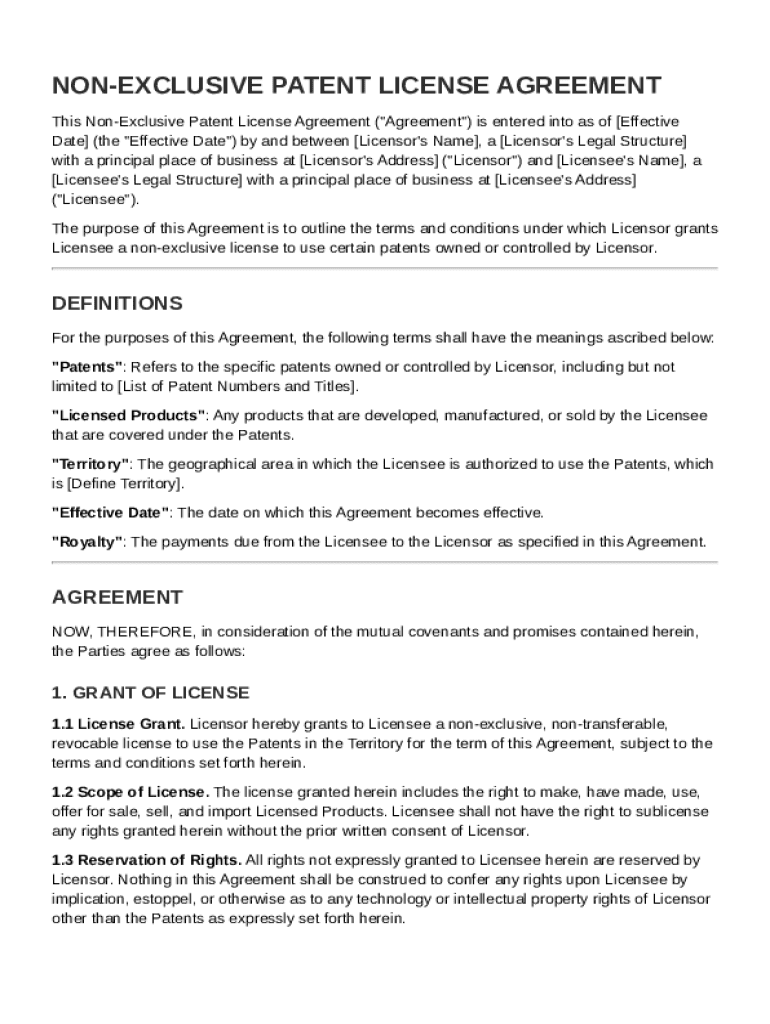
A Non-Exclusive Patent License Agreement is a legal contract that enables a Licensee to use specific patents owned by a Licensor while allowing the Licensor to grant similar rights to other Licensees. This type of agreement is commonly used in industries where multiple parties may benefit from access to a particular technology or intellectual property without exclusivity. It stipulates the scope of usage, including geographical areas, duration, and specific patent applications.
Practical Examples
- Tech Industry: A company developing software might license a patented algorithm to enhance its applications.
- Pharmaceuticals: A drug company could license a non-exclusive right to a patented pharmaceutical compound to manufacture a generic version.
Key Elements of the Non-Exclusive Patent License Agreement Template
An essential aspect of the agreement includes definitions, which clarify the meaning of terms used throughout the document. This usually covers:
- Licensor and Licensee: Clearly defines the parties involved.
- Licensed Patents: Specifies the patents included in the agreement.
- Usage Rights: Details scope, such as manufacturing, selling, or modifying products using the patented technology.
Responsibilities of the Parties
The agreement enumerates the obligations of both the Licensor and Licensee. This typically involves:
- Licensor's Duties: Ensuring the patent is valid and enforceable and potentially providing support.
- Licensee's Duties: Paying royalties and adhering to usage limits.
How to Use the Non-Exclusive Patent License Agreement Template
Using the template involves understanding its structure and completing the necessary fields relevant to your specific situation. The steps to utilize this form effectively include:
- Identify Parties: Clearly name and describe the Licensor and Licensee entities.
- Describe Patents: Provide patent numbers and descriptions.
- Set Terms: Define the agreement duration and geographic scope.
- Specify Royalties: Outline payment terms, including rates and schedules.
- Include Termination Conditions: Detail circumstances under which the agreement may be ended by either party.
Legal Use of the Non-Exclusive Patent License Agreement Template
Adhering to legal and jurisdictional standards is imperative for the enforceability of the agreement. Key considerations include:
- Governing Law: Determine which states' laws apply, especially if parties are in different locations.
- Compliance: Ensure compliance with federal regulations like the Patent Act.
- Dispute Resolution: Specify methods such as arbitration or litigation for dispute handling.
Real-World Scenario
A U.S.-based startup uses a Non-Exclusive Patent License Agreement to integrate a European firm's proprietary technology while ensuring compliance with both regions' patent laws.
Steps to Complete the Non-Exclusive Patent License Agreement Template
Completing this agreement involves detailed attention to each section to ensure clarity and accuracy. Here’s a streamlined approach:
- Gather Information: Collect all necessary details about the patents and involved parties.
- Draft Initial Terms: Use a clear and concise language for initial agreement terms.
- Review Provisions: Ensure all responsibilities, rights, and obligations are explicitly stated.
- Consult Legal Experts: Before finalizing, consult with legal counsel to review language and ensure compliance.
- Finalize and Sign: Both parties review and execute the agreement.
State-Specific Rules for the Non-Exclusive Patent License Agreement Template
While federal laws regulate patents broadly, state-specific nuances exist regarding contract enforcement and dispute handling. Recognizing these differences can be beneficial:
- California: May have restrictions on arbitration clauses in agreements.
- New York: Specific terms around confidentiality and non-disclosure may differ due to state regulations.
Important Terms Related to Non-Exclusive Patent License Agreement Template
Understanding specific terminology is crucial to navigating the template effectively. Key terms include:
- Grant Clause: Specifies what rights are being transferred.
- Royalty Clause: Details financial compensation for patent usage.
- Indemnification: Protective measure where one party agrees to compensate for potential losses or damages.
Examples of Using the Non-Exclusive Patent License Agreement Template
To illustrate its utility, consider instances across various sectors:
- Academic Collaborations: Universities licensing patents non-exclusively to multiple tech companies for R&D purposes.
- Auto Industry: Manufacturers licensing a non-exclusive patent for fuel-efficient technology to integrate into different car models.
Edge Cases
- Transfer of Ownership: The implications when the Licensor sells the patent to another entity.
- Bankruptcy: How the license is treated if the Licensee faces financial insolvency.
By thoroughly addressing each of these facets, users of the Non-Exclusive Patent License Agreement Template can navigate its complexities with greater confidence and ensure the successful implementation of patent licensing strategies.