






Definition & Meaning
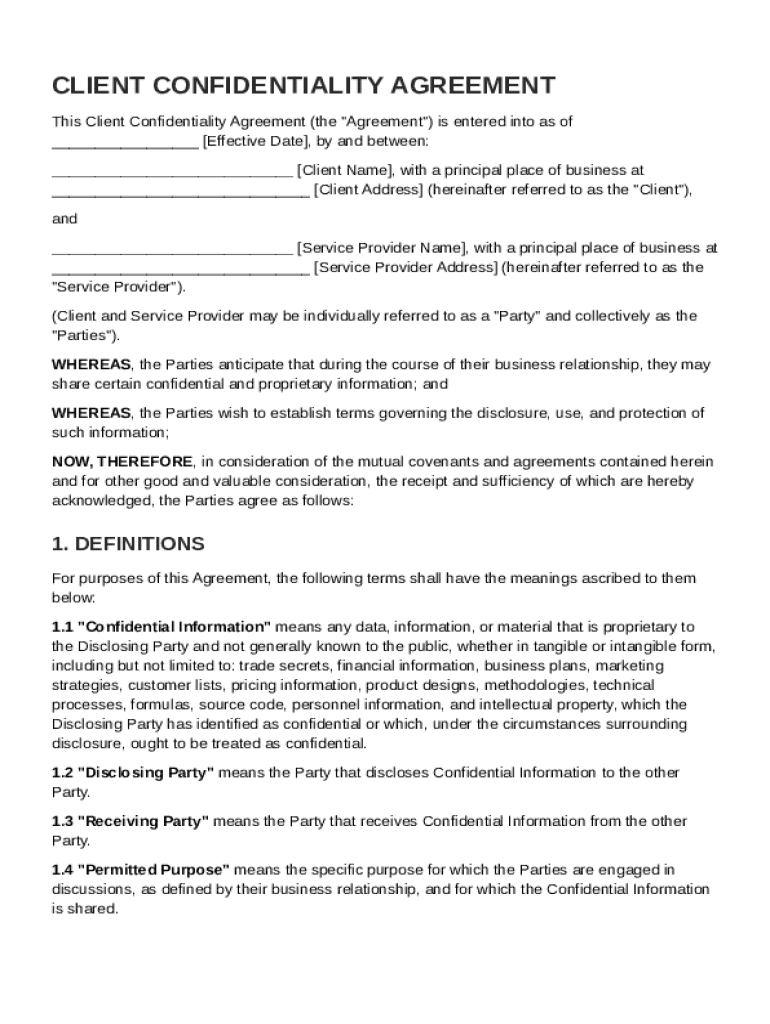
The Client Confidentiality Agreement Template serves as a blueprint for establishing the terms under which a client and a service provider agree to share confidential information. This template typically outlines the roles of the disclosing and receiving parties, defines what constitutes 'Confidential Information,' and stipulates the responsibilities each party has to protect this information. The agreement also clarifies permitted uses and potential exclusions, ensuring both parties have a clear understanding of their obligations.
Detailed Breakdown
- Disclosing Party: This refers to the party that shares confidential information with another under the agreement.
- Receiving Party: The party responsible for safeguarding the confidentiality of shared information.
- Confidential Information: This covers all non-public, sensitive data exchanged as part of the business relationship.
Key Elements of the Client Confidentiality Agreement Template
The Client Confidentiality Agreement Template encompasses several critical components that define the scope and execution of confidentiality obligations.
Major Components
- Obligations of Maintaining Confidentiality: Details specific actions the receiving party must take to protect confidential information.
- Permitted Uses: Outlines the circumstances under which confidential information can be used, preventing misuse.
- Security Measures: Specifies the methods for ensuring information protection, such as encryption or access controls.
Procedural Elements
- Duration of Confidentiality: Establishes how long confidentiality is maintained after the conclusion of the relationship.
- Termination Procedures: Details instructions for the return or destruction of confidential information once the agreement ends.
Steps to Complete the Client Confidentiality Agreement Template
Following a series of steps ensures the template is completed accurately, offering comprehensive coverage of confidentiality requirements.
Step-by-Step Instructions
- Identify Parties: Clearly name the disclosing and receiving parties.
- Define Confidential Information: Elaborate on what information is considered confidential under the agreement.
- Specify Obligations: Detail the responsibilities each party holds regarding information protection.
- Outline Permitted Uses: Describe scenarios where using the confidential information is acceptable.
- Establish Security Measures: Specify the processes for protecting information.
Examples of Using the Client Confidentiality Agreement Template
Understanding potential scenarios where this template is utilized helps underscore its importance in various professional settings.
Practical Scenarios
- Service Providers and Clients: When sharing sensitive business strategies or client data.
- Consultants: Engaging with businesses and accessing their proprietary information for improvement plans.
Who Typically Uses the Client Confidentiality Agreement Template
This template finds utility across multiple industries, reflecting its versatility in maintaining confidential exchanges.


Common Users
- Businesses and Corporations: Companies leveraging this agreement when outsourcing services or consulting.
- Healthcare Providers: Protecting patient information shared with external vendors.

Legal Use of the Client Confidentiality Agreement Template
Ensuring the legal soundness of the confidentiality agreement is crucial to its enforcement.
Legal Considerations
- Governing Laws: The agreement should specify which state laws apply to any potential disputes.
- Remedies for Breach: Details consequences and legal remedies available should a party fail to comply with the agreement.
State-Specific Rules for the Client Confidentiality Agreement Template
It's essential to be aware of differences in requirements and enforcement across various states.
State Variations
- California: Strict privacy laws may necessitate inclusion of additional provisions.
- Texas: May have distinct stipulations regarding electronic records and security standards.
Important Terms Related to Client Confidentiality Agreement Template
Recognizing and defining crucial terms aids in the precise execution and understanding of the agreement.
Critical Terms
- Exclusions from Confidentiality: Information not protected under the agreement.
- Amendments: Procedures for modifying terms of the agreement.
- Waivers: Process for formally relinquishing rights under specific conditions of the agreement.
Software Compatibility
Understanding the compatibility of the Client Confidentiality Agreement Template with various software platforms ensures efficient digital management.
Supported Platforms
-
Document Editing Tools: Compatible with Docs, Excel, and PDF editors.
-
Integration with DocHub: Allows for direct creation, editing, and saving within integrated platforms.
-
Cloud Services: Direct import/export capabilities for Google Drive, Dropbox, and others.