
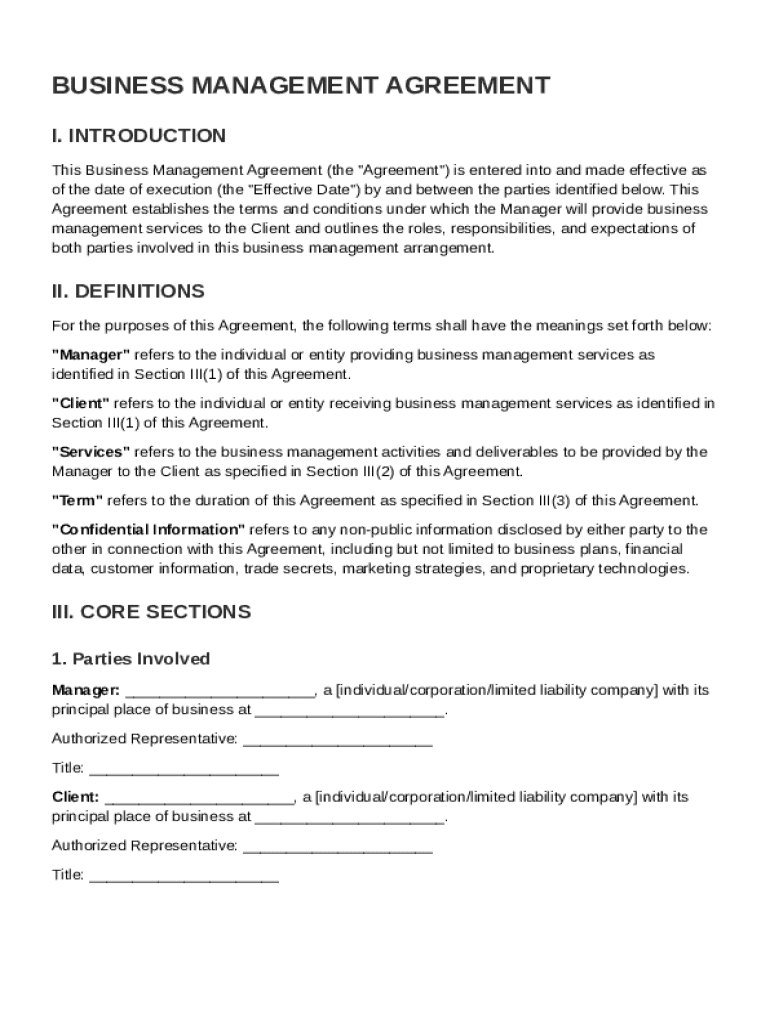







Definition & Meaning
A Business Management Agreement Template is a standardized contractual document designed to outline the specifics of the relationship between a Manager and a Client. It encompasses the roles, responsibilities, and expectations of both parties within the business management services agreement. The template serves as a foundational tool, ensuring that all aspects of the collaboration are clear, legally compliant, and aligned with industry standards.
Typically, such agreements include details on the service scope, compensation method, confidentiality clauses, dispute resolution mechanisms, and termination protocols. This comprehensive framework assists in averting misunderstandings and allows each party to have a detailed understanding of their obligations.
How to Use the Business Management Agreement Template
Using a Business Management Agreement Template involves several crucial steps aimed at tailoring the template to fit the specific needs of both the Manager and the Client.
-
Review the Standard Clauses: Begin by examining the standard sections included within the template, such as the services provided, compensation terms, and confidentiality agreements.
-
Customize Specific Terms: Adapt the template to reflect the unique requirements of the business relationship. This might involve specifying the exact services to be delivered, setting performance benchmarks, or detailing the compensation structure.
-
Include Party-Specific Details: Clearly identify the parties involved, stating their legal names and contact information. This helps ensure that each party is clearly defined within the agreement.
-
Consult Legal Counsel: Having a legal expert review the agreement is advisable to ensure compliance with local laws and to tailor it effectively to meet regulation standards.
-
Finalize and Sign: Once the template has been customized and legally reviewed, both parties should sign the document to forge a legally binding contract.
Steps to Complete the Business Management Agreement Template
Completing the Business Management Agreement Template is a methodical process designed to guarantee that all pertinent information is captured:
-
Gather Necessary Information: Compile details about the Manager, Client, and specific business management services to be included in the agreement.
-
Fill the Template: Start by inputting the information gathered into corresponding sections of the template, paying close attention to detail.
-
Verify Terms and Conditions: Double-check the agreement's terms, including service descriptions, compensation, confidentiality, and other key clauses, to confirm accuracy.
-
Seek Feedback: Encourage input from involved parties to ensure that the agreement meets mutual expectations and covers all relevant aspects.
-
Educate Parties on Agreement Terms: Make sure both parties fully understand their commitments and responsibilities outlined in the agreement.
-
Finalize with Signatures: Obtain signatures once all parties agree and are satisfied with the terms, making the agreement effective and enforceable.
Key Elements of the Business Management Agreement Template
The core components of a Business Management Agreement Template are essential in detailing every facet of the arrangement:
-
Service Scope: Specifications of the business management services that the Manager will provide.
-
Compensation Terms: A detailed outline of how and when the Manager will be compensated for services rendered.
-
Confidentiality: Clauses detailing how sensitive business information should be protected and used.
-
Dispute Resolution: Processes and procedures to be followed in the event of disagreement or conflict, including mediation or arbitration options.
-
Termination Provisions: Conditions under which the agreement can be terminated by either party, including notice periods and obligations upon termination.
-
Compliance Standards: Requirements ensuring all activities are conducted in accordance with applicable laws and regulations.
Legal Use of the Business Management Agreement Template
Legally, the Business Management Agreement Template acts as a safeguard ensuring that both parties are protected under the law. The agreement must comply with federal, state, and local laws, particularly when it comes to compensation, confidentiality, and service delivery standards.
The enforceability of the agreement hinges on its compliance with the ESIGN Act if signed electronically, ensuring that electronic signatures are legally recognized. Additionally, the agreement should account for any state-specific requirements that pertain to business management services.
Examples of Using the Business Management Agreement Template
Consider a small business owner seeking to hire a management consultant to streamline operations. The Business Management Agreement Template would help define the consultant’s role, expected outcomes, and payment terms, ensuring expectations align.
Another scenario involves a startup company hiring a project manager to oversee a product launch. The template would clarify the project manager’s responsibilities, the goals of the project, and provide a structure for assessing performance, thereby facilitating a smooth working relationship.
Who Typically Uses the Business Management Agreement Template
-
Business Owners and Entrepreneurs: Seeking to define and formalize management relationships.
-
Management Consultants: Looking to establish a clear service framework before beginning a consultancy role.
-
Startups and Small Businesses: Benefiting from structured agreements that help streamline management collaborations.
-
Corporations: Using the template to engage external management experts for specific projects or business units.
These entities find the template particularly useful in ensuring clarity, minimizing risks, and fostering a collaborative environment.

Important Terms Related to the Business Management Agreement Template
A comprehensive understanding of the following terms is critical for anyone utilizing the Business Management Agreement Template:
-
Scope of Services: Describes the activities and responsibilities the Manager is expected to perform.
-
Confidential Information: Refers to any non-public information shared between the parties that must not be disclosed.
-
Indemnification: Provisions related to holding one party harmless for certain losses or damages.
-
Performance Metrics: Standards or benchmarks used to evaluate the Manager’s performance under the agreement.
-
Force Majeure: Clauses relieving parties from liability or obligation when events beyond their control prevent contract fulfillment.
Understanding these terms ensures all parties have a clear insight into the agreement's stipulations and fosters confident participation in the business arrangement.




