




01. Edit your form online
Type text, add images, blackout confidential details, add comments, highlights and more.

Type text, add images, blackout confidential details, add comments, highlights and more.

Draw your signature, type it, upload its image, or use your mobile device as a signature pad.

Send it via email, link, or fax. You can also download it, export it or print it out.
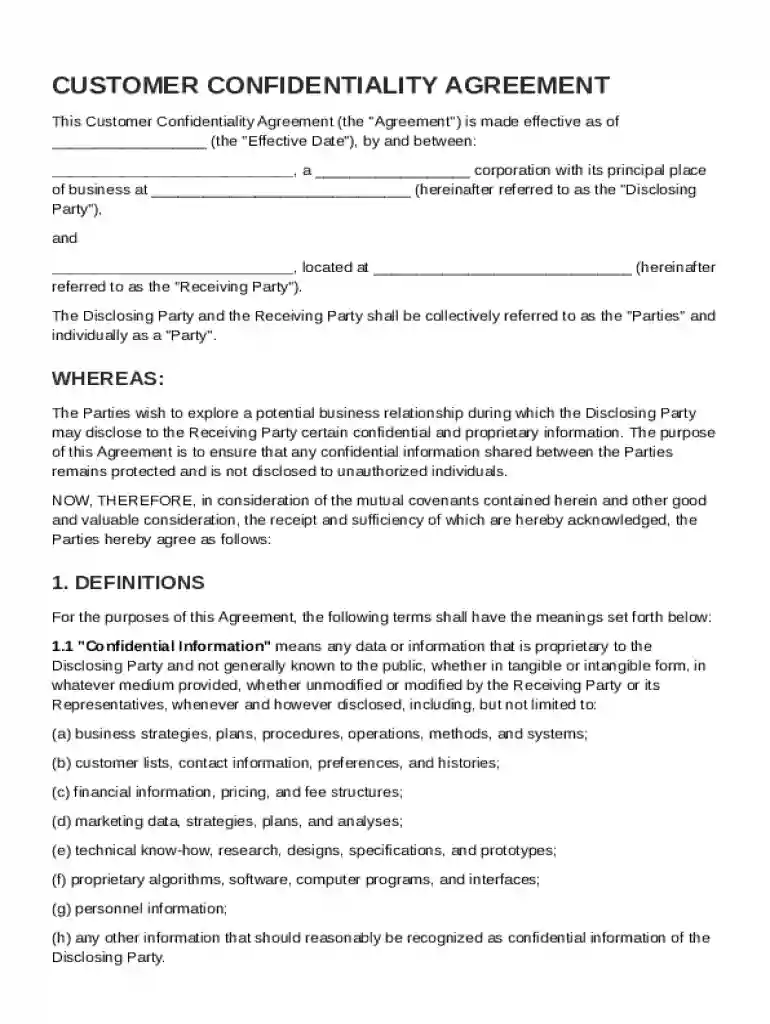
A Customer Confidentiality Agreement (CCA) Template is a legal document that outlines the conditions under which confidential information is shared between a Disclosing Party, the entity providing information, and the Receiving Party, the entity receiving it. This agreement is crucial for protecting sensitive information during business negotiations, partnerships, or any professional setting where data privacy is essential. It defines what constitutes "Confidential Information," establishes the obligations of the Receiving Party to maintain discretion, and provides exceptions to these obligations. The CCA also defines the agreement's duration, the procedures for the return or destruction of information upon termination, and the governing law. By offering a structured format, this template ensures that all pertinent issues are addressed comprehensively.
This agreement contains several key sections designed to protect sensitive information effectively.
Confidential Information Definition: Clearly specifies what information is considered confidential, providing examples like financial data, trade secrets, business plans, or client data.
Obligations of the Receiving Party: Details how the Receiving Party should handle the confidential information, typically including restrictions on sharing, copying, or using the data outside of agreed purposes.
Exceptions to Confidentiality: Lists circumstances under which information may be disclosed, such as when required by law or when the information becomes publicly available through no fault of the Receiving Party.
Duration of Agreement: Specifies the length of time the confidentiality obligations will be in effect, which might extend beyond the termination of the agreement itself.
Termination Clauses: Outlines the conditions under which the agreement might be terminated, and the procedures for information return or destruction.
Utilizing the CCA template involves several steps to ensure it suits your specific needs.
Download the Template: Obtain the template from a reliable source that ensures it is compliant with applicable laws.
Customize the Template: Modify the template to fit your specific context, ensuring that all pertinent information is accurately reflected, including parties' details and precise definitions of confidential data.
Review Legal Compliance: Consider having the agreement reviewed by legal counsel to ensure that it complies with relevant legal standards and provides adequate protection.
Discuss with the Other Party: Ensure both parties understand the terms and agree to them, addressing any concerns or special requirements before signing.
Sign and Secure the Agreement: Once finalized, have all parties sign the document, and ensure it is stored securely to prevent unauthorized access.
Understanding specific terminology within the CCA is vital for clarity and enforcement.
Disclosing Party: The entity providing confidential information.
Receiving Party: The individual or organization receiving and required to protect the confidential information.
Non-Disclosure: A commitment to not disclose specific information to third parties without explicit permission.
Governing Law: Legal framework under which the agreement is interpreted and enforced, usually specific to a certain jurisdiction.
CCAs must be employed within the bounds of legal requirements to ensure enforceability.
Compliance with the ESIGN Act: For digital versions, ensure that electronic signatures are legally compliant under the Electronic Signatures in Global and National Commerce Act.
Enforcement: The template should clearly state the governing law and be enforceable in its designated jurisdiction.
Amendments: Specify the procedure for making amendments to the agreement, including the need for written consent from all parties.
Real-world scenarios demonstrate the utility of CCAs in protecting business interests.
Business Partnerships: When two companies collaborate, sharing proprietary information such as product designs or marketing strategies, a CCA helps ensure that such data is not misused.
Employee Agreements: Companies often require employees to sign CCAs to protect internal systems and procedures or client information accessed during employment.
Consultant Engagements: Consultants handling sensitive information about a company's operations or finances can be bound by CCAs to prevent unauthorized dissemination.
Follow these steps to properly fill out and complete a CCA template.
Identify the Parties: Clearly name the Disclosing and Receiving Parties, including addresses and any relevant contact information.
Define Confidential Information: Be explicit in what constitutes confidential information for your purposes, tailoring it to suit your business needs.
Specify Obligations and Exceptions: Clearly outline what the Receiving Party can and cannot do with the information, including any legal safeguards or conditions under which disclosure might be required.
Determine Duration and Termination: Set the timeline for which confidentiality is required and what steps will follow the agreement's conclusion.
Secure Legal Review: Engage a legal expert to review the drafted agreement to ensure robust protection and compliance with applicable laws.
Execute and Store: Once agreement terms are set and signed by both parties, maintain a secure copy for future reference.
Several business types commonly benefit from incorporating CCAs.
Technology Companies: Protecting proprietary algorithms and software designs.
Healthcare Providers: Safeguarding patient data and treatment plans.
Financial Services: Ensuring client data privacy and secure transaction information.
Manufacturers: Protecting innovative product designs and processes.
Consultancies: Securing sensitive client strategies and insights.
Variations in state laws can affect the application of CCAs.
California: Might impose additional requirements under the California Consumer Privacy Act (CCPA) regarding personal data protection.
New York: Could require specific language relating to financial data protection under local regulations.
Texas: Generally has robust business protections, which may necessitate detailed non-compete clauses alongside the CCA.
Illinois: Special considerations might apply under the Biometric Information Privacy Act (BIPA) for agreements involving biometric data.
Navigating these legal landscapes ensures compliance and protection, making it essential to understand state-specific nuances.
At DocHub, your data security is our priority. We follow HIPAA, SOC2, GDPR, and other standards, so you can work on your documents with confidence.



Dec 18, 2025 Each party will use the others Confidential Information only to perform under this Agreement and will protect it with at least the sameRead more
Sample Confidentiality/Non-Disclosure Agreement. Samples, Templates Rates. Sample Confidentiality/Non-Disclosure Agreement. Category: General Document


