






Definition and Purpose of the HIPAA Business Associate Agreement
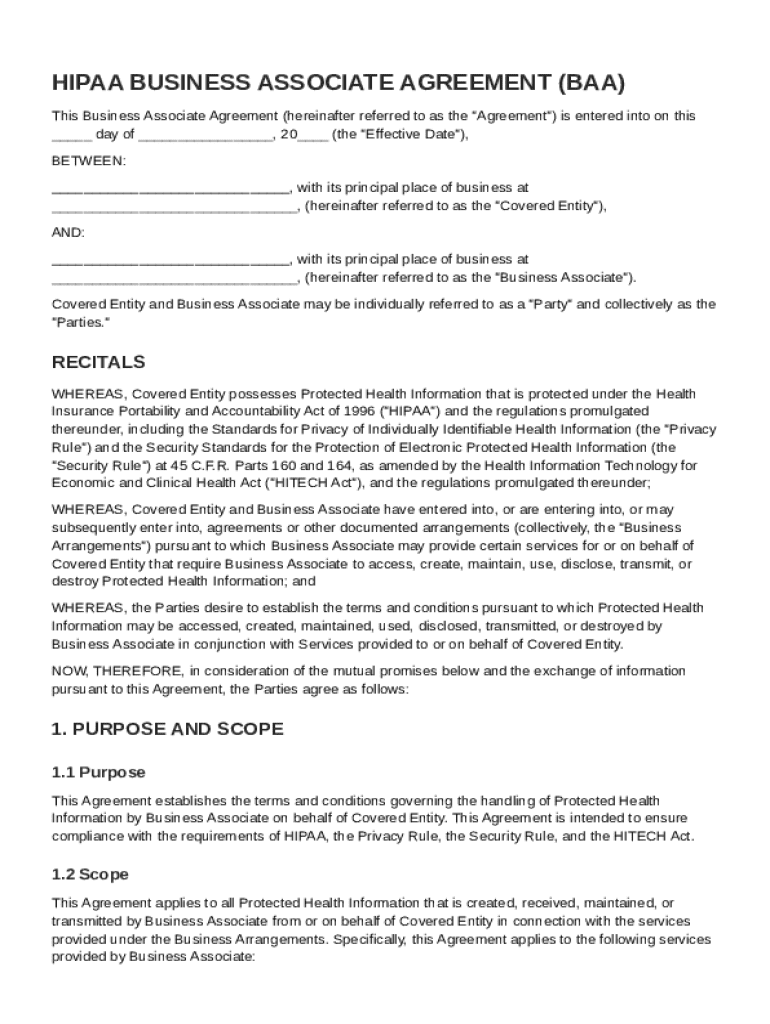
The HIPAA Business Associate Agreement (BAA) is a critical component of Health Insurance Portability and Accountability Act (HIPAA) compliance. It establishes the terms under which a Business Associate may handle Protected Health Information (PHI) on behalf of a Covered Entity. Specifically, a BAA ensures adherence to HIPAA's Privacy Rule and Security Rule by outlining the responsibilities and obligations of each party involved in the sharing of PHI. This agreement serves as a safeguard against unauthorized use or disclosure of sensitive health information and defines protocols for addressing potential breaches.
How to Use the HIPAA BAA Agreement Template
Using a HIPAA BAA Agreement Template simplifies the creation of a precise and compliant agreement between a Covered Entity and a Business Associate. The process involves customizing the template with specific details pertinent to the respective parties:
- Identify Parties: Clearly list both the Covered Entity and the Business Associate, including their legal names and contact information.
- Define PHI Usage: Detail the permissible uses and disclosures of PHI, ensuring they align with both parties' roles and responsibilities.
- Outline Security Measures: Specify the security measures and practices in place to protect the PHI, in accordance with HIPAA's Security Rule.
- Establish Breach Protocols: Set forth procedures for reporting and handling data breaches, including timelines and accountabilities.
- Review and Revise: Legal counsel review is recommended to ensure the agreement meets all regulatory requirements before finalizing.
Obtaining the HIPAA BAA Agreement Template
Accessing a HIPAA BAA Agreement Template typically involves:
- Online Platforms: Many document management services, including DocHub, offer downloadable templates that can be customized.
- Legal Resources: Specific health law or compliance websites may provide template options.
- Professional Legal Services: Consult a legal professional specializing in healthcare law to procure a tailored template.
Steps to Complete the HIPAA BAA Agreement Template
Completing the HIPAA BAA Agreement Template involves a series of steps:
- Gather Required Information: Collect comprehensive details about both the Covered Entity and the Business Associate.
- Customize the Template: Modify the template fields to accurately reflect the agreement's terms.
- Incorporate Specific Protections: Ensure inclusion of specific security measures and data protection protocols.
- Internal Review: Obtain reviews from relevant stakeholders within both parties.
- Execute the Agreement: Finalize and execute the agreement by obtaining signatures from authorized representatives.
Important Terms Related to HIPAA BAA
Understanding specific legal and technical terms is essential for using a HIPAA BAA effectively:
- Protected Health Information (PHI): Any information about health status, provision of healthcare, or payment that can be linked to an individual.
- Covered Entity: Any entity that provides treatment, payment, or operations in healthcare.
- Business Associate: A person or organization, other than a member of a Covered Entity's workforce, that performs functions or activities on behalf of the Covered Entity that involve the use of PHI.
Legal Use of the HIPAA BAA Agreement Template
A HIPAA BAA Agreement Template must comply with federal regulations and adhere to state-specific laws where applicable. Legal use involves:
- Ensuring Compliance: The agreement must align with HIPAA regulations for it to be legally valid.
- Confirming Mutual Understanding: Both parties must have a clear understanding of their obligations as stipulated by the agreement.
- Regular Updates: The agreement should be reviewed periodically and updated in response to any changes in HIPAA regulations or business processes.
Key Elements of the HIPAA BAA Agreement Template
The HIPAA BAA Agreement Template typically includes the following key elements:
- Scope of Work: Detailed description of the work the Business Associate will perform.
- Security Obligations: Specific security measures the Business Associate must implement to protect PHI.
- Breach Notification: Procedures for breach notification, including timelines and responsible parties.
- Indemnification: Clauses outlining liability distribution between the parties.
- Termination Conditions: Conditions under which the agreement may be terminated by either party.
Examples of Using the HIPAA BAA Agreement Template
Real-world scenarios of HIPAA BAA use include:
- Healthcare Providers and IT Companies: A hospital engaging an IT service provider to manage patient records will require a BAA to ensure proper PHI handling.
- Medical Billing Services: A physician's office working with an outside billing company will use a BAA to stipulate terms related to PHI use and breach protocols.
Who Typically Uses the HIPAA BAA Agreement Template?
The HIPAA BAA is commonly utilized by:
- Healthcare Providers: Hospitals, clinics, and individual practitioners.
- Healthcare Service Providers: IT companies, billing services, and data processing firms.
- Legal and Compliance Departments: Organizations needing to ensure compliance with healthcare regulation standards.