Definition and Meaning of a Property Division Agreement Template
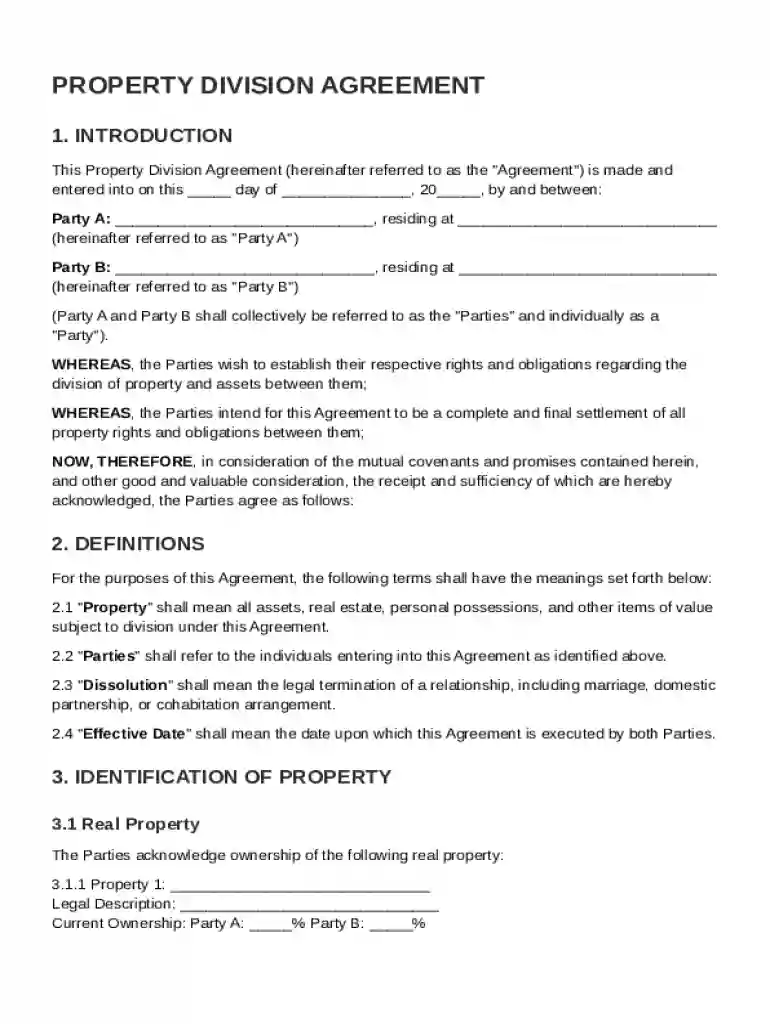
A Property Division Agreement Template is a legal document used to outline the division of assets and liabilities between two parties, typically following a dissolution of a relationship. This document formalizes how property, both real and personal, will be divided, setting clear boundaries and rights for each party involved. The template addresses several key areas, including the identification of property, agreed methods for valuation, and the responsibilities each party holds. It serves as a binding agreement to prevent future disputes and ensure an equitable division that is mutually acceptable.
Key Features of the Template
- Identification of Property: Clearly lists all assets and liabilities, specifying which party retains ownership over each.
- Valuation Methods: Provides the agreed method for determining the current value of assets, ensuring fairness.
- Liabilities Allocation: Outlines which party will assume responsibility for existing debts or obligations.
- Future Interests: Addresses rights to future assets or liabilities, ensuring parties understand ongoing commitments.
Several examples highlight the utility of such agreements. For instance, in a divorce, a couple might use this template to decide who retains ownership of the home, who takes over car payments, or how shared investments will be split. These terms help avoid misunderstandings and provide legal protection against future claims.
How to Use the Property Division Agreement Template
Using the Property Division Agreement Template involves several methodical steps to ensure both parties are adequately represented, and the agreement is legally sound.
- Obtain the Template: Secure a trusted version of the template from a credible source or through legal assistance to ensure all relevant sections are present.
- Identify Assets and Liabilities: Collaboratively list all shared and individual assets, including properties, accounts, and personal items.
- Agree on Terms: Both parties must mutually agree on how each item will be divided, using methods that assess value and respect each party's contributions.
- Legal Review: Have the document reviewed by an attorney to check compliance with local laws and ensure enforceability.
- Signatures and Notarization: Both parties should sign the document, and in some jurisdictions, notarization may be required to enhance legal standing.
Practical Scenarios
- Couples Going Through Divorce: To legally manage the distribution of shared assets.
- Business Partners: Dividing shared investments or tangible assets in the event of a partnership dissolution.
Key Elements of the Property Division Agreement Template
Several critical components ensure the document's comprehensive nature. They represent the pillars upon which the agreement's fairness and legal adequacy are built.
- Party Identification: Clearly names both parties involved in the agreement, alongside identification numbers if necessary.
- Detailed Asset List: Comprehensive listing of all assets, including their estimated values and intended recipient.
- Dispute Resolution Clause: Outlines methods such as mediation or arbitration to resolve disagreements that might arise post-agreement.
- Confidentiality Clause: Drills down on non-disclosure to protect privacy and the specifics of the arrangement.
- Governing Law: Specifies which jurisdiction’s laws will apply, crucial for resolving legal disputes in court.
These elements help safeguard both parties and ensure that the agreement is actionable and covers all bases. Amendments and adjustments can be made to these templates, provided both parties agree.
Steps to Complete the Property Division Agreement Template
Completing the Property Division Agreement Template is an organized process designed to provide clarity and legal protection. Here's a step-by-step guide:
- Gather Documentation: Collect all necessary documents related to the assets and liabilities to be divided (e.g., property deeds, bank statements, loan documents).
- Define Terms and Conditions: Both parties discuss and record how each item will be allocated.
- Draft the Initial Agreement: Fill out the template based on discussions and agreed terms.
- Review and Revise: Both parties review the draft, making necessary changes to ensure accuracy and fairness.
- Seek Legal Approval: Attorneys for both parties should approve the document to ensure legal compliance.
- Finalize and Sign: Once finalized, both parties sign the document in the presence of a notary if required.
Considerations for Completion
- Precision and Clarity: Ensure language is precise and unequivocal to prevent future disputes.
- Avoidance of Ambiguities: Define terms explicitly to avoid any possible contradictory interpretations.
Legal Use of the Property Division Agreement Template
The Property Division Agreement Template must conform to legal standards to be enforceable. This involves adherence to state laws where applicable, ensuring both parties enter into the agreement voluntarily and with full disclosure of relevant information. Disclosures must be complete to prevent future claims of coercion or fraud. It is important to remember that certain states might have unique requirements for property division agreements; thus, understanding local regulations or having an attorney review the agreement is prudent.
Legal Safeguards
- Compliance with ESIGN: If using digital signatures, ensure adherence to the legal standards set by the ESIGN Act.
- Court Compliance: Ensure the document meets legal formalities suitable for court presentation should disputes arise.
Who Typically Uses the Property Division Agreement Template
This template is commonly used by a variety of individuals and groups involved in asset distribution.

- Divorcing Couples: To amicably settle the division of marital assets and liabilities.
- Co-habiting Partners: Non-marital partners who wish to formalize the division of shared property.
- Domestic Partners: Registered domestic partnerships may require a formal agreement for asset division similar to a marriage dissolution.
Business Applications
- Business Dissolution: In cases where business partnerships dissolve, the template can help apport property and liabilities equitably.
- Joint Ventures: Partners in a joint venture may use such agreements to outline the distribution upon reaching project completion or dissolution of the venture.
Important Terms Related to Property Division Agreement Template
This agreement involves specific legal terms and definitions that clarify the responsibilities and expectations of both parties.
- Assets and Liabilities: Assets refer to property and financial interests owned by the parties, while liabilities are debts and obligations.
- Equitable Distribution: A legal principle that suggests fair division of property, though not necessarily equal, based on circumstances.
- Mediation/Arbitration: A dispute resolution process that might be stipulated within the agreement to settle disagreements with third-party assistance.
- Confidentiality Agreements: Prevent sharing or disclosure of the terms outside of legal or agreed contexts.
Understanding these terms aids parties in comprehending their rights and obligations within the agreement, helping to prevent disputes or misunderstandings.