Definition & Meaning
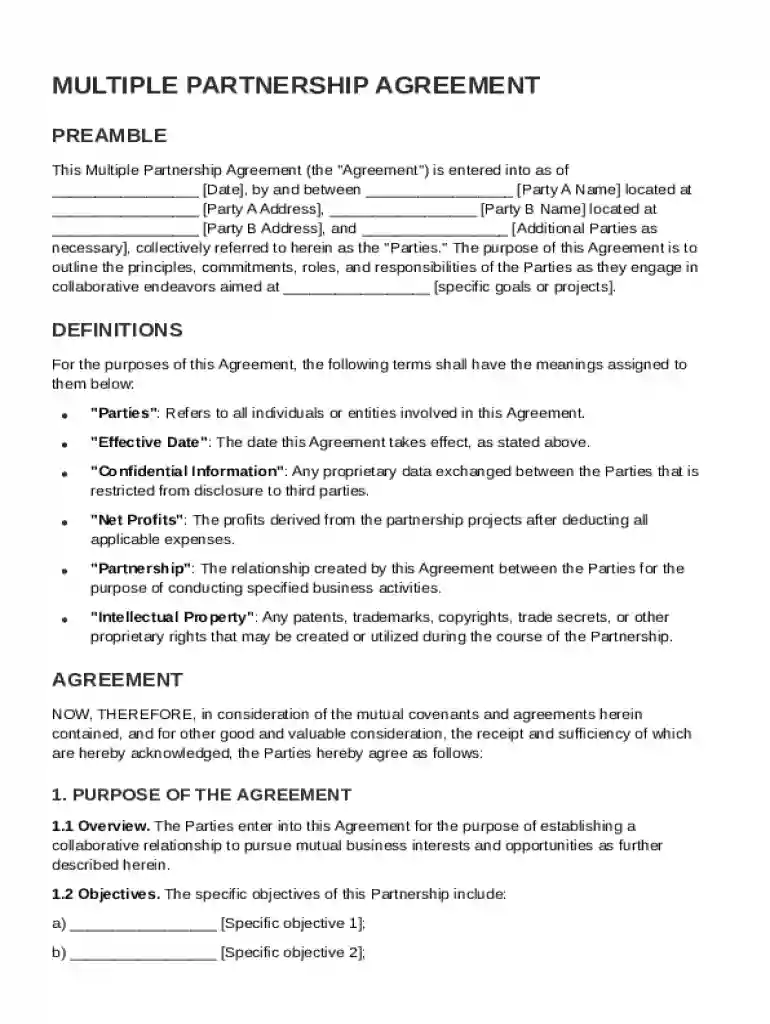
A Multiple Partnership Agreement Template is a legal document that outlines the collaborative relationship between several parties entering into a business partnership. It encompasses a detailed framework highlighting roles, responsibilities, financial agreements, confidentiality obligations, and dispute resolution processes. By establishing explicit expectations, this template provides a structured approach for partners to pursue mutual business goals while safeguarding proprietary information. Additional elements may include terms for the duration of the partnership and conditions for termination, ensuring that all parties are aware of their commitments and the circumstances under which the partnership may dissolve.
How to Use the Multiple Partnership Agreement Template
To effectively utilize a Multiple Partnership Agreement Template, consider the following steps:
- Identify Parties Involved: Clearly list all partners entering into the agreement, including individual names or business entities.
- Define Objectives: Outline the primary objectives the partnership aims to achieve, ensuring alignment with all parties' strategic goals.
- Assign Roles and Responsibilities: Detail the specific roles, responsibilities, and contributions each partner will make towards achieving the partnership's objectives.
- Financial Arrangements: Describe the financial commitments, profit-sharing ratios, and contributions required from each party, specifying how expenses will be managed and profits distributed.
- Confidentiality and Non-disclosure: Include clauses that protect sensitive information exchanged between partners, outlining any restrictions on disclosure.
- Dispute Resolution: Incorporate mechanisms such as mediation or arbitration to resolve potential conflicts without resorting to litigation.
- Signatures: Ensure all parties sign and date the document to solidify the agreement’s terms legally.
Key Elements of the Multiple Partnership Agreement Template
The Multiple Partnership Agreement Template contains several critical elements that provide a comprehensive legal framework for partnerships:
- Partner Information: Names, addresses, and specific details about each partner involved.
- Business Purpose: A concise description of the partnership's primary objective and purpose.
- Capital Contributions: Specifications on the amount and type of capital each partner will contribute, such as cash, property, or services.
- Profit Distribution: An explanation of how profits will be shared among partners, which may be proportional to their contributions or based on a predetermined formula.
- Management Structure: The decision-making processes and leadership roles within the partnership.
- Dissolution Terms: Conditions and procedures for dissolving the partnership, including handling liabilities and distributing assets.
- Governing Law: The specific legal jurisdiction that will govern the agreement.
Legal Use of the Multiple Partnership Agreement Template
In the United States, the Multiple Partnership Agreement Template is vital for legally securing the interests of all parties involved in a business partnership. These agreements abide by state and federal laws, providing a legally enforceable document that outlines each partner's rights and obligations. By clearly defining the terms of partnership upfront, the agreement helps mitigate legal disputes and ensures equitable resolution if disagreements arise. Additionally, compliance with laws like the Uniform Partnership Act (UPA) or the Revised Uniform Partnership Act (RUPA) may be required, depending on the state jurisdiction.
Important Terms Related to Multiple Partnership Agreement Template
Several essential terms frequently appear within a Multiple Partnership Agreement Template:
- Partner: An individual or entity participating in the partnership, contributing resources and sharing risks and profits.
- Capital Account: Records each partner’s contributions and share of profits and losses.
- Fiduciary Duty: A partner’s legal obligation to act in the partnership’s best interest, avoiding conflicts of interest.
- Indemnification: Provisions ensuring partners are compensated for any liabilities or losses incurred on behalf of the partnership.
- Dissociation: Process by which a partner exits the partnership, voluntarily or involuntarily.
Steps to Complete the Multiple Partnership Agreement Template
Completing this template involves a series of detailed steps:
- Gather Information: Collect detailed information about the partners and the business objectives.
- Draft Initial Document: Fill out the initial sections of the template, including partner details and the partnership’s purpose.
- Negotiate Terms: Discuss and adjust the terms to ensure mutual agreement on contributions, roles, and profit distribution.
- Review Legal Considerations: Consult with legal professionals to ensure compliance with applicable laws and regulations.
- Finalize Agreement: Make necessary revisions to address all parties’ concerns and finalize the terms.
- Secure Signatures: All parties involved should review, sign, and date the agreement, ensuring its enforceability.
State-Specific Rules for the Multiple Partnership Agreement Template
State-specific rules and regulations can significantly influence the terms of a Multiple Partnership Agreement:
- Registration Requirements: Certain states require partnerships to register before conducting business.
- Jurisdictional Variations: Specific rules, such as governing law and dispute resolution processes, may vary by state.
- Uniform Partnership Acts: Adoption and variation of uniform acts, such as the UPA or RUPA, can differ, influencing specific disclosure requirements and legal ramifications.
- Tax Implications: Vary based on the state, potentially affecting partners' financial contributions and profit distributions.
Examples of Using the Multiple Partnership Agreement Template
Practical scenarios where the Multiple Partnership Agreement Template proves beneficial include:
- Startup Ventures: Multiple individuals pooling resources and skills to launch a new business.
- Joint Ventures: Companies collaborating on a specific project or market expansion.
- Professional Partnerships: Law firms or medical practices where professionals share business management and profits.
- Real Estate Investments: Investors forming partnerships to acquire, develop, or manage properties.
Providing a transparent and enforceable partnership framework, this template assists in aligning parties’ expectations and safeguarding interests across diverse business ventures.