






Definition & Meaning
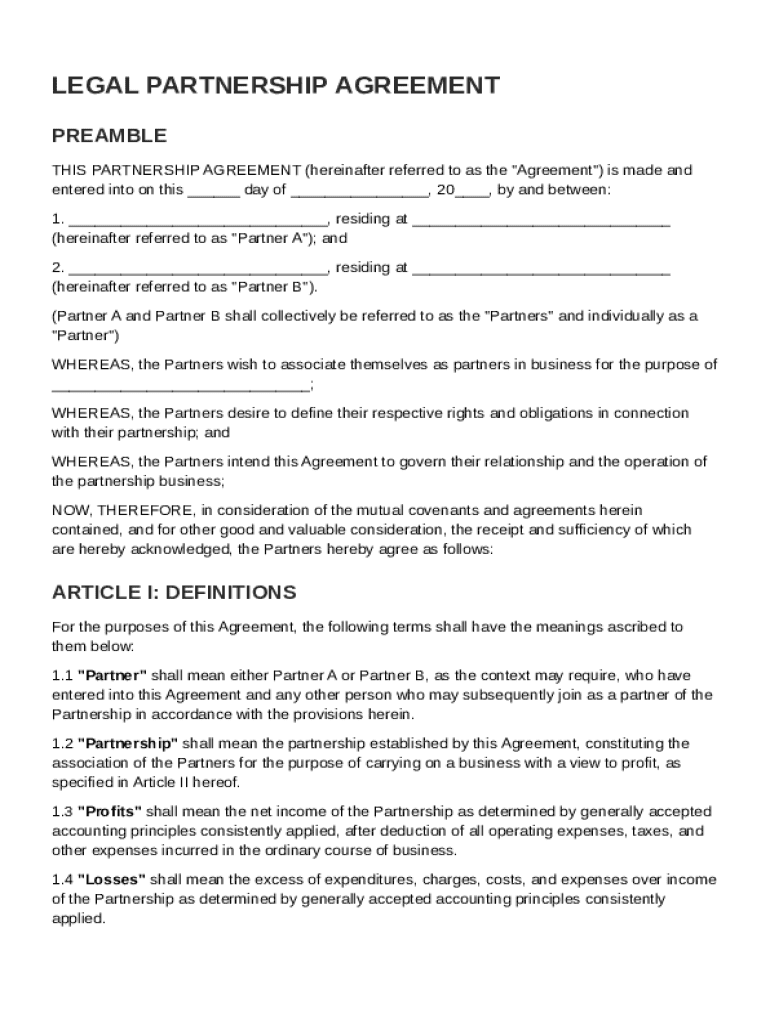
A Legal Partnership Agreement Template is a formal document that serves as a blueprint for creating a partnership between two or more parties. This agreement outlines essential elements of a partnership, such as its purpose, management, and operational strategies. By delineating clear roles and expectations, it helps prevent miscommunications and disputes. The template includes sections defining key terms and stipulations for capital contributions, profit and loss distributions, management structures, and partner withdrawal or addition procedures. It also encompasses provisions for confidentiality and dispute resolution mechanisms like mediation and arbitration to enhance legal clarity and enforceability.
Key Elements of the Legal Partnership Agreement Template
The Legal Partnership Agreement Template incorporates several critical components to ensure a comprehensive partnership framework:
- Purpose and Objectives: Establishes the intent and ambitions of the partnership, aligning all involved parties towards mutual goals.
- Capital Contributions: Details each partner's financial obligations, ensuring clarity on contributions required at the outset and during the partnership.
- Profit and Loss Distribution: Specifies how earnings and liabilities will be shared among partners, promoting financial transparency and fairness.
- Management Structure: Outlines governance, decision-making processes, and roles within the partnership to streamline operations.
- Dispute Resolution: Incorporates methods such as mediation or arbitration to mitigate potential conflicts efficiently.
- Governing Law: States the jurisdiction whose laws will govern the agreement, providing a legal foundation to the contract.
Steps to Complete the Legal Partnership Agreement Template
Completing a Legal Partnership Agreement Template involves a series of methodical steps to ensure accuracy and completeness:
- Review Basic Details: Identify and fill out the names and contact information of all partners involved.
- Describe Partnership Purpose: Clearly define what the partnership intends to achieve and outline the primary business activities.
- Set Contribution Terms: Specify initial capital contributions and any future financial commitments required from each partner.
- Define Profit and Loss Sharing: Establish the method for distributing profits and addressing any losses to ensure financial agreements are understood.
- Establish Management Protocols: Determine the management hierarchy, decision-making processes, and specific roles and responsibilities.
- Include Dispute Resolution Clauses: Add mediation and arbitration clauses to provide a roadmap for resolving disagreements.
- Agree on Governing Law: Decide on and document the legal system that will oversee the agreement's conditions and outcomes.
State-Specific Rules for the Legal Partnership Agreement Template
Legal partnership agreements must adhere to varying state-specific guidelines in the U.S.:
- Filing Requirements: Certain states may require filing a partnership agreement with the Secretary of State or another governing body.
- Minimum Partner Count: Some states have regulations on the minimum number of partners needed to form a legal partnership.
- Tax Obligations: State tax obligations and reporting standards can differ, necessitating adherence to local tax codes.
- Duration and Dissolution Provisions: States might mandate clauses concerning the duration of the partnership and specific dissolution procedures.
Who Typically Uses the Legal Partnership Agreement Template
Various parties might utilize the Legal Partnership Agreement Template to formalize professional relationships:
- Small Business Owners: Entrepreneurs forming partnerships to collectively leverage resources and knowledge.
- Professional Firms: Law firms, accounting firms, and medical practices commonly employ partnership agreements to clarify management roles.
- Real Estate Investors: Multiple investors may use partnership agreements to streamline property investments and management strategies.
- Family-Owned Businesses: Partnerships between family members seek to formalize roles and support succession planning with these templates.


Examples of Using the Legal Partnership Agreement Template
Real-world scenarios where a Legal Partnership Agreement Template would be vital include:
- Startup Founders: Two tech entrepreneurs merging expertise to co-develop a new application.
- Retail Ventures: Partners pooling resources to launch a boutique and clearly defining profit-sharing plans.
- Joint Ventures: Companies collaborating on a specific project and using the agreement to define scope and resource allocation.
- Construction Projects: Contractors forming partnerships to undertake a complex building project, relying on the agreement to assign duties.
Digital vs. Paper Version
With the advent of digital platforms, choosing between a digital or paper version of the Legal Partnership Agreement Template has significant implications:
- Accessibility: Digital templates provide easy access, editing, and sharing capabilities, enhancing collaboration among partners.
- Efficiency: They expedite the signing process through e-signatures, reducing the need for physical meetings.
- Storage and Organization: Digital agreements offer secure, organized storage, allowing for effortless retrieval of documents when needed.
- Environmental Impact: Opting for digital reduces paper consumption, contributing to sustainable business practices.
Business Types That Benefit Most from Legal Partnership Agreement Template
Specific businesses are ideally suited to incorporate a Legal Partnership Agreement Template into their operational strategy:
- Consulting Agencies: Small teams seeking to define roles and profit division clearly.
- Joint Ventures in R&D: Research and development projects that align multiple stakeholders towards a common goal.
- Hospitality Partnerships: Hotel and restaurant owners developing strategic partnerships to enhance market position.
- Logistics Companies: Partnerships formed to manage supply chain operations, leveraging each company’s strengths for mutual benefit.