




01. Edit your form online
Type text, add images, blackout confidential details, add comments, highlights and more.

Type text, add images, blackout confidential details, add comments, highlights and more.

Draw your signature, type it, upload its image, or use your mobile device as a signature pad.

Send it via email, link, or fax. You can also download it, export it or print it out.
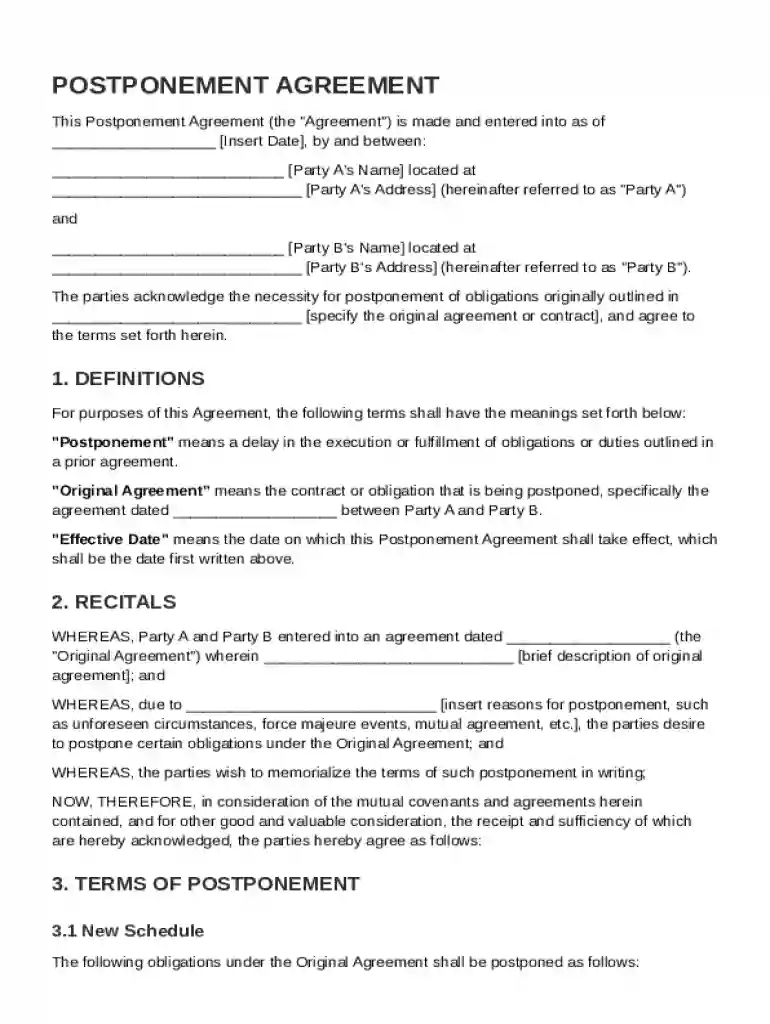
A Postponement Agreement Template is a pre-structured document used to formalize the decision between two or more parties to defer certain obligations initially agreed upon in a prior contract. This form outlines the conditions under which the delay is permissible, specifying new timelines, and highlighting the rights and responsibilities of each party during the postponement period. Typically, such an agreement is implemented when unforeseen changes necessitate modifications to the original terms. The template serves to maintain legal clarity and protect the interests of all involved parties by formally documenting the agreed-upon amendments.
Using a Postponement Agreement Template involves a series of steps to ensure that the document is filled out correctly and fully reflects the intentions of the parties involved. Here's a step-by-step breakdown:
Download the Template: Obtain a copy of the template from a reliable source, such as DocHub, ensuring it meets any specific requirements you have.
Identify Parties and Obligations: Clearly identify all parties involved and specify the obligations originally agreed upon that are to be postponed.
Specify Reasons for Postponement: Document the reasons necessitating the postponement, providing context and any relevant evidence or conditions that have led to the decision.
Establish New Timelines: Define new deadlines for the obligations, ensuring that they are realistic and mutually agreeable.
Include Legal Provisions: Insert standard clauses such as governing law, amendment procedures, and severability to maintain the legal integrity of the agreement.
Review and Sign: All parties should thoroughly review the draft for accuracy before signing.
The Postponement Agreement Template includes several critical components necessary for its efficacy and legitimacy:
Parties Involved: Clear identification of all involved parties, including names and contact information.
Original Agreement Details: Reference to the original agreement, specifying the sections or obligations subject to postponement.
Reasons for Postponement: Detailed account of the circumstances leading to the deferment to ensure mutual understanding.
New Schedule: Clearly defined dates and deadlines for fulfilling postponed obligations.
Agreement Provisions: Standard legal clauses ensuring the agreement is binding and enforceable, including provisions on amendments, severability, and governing law.
Signatures: Signature blocks for all parties, signifying agreement to the terms outlined.
Utilizing a Postponement Agreement Template is subject to certain legal considerations to ensure its enforceability:
Mutual Consent: All parties must agree to the terms willingly and without coercion, reflecting true consent for the delay.
Clarity of Terms: The terms should be clear, leaving no room for ambiguity that could result in disputes later.
Compliance with Governing Law: The agreement must comply with applicable laws and regulations, which may vary by jurisdiction.
Amendment and Termination Guidelines: Clearly outline how the agreement can be amended or terminated, providing a means for parties to adapt to future changes.
The Postponement Agreement Template is widely used across various sectors and scenarios, including:
Business Transactions: Companies may use it to delay the delivery of goods or services due to supply chain disruptions or other business constraints.
Real Estate Deals: Buyers or sellers may defer closing dates in response to financing or other conditional issues.
Service Contracts: Service providers may postpone delivery timelines due to unforeseen circumstances like equipment failures or labor shortages.
Personal Agreements: Individuals may delay personal obligations, such as debt settlements or maintenance agreements, due to temporary financial hardships.


Understanding certain terms is critical when dealing with a Postponement Agreement Template:
Obligor and Obligee: The obligor is the party with the duty to perform an obligation, while the obligee is the party expecting fulfillment.
Force Majeure: This clause refers to unexpected events outside of control, like natural disasters, which can affect obligations.
Severability: A legal concept ensuring that if part of the agreement is invalidated, the remaining sections remain enforceable.
The application and enforceability of a Postponement Agreement can vary significantly depending on the state. It is crucial to consider:
Local Contract Laws: Each state has specific rules governing contracts that can affect the template's validity.
Required Provisions: Some states may require additional provisions or different forms of acknowledgment or registration.
Enforceability of Postponement Clauses: States may differ in how they view and enforce clauses related to delays and timelines.
Dispute Resolution Norms: The preferred methods for handling disputes arising from postponement agreements can vary widely.
Real-world applications of a Postponement Agreement Template can provide insight into its adaptability and practicality:
Supplier Delays: A manufacturer may agree with a supplier to postpone the delivery of raw materials due to logistical challenges, adjusting their production schedule accordingly.
Event Planning: An event planner may defer the delivery of services due to venue restrictions, with the agreement specifying new dates and responsibilities.
Construction Projects: Builders may delay project milestones due to weather conditions, allowing for adjustments in workforce allocations and resource planning.
Completing the template requires careful attention to detail:
Gather Necessary Information: Assemble all details related to the original contract and the reasons for postponement.
Complete Template Fields: Fill out the template, including all required fields and any additional specifications unique to the situation.
Seek Legal Review: Consider having a legal professional review the document to ensure that it covers all necessary aspects comprehensively.
Finalize and Execute: Sign the agreement along with all involved parties, ensuring that each party receives a copy for their records.
At DocHub, your data security is our priority. We follow HIPAA, SOC2, GDPR, and other standards, so you can work on your documents with confidence.


