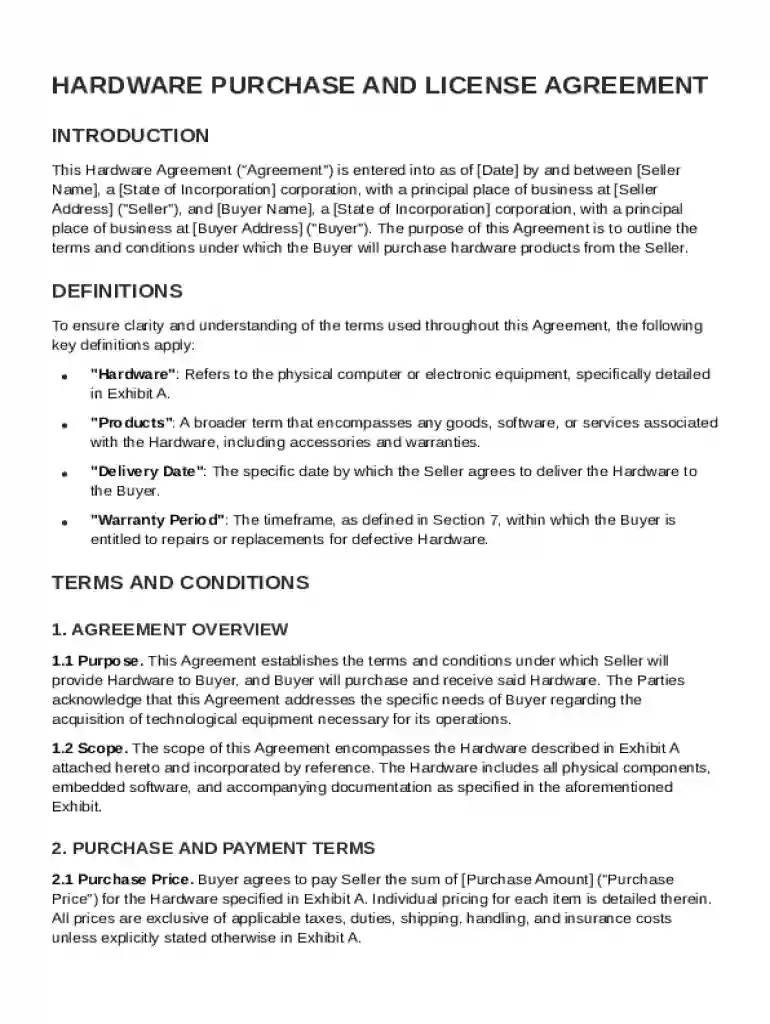
Key Elements of the Hardware Agreement Template
The Hardware Agreement Template serves as a comprehensive framework for outlining the terms and conditions related to the sale and transfer of hardware products. This document typically includes specific elements that ensure clarity and legal protection for both parties involved. Key components often include:
- Definitions: Establishing a clear understanding of essential terms such as "hardware," "seller," "buyer," and any other critical terminology used throughout the agreement.
- Purchase and Payment Terms: Details on the agreed-upon price, payment methods, and timelines for payment to ensure transparent financial transactions.
- Delivery Logistics: Information about the delivery process, including timelines, responsibilities of the seller and buyer, and conditions for successful delivery and receipt of hardware.
- Ownership Transfer: Clauses that specify the point at which ownership is officially transferred from the seller to the buyer, which is crucial for determining liability and risk.
- Warranties: Descriptions of any warranties provided by the seller, including duration and conditions, to assure the buyer of the product's quality and functionality.
- Maintenance Support: Specification of any support services available for the hardware post-purchase, including lead times and service conditions.
- Liability Limitations: Clauses that outline the extent of liability for each party, potentially including limits on financial responsibility or penalty for breach of agreement.
- Termination Clauses: Terms governing the conditions under which the agreement can be terminated prematurely by either party, protecting against unforeseen circumstances.
- Governing Law: Designation of the governing jurisdiction and the applicable laws to address any potential legal disputes arising from the agreement.
Practical Examples
Consider a technology company purchasing servers from a manufacturer. The Hardware Agreement Template would delineate the specific models, quantities, pricing, delivery timelines, and post-sale support services. It might also cover warranty details that protect the technology company should any hardware malfunctions occur within a specified period.
How to Use the Hardware Agreement Template
Navigating the preparation and completion of a Hardware Agreement Template requires a structured approach to ensure all pertinent details are accurately captured and mutually agreed upon. Utilizing the template involves several key steps:
- Review Initial Requirements: Before commencing, clarify the scope and particulars of the hardware transaction, including quantity, delivery expectations, and any specific buyer preferences.
- Fill Out Template Fields: Use the template to input essential data, ensuring accuracy and consistency. Fields might include names, addresses, descriptions of the hardware, terms of sale, and any bespoke obligations.
- Customize Terms and Conditions: Adjust the standard clauses of the template to reflect the specific nuances of the transaction at hand, adding or modifying sections as needed to suit particular agreements.
- Invite Collaborations: Allow for input from all relevant stakeholders. Utilize collaboration tools to gather feedback and approval from other parties involved in the transaction.
- Legal Review: It's advisable to have a legal expert review the completed document to ensure compliance with relevant legal standards and that it effectively protects the involved parties' interests.
- Finalize and Sign: Once all parties are satisfied, signatures from authorized individuals can be collected electronically or in person to execute the agreement legally.
This structured approach ensures thoroughness and minimizes the risk of oversights that could lead to disputes or compliance issues.
Legal Use of the Hardware Agreement Template
Understanding the legal ramifications of using a Hardware Agreement Template is crucial for safeguarding interests and upholding the terms outlined in the contract. The agreement's legality is underpinned by:
- Compliance with the ESIGN Act: The use of electronic signatures within the agreement is a legally recognized practice in the United States, ensuring that digital signatories are as binding as handwritten ones.
- State and Federal Laws: Adherence to applicable laws concerning sales and contracts is mandatory. This often includes aligning the agreement with specific state laws relevant to the jurisdiction in which the parties are operating.
- Uniform Commercial Code (UCC): Contracts for the sale of goods, including hardware, are often governed by the UCC, which provides a standardized set of rules to simplify and harmonize the law of sales and commercial transactions.
- Legal Recourse and Remedies: The template usually includes sections that outline legal recourse and dispute resolution mechanisms, such as arbitration or mediation, should there be a breach or disagreement.
Understanding these legal components aids in drafting an enforceable agreement that minimizes risk and ensures compliance, thereby offering protection during unforeseen disagreements.
Important Terms Related to the Hardware Agreement Template
Familiarity with the specific terminology used within a Hardware Agreement Template is essential for interpreting the document accurately. Common terms typically include:
- "Goods": Referring to the hardware products being sold, this term could include specifications such as model numbers or features.
- "Force Majeure": A clause that excuses one or both parties from performance obligations due to events beyond their control, such as natural disasters.
- "Breach of Contract": Occurs when either party fails to fulfill their obligations under the contract's terms, potentially triggering legal action or penalties.
- "Indemnification": An obligation by one party to cover losses or damages incurred by the other party under specified circumstances or conditions.
Having a clear understanding of these terms ensures transparent communication and facilitates the accurate drafting and implementation of the contract.
Examples of Using the Hardware Agreement Template
In real-world applications, the Hardware Agreement Template is utilized across various industries and contexts to formalize transactions. For instance:
- Technology Firms: Often employ these agreements when procuring computer systems, networking equipment, or components for production facilities to lay out detailed specifications and delivery schedules.
- Manufacturing Companies: Use hardware agreements to purchase necessary equipment for assembly lines, ensuring that delivery times align with production timelines and warranties cover operational uptime.
- Educational Institutions: Frequently require agreements when outfitting campuses with computers and projectors, clarifying installation and maintenance responsibilities.
These examples underscore the flexibility of the Hardware Agreement Template to accommodate diverse scenarios requiring meticulous specification and clear terms among different parties.
Steps to Complete the Hardware Agreement Template
Filling out and finalizing a Hardware Agreement Template requires attention to detail and a structured approach. Users can follow these steps to ensure a comprehensive and valid agreement:
- Initial Information Gathering: Collect all necessary details, including the parties' addresses, hardware specifications, and payment arrangements.
- Document Preparation: Input the gathered information into the relevant sections of the template, ensuring accuracy for all entries.
- Review and Edit: Carefully review the document for any inconsistencies or gaps, making necessary revisions to meet the specific requirements of the transaction.
- Legal Adjustment and Compliance Check: Verify that the agreement reflects applicable legal standards and includes all clauses necessary to protect the rights and responsibilities of each party.
- Stakeholder Review: Share the draft with all parties for review, capturing feedback and incorporating any reasonable requests or recommendations.
- Final Approval and Signature Collection: Once adjustments are made, collect signatures from authorized representatives to formalize the agreement, either digitally or in physical formats.
By following these systematic steps, users can ensure the agreement is legally sound, comprehensive, and tailored to the specific needs of their transaction.
State-Specific Rules for the Hardware Agreement Template
When using a Hardware Agreement Template, considering state-specific rules and requirements is critical. Key considerations often include:
- Contractual Variations: While templates provide a general base, states may have unique provisions related to consumer protection, breach of contract, and warranties that need to be integrated.
- Tax Implications: Sales tax applicability varies by state, influencing the structuring of payment terms and final pricing.
- Regulatory Compliance: Depending on the state, certain regulatory frameworks must be adhered to, impacting the terms of delivery and installation, especially for technology-related hardware.
Knowing these state-specific considerations helps prevent legal challenges and ensures that the agreement reflects localized statutory requirements.