




01. Edit your form online
Type text, add images, blackout confidential details, add comments, highlights and more.

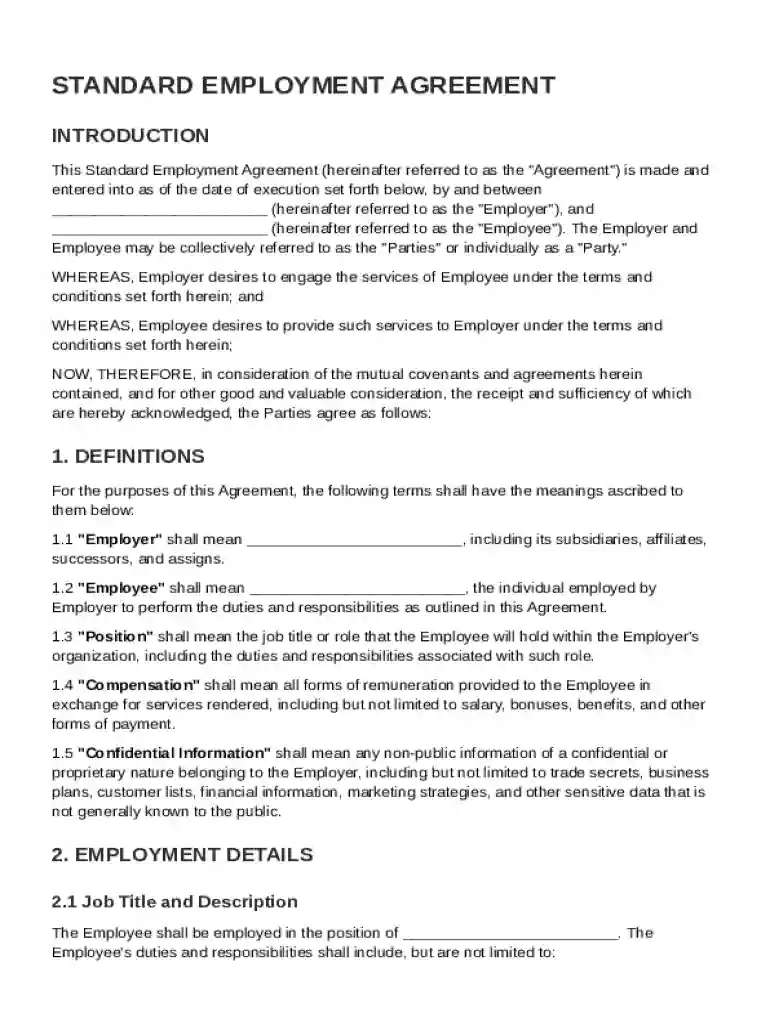
Type text, add images, blackout confidential details, add comments, highlights and more.

Draw your signature, type it, upload its image, or use your mobile device as a signature pad.

Send it via email, link, or fax. You can also download it, export it or print it out.
Understanding the key elements of a Standard Employment Agreement Template can provide clarity and structure in formalizing an employment relationship. The agreement typically includes:
Definitions of Key Terms: Provides clarity on specific terminology used throughout the agreement, ensuring both parties have a mutual understanding.
Position and Job Duties: Specifies the job title, department, and a detailed description of the employee’s responsibilities. This section ensures expectations are clear and measurable.
Compensation and Benefits: Details the employee's salary or hourly wage, payment schedule, and any additional benefits such as health insurance, retirement plans, bonuses, and paid time off.
Work Schedule and Location: Outlines the expected working hours, days of the week to be worked, and the primary location of work.
Performance Expectations: Sets standards for employee performance and behavior including evaluation processes and repercussions for not meeting expectations.
Confidentiality Obligations: Protects proprietary information by requiring the employee to keep company information confidential both during and after employment.
Termination Procedures: Includes conditions under which either party may terminate the employment, notice required, and any severance arrangements.
Governing Law: Specifies which state’s laws will govern the agreement, relevant if the employer and employee are in different states.
Acknowledgment of Understanding: Both parties affirm they understand and agree to the terms of the agreement, often requiring signatures from both the employee and employer.
Utilizing the Standard Employment Agreement Template effectively can streamline the hiring process:
Customization: Start by tailoring the template to fit the specific needs of your organization and the job role. Adjust sections like job duties and compensation to reflect the position accurately.
Legal Review: It's advisable to have the document reviewed by legal counsel to ensure compliance with applicable labor laws and company policies.
Clear Communication: Ensure that both the employer and the employee thoroughly understand all outlined terms. Encourage questions and provide clarifications before finalization.
Digital Tools: Platforms like DocHub facilitate easy editing and sharing of the template. Features like real-time collaboration and electronic signatures can expedite agreement completion.
Finalization: Once both parties agree to the terms, ensure the document is signed, dated, and securely stored, providing copies to both parties.
Familiarity with the key terms associated with a Standard Employment Agreement Template will enhance its effective use:
At-Will Employment: A common employment relationship allowing either party to terminate the employment at any time without cause.
Non-Compete Clause: A provision that restricts the employee's ability to work with competitors after leaving the company for a specified period and within certain geographical boundaries.
Probationary Period: An introductory phase for new employees to assess suitability and job performance, typically lasting 30, 60, or 90 days.
Severability Clause: Ensures that if any part of the agreement is found invalid or unenforceable, the remainder still remains in effect.
Indemnification: Protects one party from legal liability or claims arising due to the other's actions during their employment.
Force Majeure: Covers unforeseeable events that prevent either party from fulfilling their contractual obligations, often excluding liability for such events.
For the template to be legally binding, certain conditions must be met:
Consideration: There must be a clear exchange of value, such as services for compensation.
Mutual Consent: Both parties must voluntarily agree to the terms without any duress or misrepresentation.
Competence and Capacity: Parties entering the agreement should have the legal capacity to contract, meaning they are of sound mind and legal age.
Legality of Purpose: The terms of employment must comply with federal and state employment laws, including non-discrimination statutes and wage regulations.
Written Form and Signatures: Though verbal agreements are valid in some regions, written agreements are more enforceable and should include signatures from both parties to confirm agreement.
Completing the template requires a systematic approach:
Gather Information: Compile all relevant details about the job position, compensation structure, benefits, and company policies.
Fill in the Details: Carefully fill out the template, ensuring all sections are completed with accurate information.
Review and Revise: Double-check for errors, ensure compliance with legal standards, and make necessary revisions.
Discuss with Employee: Present the draft to the prospective employee, encourage feedback, and address any concerns or required amendments.
Final Review and Agreement: Once both parties agree to the terms, conduct a final review.
Signature Collection: Obtain electronic or physical signatures from both parties, using tools like DocHub for easy document management.
Document Storage: Store the signed agreement securely, maintaining compliance with record-keeping requirements.
A variety of organizations and individuals can benefit from using a Standard Employment Agreement Template:
Small and Medium Enterprises (SMEs): Streamlines the hiring process, providing a standard framework to manage employee relationships.
Large Corporations: Ensures consistency across departments, maintaining compliance and minimizing legal risks.
Human Resource Departments: Simplifies the onboarding process through standardized documentation.
Freelancers and Consultants: Serves as a basis for contracts when engaging in long-term projects with single clients.
Startups: Establishes clear terms for initial hirings, crucial for companies with fluctuating needs and growth strategies.


Understanding that rules may vary by state is crucial for compliant agreements:
Employment-at-Will Variations: Some states have exceptions or legal precedents that can alter the standard at-will provisions.
Non-Compete Enforceability: States like California have strict limitations on non-compete clauses, impacting their inclusion in agreements.
Minimum Wage Requirements: Variations in state and local laws may require adjustments in compensation terms.
Leave Policies: Different states have unique requirements for sick leave or family leave that must be reflected in the agreement.
Anti-Discrimination State Laws: Some states have additional protected classes under their anti-discrimination laws beyond federal guidelines.
The choice between digital and paper versions impacts efficiency and management:
Digital Versions: Offer flexibility and ease of storage, allowing for quick updates and electronic signatures. Platforms like DocHub facilitate easy sharing and collaboration.
Paper Versions: Can be preferred for traditional record-keeping or in situations lacking digital infrastructure. They require physical signatures and manual filing systems.
Hybrid Approach: Combining both methods retains the advantages of instant updates and legal compliance. Keeping digital copies for operational use while maintaining signed paper originals for legal purposes may offer the best of both worlds.
At DocHub, your data security is our priority. We follow HIPAA, SOC2, GDPR, and other standards, so you can work on your documents with confidence.


May 24, 2012 The written particulars should include all the legal requirements detailed below, or consist of a letter of appointment with minimal informationRead more
Jun 1, 2026 Faculty employment agreement templates are provided below for Assistant Professor and Associate/Full Professor. Units can use the templatesRead more


