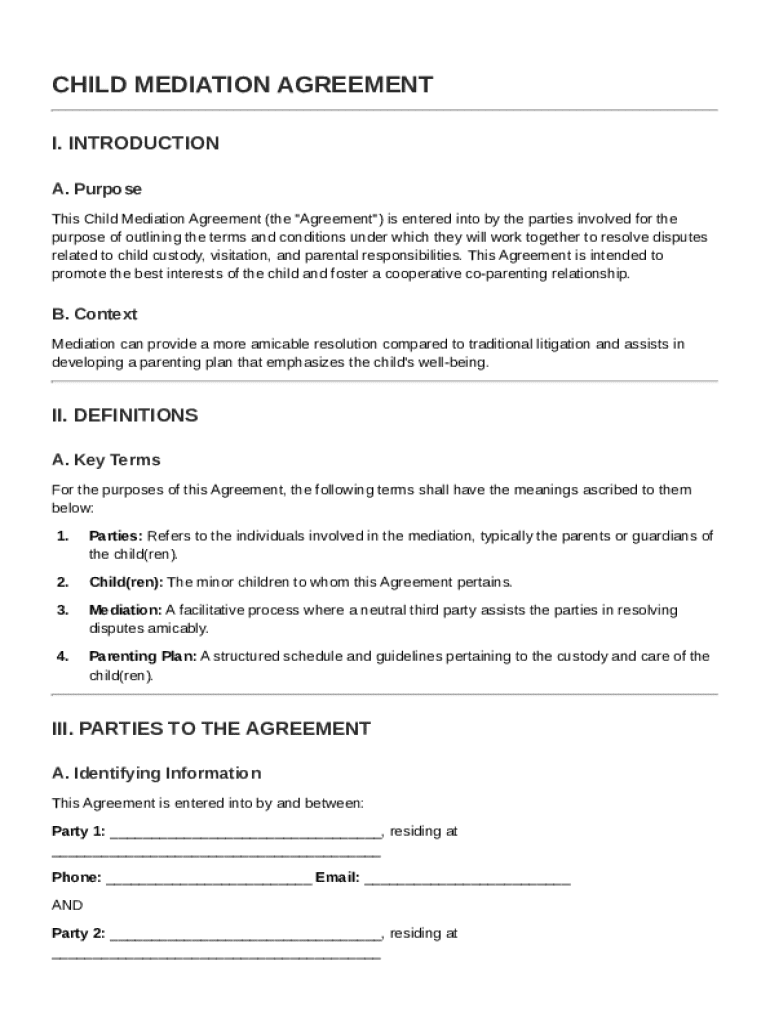







Definition and Meaning of a Child Mediation Agreement Template
A Child Mediation Agreement Template is a standardized document used in legal and family mediation settings to outline the terms and conditions under which child-related disputes are resolved outside the courtroom. It is primarily intended for parents who wish to address issues regarding child custody, visitation rights, and parental responsibilities through a structured mediation process. The agreement underscores the best interests of the child involved and seeks to promote a cooperative co-parenting dynamic between the parties. It includes detailed provisions on custody arrangements, communication guidelines, and methods for conflict resolution, providing a comprehensive framework for addressing potential disagreements in the future.
Key Components Include:
- Custody arrangements outlining the physical and legal custody of the child(ren).
- Parenting schedules specifying visitation times and special occasions.
- Communication protocols between parents to ensure effective co-parenting.
- Conflict resolution strategies to address disagreements without resorting to litigation.
Key Elements of the Child Mediation Agreement Template
The Child Mediation Agreement Template is comprised of several essential elements that provide clarity and structure to the mediation process. These elements ensure that each aspect of the parental responsibilities and child welfare is adequately addressed.
Legal Custody and Physical Custody
- Legal Custody: Defines which parent is responsible for making major decisions regarding the child's education, healthcare, and religious upbringing.
- Physical Custody: Details where the child will reside and the visitation rights of the non-custodial parent.
Parenting Time Schedule
A detailed calendar that outlines regular and holiday visitation schedules. This section ensures that both parents have time allocated that fosters a healthy parent-child relationship. It can include details for transferring the child between homes and stipulations for travel.
Communication Guidelines
Establishes the communication methods and frequency between parents regarding child-related matters. It can outline preferred communication channels, response times, and mechanisms for updating one another about the child's welfare.
Steps to Complete the Child Mediation Agreement Template
Filling out a Child Mediation Agreement Template requires careful consideration of all involved parties' roles and responsibilities. The steps below offer guidance on completing this critical document.
- Identify and Define Parties: Clearly list the names of both parents and any other relevant parties involved in the child's life.
- Outline Custody Arrangements: Specify details of both legal and physical custody agreements.
- Draft the Parenting Time Schedule: Use a calendar to plan regular visitation schedules, including holidays and vacations.
- Set Communication Guidelines: Agree on communication methods and protocols.
- Develop a Conflict Resolution Plan: Create strategies for resolving potential disputes without legal proceedings.
- Review and Amend: Both parties should review the agreement for completeness and accuracy, making amendments as necessary.
- Signatures: Secure signatures from all involved parties to formalize the agreement.
Legal Use of the Child Mediation Agreement Template
In the United States, a Child Mediation Agreement Template serves as a legal document that is admissible in court should disputes arise in the future. It is pivotal in reinforcing the mediation process as a viable alternative to courtroom litigation. The agreement is crafted within the standards provided by the Uniform Child Custody Jurisdiction and Enforcement Act (UCCJEA) to ensure consistency across states.
Legal Considerations Include:
- State Compliance: Each agreement must comply with state laws where the child resides.
- Enforceability: Once signed, the agreement can be submitted to a court for approval, becoming legally enforceable.
- Modification Provisions: Include clauses on how future amendments to the agreement can be legally made and approved.
How to Use the Child Mediation Agreement Template
Using a Child Mediation Agreement Template effectively involves understanding its structure and purpose. It is designed to be a flexible yet robust framework that facilitates clear communication and cooperation between parents.
Practical Scenarios for Use:
- Initial Mediation Sessions: Utilize the template as a starting guide during the first mediation meetings.
- Ongoing Reference: The agreement can be used as a reference point in ongoing parental discussions.
- Modification and Updates: Parents can update the agreement as circumstances change, such as relocation or changes in the child's school schedule.
Important Terms Related to the Child Mediation Agreement Template
Understanding the terminology used within the Child Mediation Agreement Template is crucial for its successful execution. The following terms frequently appear in the context of child custody mediation:
- Custodial Parent: The parent with whom the child resides most of the time.
- Non-Custodial Parent: The parent who has visitation rights and may hold joint legal custody.
- Mediation: A facilitated negotiation process that aims to resolve disputes outside of the courtroom.
- Best Interest of the Child: A standard that prioritizes the health, safety, and welfare of the child in custody proceedings.
Examples of Using the Child Mediation Agreement Template
Real-world examples of Child Mediation Agreements can demonstrate its flexibility and adaptability to a variety of family dynamics.
Case Study: Joint Custody Arrangement
In this scenario, both parents share equal responsibility in making decisions regarding their child's education and healthcare, while the child spends equal time living with each parent. The mediation agreement includes a detailed plan outlining how the parents will handle school tuition, extracurricular activities, and medical appointments.
Case Study: Primary Custody with Visitation Rights
Another example features a primary custodial arrangement where one parent holds the majority of the responsibilities, with the other parent maintaining regular visitation rights. The agreement specifies transportation logistics and summer vacation plans to ensure no conflicts arise.
State-Specific Rules for the Child Mediation Agreement Template
While the Child Mediation Agreement Template strives for uniformity, each U.S. state may impose specific regulations that can affect the template's structure and content.
Variations by State
- California: Emphasis on co-parenting programs as part of mediation.
- Texas: Requires consideration of the child’s preference if they are over a certain age.
- New York: Mandates specific clauses regarding child support as part of the custody agreement.
Understanding state-specific rules ensures the Child Mediation Agreement Template remains compliant and enforceable in the relevant jurisdiction.