







Definition & Meaning
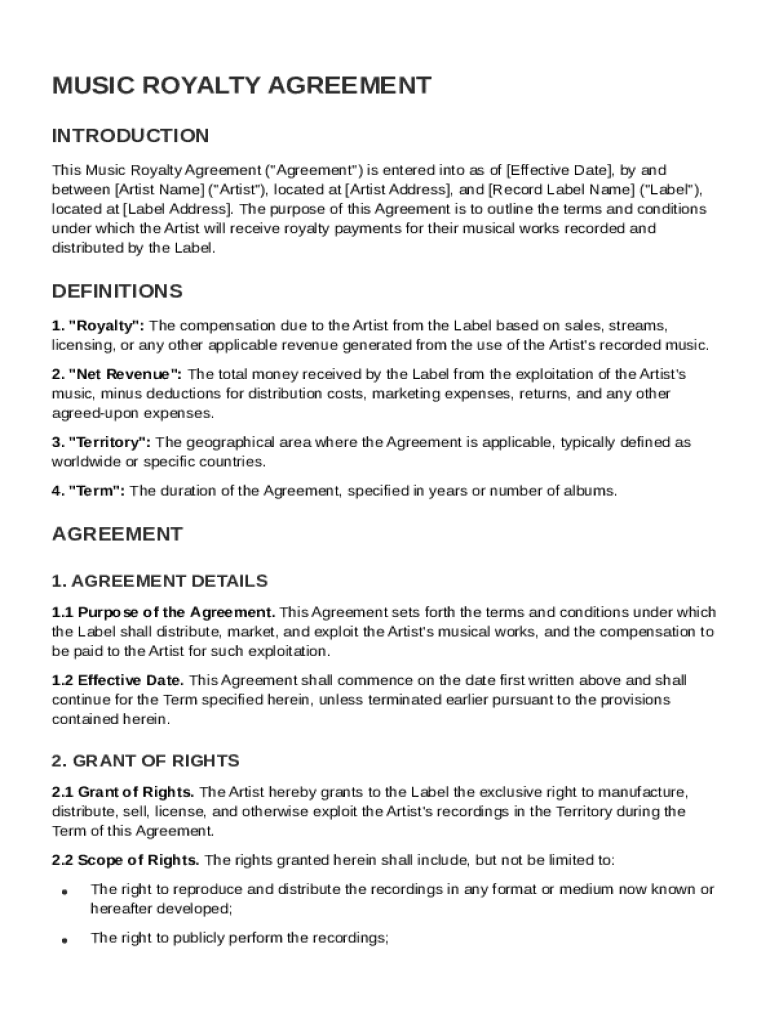
A Music Royalty Agreement is a legal document that outlines the terms and conditions between an artist and a record label concerning royalty payments for the artist's musical works. It specifies key definitions such as 'Royalty', which refers to the payment made to the artist based on sales, and 'Net Revenue', which details the total earnings after expenses. This agreement grants exclusive rights to the label for the distribution and exploitation of the recordings, ensuring the artist receives fair compensation while allowing the label to profit from the music's success.
Key Elements Explained
- Royalty Rates: Percentage of sales or revenue paid to artists.
- Payment Schedules: How often and when the royalties are paid.
- Exclusive Rights: Rights given to the label to distribute and exploit the music.
- Accounting and Audits: Procedures to verify sales and payments.
- Termination and Dispute Resolution: Conditions for ending the contract and resolving conflicts.
How to Use the Music Royalty Agreement Template
Using a Music Royalty Agreement Template involves customizing it to fit the specific needs of the artist and label involved. It serves as a framework that can be adapted according to the terms negotiated between both parties. Typically, it involves adding specific figures for royalty rates, modifying the language to reflect the desired legal terms, and filling in the names and details of the involved parties. Legal counsel is often recommended to ensure that the template aligns with both parties' expectations and requirements, offering protection and clarity for both artist and label.
Steps for Customization
- Review Standard Terms: Familiarize yourself with the template's standard clauses.
- Negotiate Terms: Discuss and agree on royalty rates, payment schedules, and rights.
- Input Specific Details: Enter the names, addresses, and other relevant information.
- Legal Review: Have an attorney examine the template to ensure compliance and fairness.
- Finalize and Sign: Ensure all parties sign the agreement to make it legally binding.
Important Terms Related to the Music Royalty Agreement Template
Understanding the terminology used in a Music Royalty Agreement Template is crucial for effective and clear contract creation. Common terms include 'Advance', which is a pre-payment against future royalties, and 'Mechanical Royalties', which are payments for reproductions of the music. Each of these terms carries significant weight in negotiations and enforcement of the contract, highlighting the importance of precise language in the agreement.
Common Terms
- Advance: Upfront payment recouped from future royalties.
- Mechanical Royalties: Payments for reproducing the music (e.g., CDs, digital downloads).
- Synchronization Rights: License to use music in timed relation with visual media.
- Performance Rights: Licensing fees collected when music is performed publicly.
Legal Use of the Music Royalty Agreement Template
The legal application of a Music Royalty Agreement Template ensures both parties are protected under the law. The template should be in accordance with U.S. legal standards, including compliance with the ESIGN Act for electronic signatures if used online. It is vital that the agreement outlines the governing law and jurisdiction, detailing where any legal proceedings would take place, to provide clarity and avoid confusion in the case of legal disputes.
Compliance Considerations
- Governing Law: Specify the state laws that will apply.
- Dispute Resolution: Include methods for handling disagreements, such as arbitration or mediation.
- Electronic Signatures: Ensure they are legally binding under the ESIGN Act.
Steps to Complete the Music Royalty Agreement Template
Filling out the Music Royalty Agreement Template involves several steps to capture all necessary information accurately. This process ensures that the resulting agreement is as clear and comprehensive as possible, reflecting the intentions of both the artist and the label. Each field should be thoroughly reviewed for accuracy and completeness.
- Gather Information: Collect all relevant details, including royalty rates and payment terms.
- Fill in Standard Fields: Enter the personal and contact information of involved parties.
- Customize Clauses: Adjust the template language to fit the specific deal.
- Review and Revise: Check for any errors or omissions, and revise as necessary.
- Seek Legal Advice: Consult with a legal professional to ensure all terms comply with relevant laws.
- Execute the Agreement: Ensure both parties sign and date the document.
Who Typically Uses the Music Royalty Agreement Template
This template is primarily used by independent artists, record labels, and music producers. These parties utilize the template to formalize the financial arrangements related to the musical works' distribution and sales. Both emerging and established artists, along with indie and major labels, find value in clearly outlining the terms of their business relationship to prevent misunderstandings and ensure transparency in royalty distribution.


Common Users
- Independent Artists: Self-releasing musicians seeking professional agreements.
- Record Labels: Companies distributing and promoting artists’ works.
- Music Producers: Individuals facilitating the creation and distribution of music tracks.

Key Elements of the Music Royalty Agreement Template
The core components of a Music Royalty Agreement Template encompass several critical sections essential for a comprehensive contract. These elements set the foundation for the business relationship, handling expectations, responsibilities, and recourse in case of disputes. Each section requires clear, specific language to ensure that both parties’ interests are protected and understood.
Core Components
- Royalty Calculations: Clearly defined formulas and examples for payment computation.
- Rights Granted: Comprehensive list of what rights are conveyed to the label.
- Audit Rights: Provisions allowing artists to verify the accuracy of royalty statements.
- Indemnification Clauses: Protections against legal liabilities and claims.
- Termination Conditions: Terms under which the agreement can be ended.
State-Specific Rules for the Music Royalty Agreement Template
In the United States, contract laws can vary significantly by state, impacting how a Music Royalty Agreement is interpreted and enforced. It is crucial to incorporate any state-specific regulations or requirements into the template. This can include differences in how electronic contracts are validated, statute limitations for claims, and unique clauses required for compliance.
State Considerations
- Verification of Signatures: State-specific rules for electronic or paper signatures.
- Statute of Limitations: Timeframe in which legal action can be initiated.
- Minimum Contract Requirements: Any additional disclosures or terms mandatory in specific states.
By understanding these elements and their state-specific contexts, parties can create well-defined and enforceable royalty agreements that cater to both artist and label needs.


