
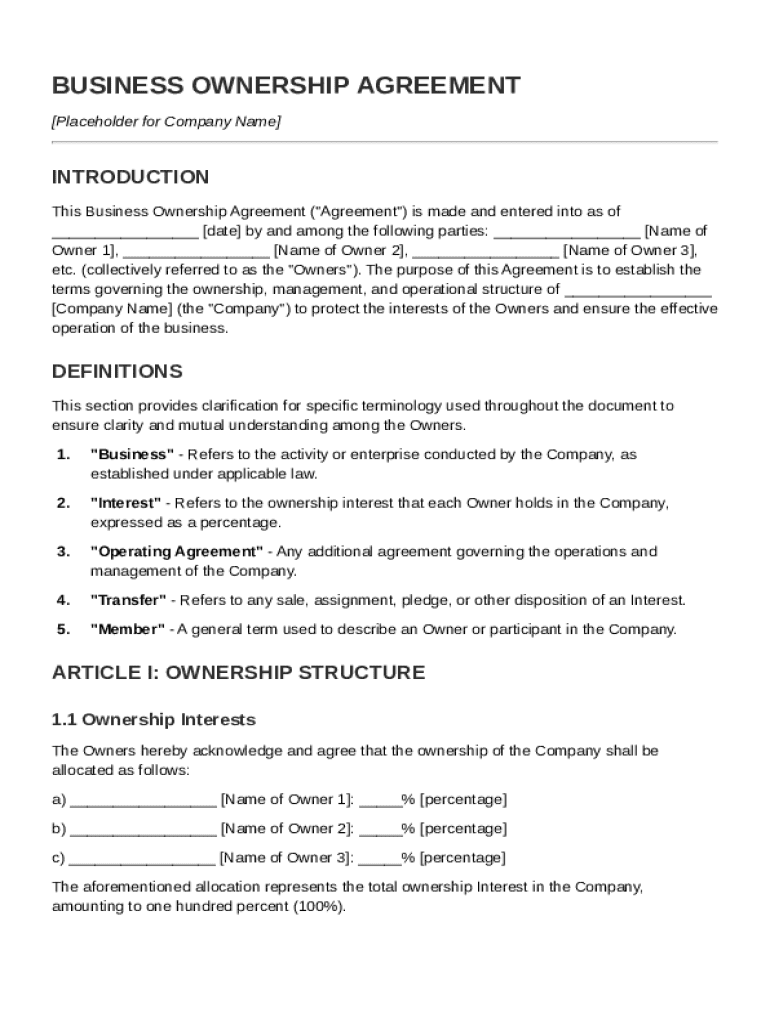







Definition and Purpose of a Business Ownership Agreement Template
A Business Ownership Agreement Template is designed to outline the terms and conditions that govern the ownership, management, and operational structure of a business among its owners. This template serves as a comprehensive guide for establishing clear agreements on ownership interests, management responsibilities, and profit distribution. By defining key terms like voting rights and procedures for transferring ownership, this template helps prevent conflicts and ensures effective business operations.
Key Elements Included in the Template
- Ownership Interests: Details each owner's percentage of the business, contributions, and responsibilities.
- Management Responsibilities: Specifies roles for decision-making, daily operations, and strategic planning.
- Profit Distribution: Outlines how profits and losses are shared among owners.
- Exit Strategies: Provides methods for owners to leave the business, ensuring a smooth transition.
- Governing Law: Indicates applicable laws that jurisdiction over disputes or modifications to the agreement.
How to Use the Business Ownership Agreement Template
Utilizing the template involves several steps to tailor it to the specific needs of a business. Begin by reviewing the entire document to understand each section. Determine if the default language meets your needs or requires modification. Input specific information such as ownership percentages, management roles, and profit-sharing agreements. It's advisable to seek legal advice to ensure the document abides by local laws and accurately reflects the intent of all parties involved.
Creating Customizable Clauses
- Adding Specific Clauses: Tailor sections to accommodate unique business needs, such as intellectual property rights or confidentiality agreements.
- Addressing Disputes: Include a clause on dispute resolution to facilitate mediation or arbitration.
- Amendment Procedures: Outline how the agreement can be modified, requiring mutual consent.
Important Terms Related to Business Ownership Agreements
There are several critical terms that are frequently used in business ownership agreements, and understanding these is key to drafting a well-rounded document.
Commonly Used Terms
- Equity Stake: Represents an owner's share of the business.
- Fiduciary Duty: The obligation owners and managers have to act in the best interest of the business.
- Unanimous Consent: A requirement that all owners must agree before certain actions can be taken.
Clarification of Complex Concepts
- Voting Rights: Differentiate between majority and supermajority votes for crucial decisions.
- Transfer Restrictions: Specify under what conditions ownership stakes can be sold or transferred.
Legal Use of the Business Ownership Agreement Template
Understanding how the agreement fits within legal frameworks is essential. This agreement must comply with relevant laws and regulations.
Legal Considerations
- Enforceability: Each clause should be legally binding and crafted to stand up in court if necessary.
- Compliance with State Laws: Ensure the agreement adheres to state-specific regulations concerning business entities.
Advice for Legal Assurance
- Seek Professional Help: Consult with legal experts to review and sanction the agreement.
- Regular Updates: Periodic revisions to keep up with changing laws and business needs.
Key Elements of the Business Ownership Agreement Template
Comprehensive coverage of essential components is necessary for a robust agreement.
Crucial Clauses to Include
- Roles and Responsibilities: Detailed descriptions enhancing clarity and reducing role conflicts.
- Financial Obligations: Outlining capital contributions, loans, and guarantees made by owners.
Protective Measures
- Non-Compete Clauses: Prevent owners from starting competing businesses should they exit.
- Indemnification: Shields owners from personal liability related to business debts.
Steps to Complete the Business Ownership Agreement Template
A step-by-step approach simplifies the task of filling out the template correctly.
Detailed Procedure
- Gather Relevant Information: Collect all necessary data about the business and its owners.
- Fill in Owner Details: Enter names, addresses, and ownership percentages.
- Specify Management Roles: Define responsibilities of each owner involved.
Verification and Finalization
- Internal Review: Conduct an initial review among all owners.
- Legal Review: Obtain a professional legal assessment before finalizing.
State-Specific Rules for Business Ownership Agreements
Different states might have varying rules surrounding business ownership agreements.
Navigating State Differences
- Registration Requirements: Some states necessitate filing the agreement with relevant authorities.
- Specific Clauses: Adjust agreements to meet any state-imposed stipulations regarding profit distribution or dispute resolution.
Practical Examples
- California: Requires explicit documentation for owner withdrawals from the business.
- Nevada: Recognizes oral agreements but advocates for written contracts for clarity.
Who Typically Uses the Business Ownership Agreement Template
Understanding the primary users of this template helps tailor its components to fit different business scenarios.


Common Users
- Small Business Owners: Establish roles and responsibilities among partners.
- Startup Founders: Define equity splits and governance structures for newly formed companies.
- Family-Owned Businesses: Clarify ownership rights among family members.

Adaptation for Various Entities
- LLCs and Corporations: Customize the template to cater to different business forms such as limited liability companies or corporations.




