Alliance Partner Agreement Template 2026

Get Form
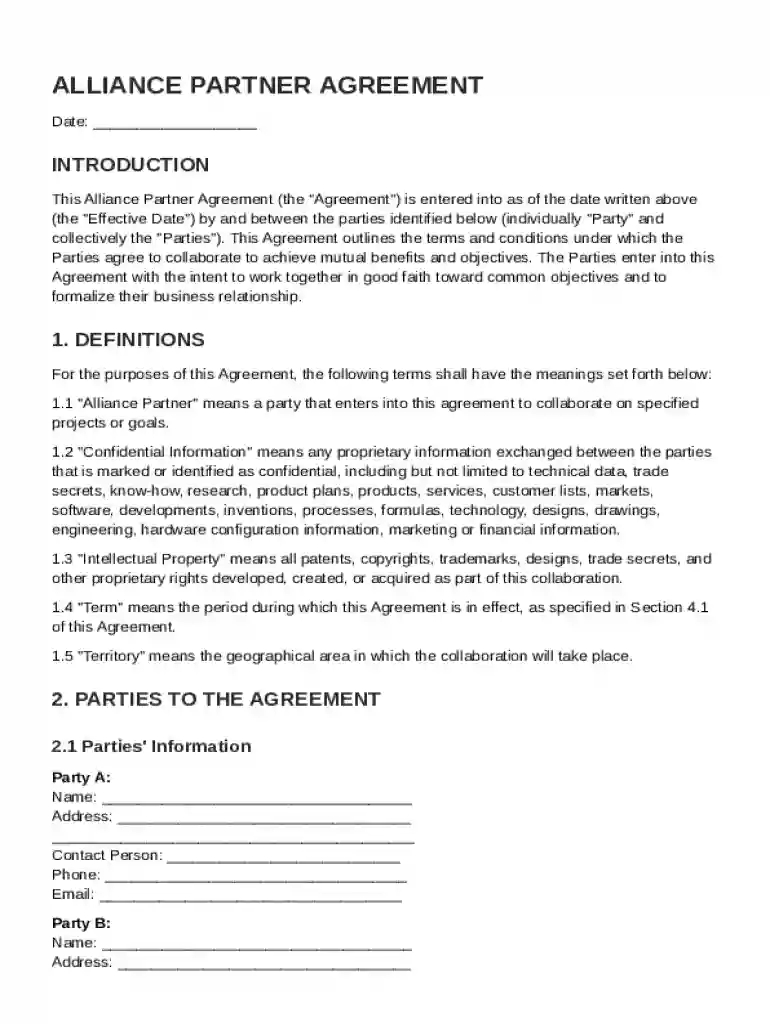
Alliance Partner Agreement Template Preview on Page 1

Here's how it works

01. Edit your form online
Type text, add images, blackout confidential details, add comments, highlights and more.

02. Sign it in a few clicks
Draw your signature, type it, upload its image, or use your mobile device as a signature pad.

03. Share your form with others
Send it via email, link, or fax. You can also download it, export it or print it out.

Definition and Purpose of the Alliance Partner Agreement Template

The Alliance Partner Agreement Template serves as a foundational document that defines and governs the collaboration between two parties, referred to as Party A and Party B. This template clarifies the nature of the partnership, outlining the roles, responsibilities, and expectations for each party involved. Key terms such as 'Alliance Partner,' 'Confidential Information,' and 'Intellectual Property' are explicitly defined to streamline understanding and minimize ambiguities. This document underscores the mutual intent to collaborate for shared benefits while establishing a formal business relationship.

Key Elements of the Template

  • Objectives and Responsibilities: The template includes specific goals for the partnership and delineates the duties of Party A and Party B to achieve these goals.
  • Performance Standards: It outlines benchmarks and performance metrics that each party should meet to ensure accountability and maintain the partnership's integrity.
  • Confidentiality and Intellectual Property: The agreement delineates how confidential information and intellectual property will be handled, ensuring both parties' interests are protected.

Steps to Complete the Alliance Partner Agreement Template

Completing the Alliance Partner Agreement Template involves several critical steps to ensure both parties understand their commitments and achieve mutual objectives.

  1. Define Parties Involved: Clearly identify Party A and Party B, specifying their roles and titles within their respective organizations.
  2. Detail the Scope of Collaboration: Describe the specific areas of collaboration and joint activities that will be undertaken.
  3. Include Key Terms and Conditions: Specify the terms that govern the partnership, such as duration, renewal options, and termination clauses.
  4. Outline Performance Metrics: Establish clear performance indicators to evaluate the success of the partnership.
  5. Address Confidentiality and Intellectual Property: Detail the protocols for managing sensitive information and ownership of intellectual property generated through the partnership.
  6. Add Signatures and Dates: Ensure both parties sign and date the document to make it legally binding.

Who Typically Uses the Alliance Partner Agreement Template?

The Alliance Partner Agreement Template is utilized by a range of business entities seeking formalize cooperative relationships.


  • Corporations: For strategic partnerships to enhance market reach or share resources.
  • Start-ups: To collaborate with more established companies for mentorship or technology sharing.
  • Non-profits: When partnering to amplify social impact and resource allocation.
  • Educational Institutions: Collaborating on research projects or exchange programs.
decoration image ratings of Dochub

Legal Use of the Alliance Partner Agreement Template

This template is a legally binding document that must comply with applicable laws and regulations to be enforceable.

Critical Legal Considerations

  • Compliance with Contract Law: Ensure the agreement adheres to state and federal contract laws.
  • Dispute Resolution Provisions: Include clauses specifying how disputes will be resolved, such as arbitration or litigation.
  • Indemnification Clauses: Define liability coverage and risk sharing between the parties involved.

Important Terms Related to the Alliance Partner Agreement Template

Understanding the terminology within the Alliance Partner Agreement Template is crucial for proper implementation.

Essential Terms and Their Definitions

  • Alliance Partner: The parties entering into the agreement with a shared strategic interest.
  • Confidential Information: Data or knowledge that is not publicly disclosed and must be protected.
  • Intellectual Property (IP): Creations of the mind, such as inventions or logos, that are legally protected.

Examples of Using the Alliance Partner Agreement Template

Practical scenarios illustrate the application and benefits of using this template in diverse contexts.

  • Technology Partnerships: A tech start-up partners with a larger firm to access proprietary software, resulting in shared innovation and expanded market reach.
  • Product Development: Two companies collaborate to develop a new product, leveraging each other's R&D capabilities for mutual benefit.
  • Joint Ventures: Entities form a joint venture, with this template laying the groundwork for operational collaboration and revenue sharing.

Key Elements of the Alliance Partner Agreement Template

Incorporating specific elements in the Alliance Partner Agreement Template ensures it is comprehensive and effective.

Detailed Components

  • Objectives: Clear goals for the partnership.
  • Roles and Responsibilities: Specific duties assigned to both parties.
  • Performance Metrics: Quantitative and qualitative criteria for assessment.
  • Confidentiality Measures: Protocols for safeguarding sensitive information.
  • Termination Clauses: Conditions under which the agreement can be dissolved.

State-Specific Rules for the Alliance Partner Agreement Template

State laws may impose specific requirements on how alliances are structured and enforced.

Examples of Variations

  • California: Requires additional disclosures related to data privacy and protection.
  • New York: Implies specific jurisdictional clauses for dispute resolution.
  • Texas: Has distinct guidelines for non-compete clauses within partnership agreements.

By ensuring these state-specific legal nuances are addressed, parties can avoid potential legal challenges and foster a smoother partnership.

be ready to get more

Complete this form in 5 minutes or less

Get form

Got questions?

We have answers to the most popular questions from our customers. If you can't find an answer to your question, please contact us.
Contact us
Example: The well-known partnership between Starbucks and Barnes Noble is an example of a strategic alliance. By placing Starbucks stores inside BarnesNoble stores, each company shares the cost of the space while providing complementary services to customers.
NATO: The North Atlantic Treaty Organization, a military alliance formed in 1949 for collective defense against aggression. EU: The European Union, a political and economic union of member states that aims to promote integration and cooperation across Europe.
It is highly recommended that you get professional legal advice when drawing up a partnership agreement. An effective agreement should include the following information but this isnt an exhaustive list and what should be included in a partnership agreement will be dependent on the specific business.
Examples of strategic alliances between big brands include Uber and Spotify, Starbucks and Target, Disney and Chevrolet, and Red Bull and GoPro. Small businesses can benefit from strategic alliances as well, as long as youre clear on your goals and have the resources to contribute in a mutual partnership.
Alliance agreements allow separate entities to join together on a specific project while protecting their other ventures from liability. Alliance agreements cover terms like each parties obligations in the partnership, guarantees, collateral, and consequences of expiration or termination of the contract.

Security and compliance

At DocHub, your data security is our priority. We follow HIPAA, SOC2, GDPR, and other standards, so you can work on your documents with confidence.
Learn more
ccpa2
pci-dss
gdpr-compliance
hipaa
soc-compliance

People also ask

How to Write a Partnership Agreement Define Partnership Structure. Outline Capital Contributions and Ownership. Detail Profit, Loss, and Distribution Arrangements. Set Decision-Making and Management Protocols. Plan for Changes and Contingencies. Include Legal Provisions and Finalize the Agreement.

Related links