







Definition and Meaning
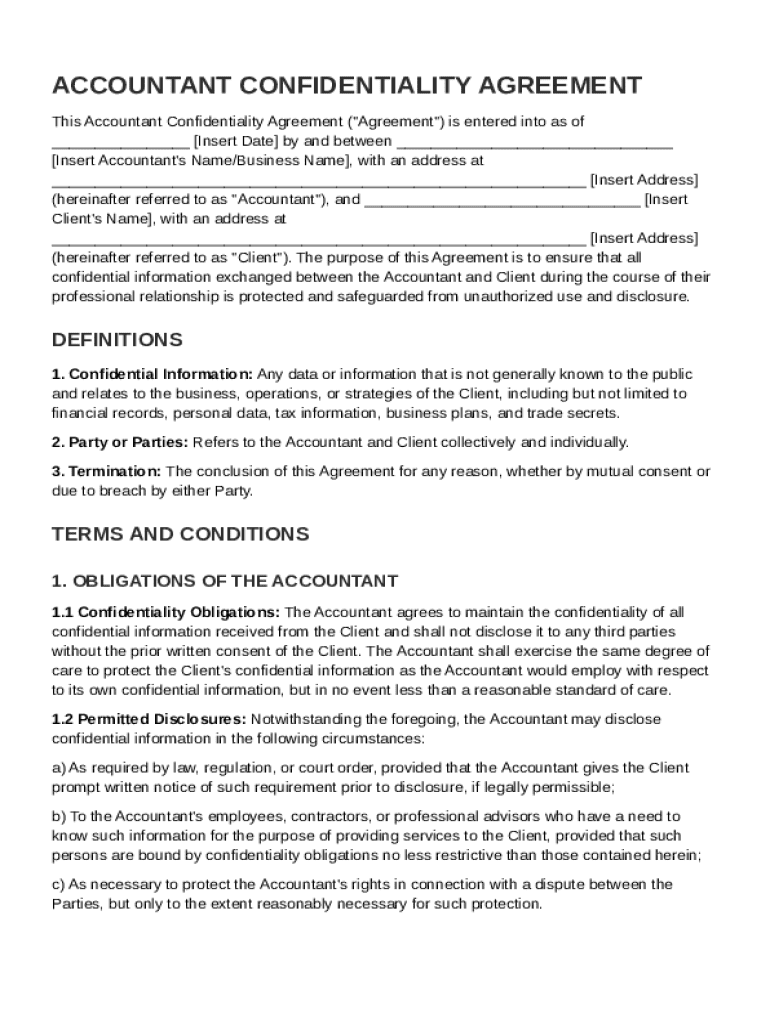
An Accountant Confidentiality Agreement is a legal document that safeguards sensitive information shared between an accountant and a client. This agreement legally obligates both parties to maintain the confidentiality of shared information under specified terms.
Key Components
- Definitions of Confidential Information: Clearly outlines what constitutes confidential data, including financial records, business plans, client lists, and proprietary information.
- Obligations of Parties: Specifies responsibilities, such as not disclosing or using the information for personal gain.
- Permitted Disclosures: Details scenarios where disclosure might be necessary, such as under legal obligations or with client consent.
- Duration: Establishes the time frame for which the confidentiality obligations remain in effect, even after the termination of the relationship.
Key Elements of the Accountant Confidentiality Agreement Template
Understanding the integral parts of this template ensures that all critical information is protected adequately.
Crucial Sections
- Introduction: Outlines the involved parties — the accountant and the client — and defines the purpose of the agreement.
- Confidentiality Commitments: Detailed clauses specifying the duty not to divulge any proprietary information.
- Scope of Confidentiality: Explains the breadth of the confidentiality, including all types of shared data.
- Exclusions: Defines any data not covered by the agreement, like publicly available information or data already known to the accountant prior to the agreement.
- Return of Information: Sets procedures for the return or destruction of confidential documents when the agreement ends.
Legal Use of the Accountant Confidentiality Agreement Template
Ensuring compliance with legal standards is essential when drafting and executing this agreement.
Legal Considerations
- Governing Law: Specifies which state’s laws will govern the agreement, important for resolving disputes.
- Amendments: Outlines how changes to the agreement should be made and documented, requiring mutual consent.
- Severability: Ensures that if a section of the agreement is found invalid, the remainder stays in effect.
- Execution: Dictates how the agreement is to be formally signed and witnessed, confirming mutual understanding and assent.
How to Use the Accountant Confidentiality Agreement Template
Ensuring thorough understanding and correct application of the template enhances its effectiveness.
Step-by-Step Instructions
- Review Definitions: Confirm that all defined terms within the agreement reflect the specific circumstances and needs.
- Customize Provisions: Adapt sections to fit the specifics of the accountant-client relationship and industry standards.
- Incorporate Exclusions: Clearly identify any information that will not be considered confidential.
- Assign Obligations: Specify each party's duties and expectations, ensuring both understand their respective responsibilities.
- Finalize and Sign: Once customized, ensure both parties sign and date the document in accordance with legal requirements.
Important Terms Related to Accountant Confidentiality Agreement Template
Familiarity with key terminology is crucial when navigating these agreements.
Glossary of Terms
- Confidential Information: Refers to any data or material that is not publicly known and is deemed proprietary by the disclosing party.
- Non-Disclosure Agreement (NDA): A broader category of agreements to which the Accountant Confidentiality Agreement belongs.
- Breach of Contract: An act of breaking the agreement which may result in legal consequences.
- Proprietary Information: Data that gives a business a competitive edge and includes trade secrets.
Who Typically Uses the Accountant Confidentiality Agreement Template
Recognizing the typical users can guide proper application and customization.


Typical Users
- Accountants and Bookkeepers: Individuals providing financial advice or management services who handle sensitive client information.
- Businesses: Corporations who want to safeguard their financial data when collaborating with external accountants or auditors.
- Freelancers/Consultants: Professionals engaged in short-term or project-based financial analysis or reporting work.
- Legal Advisors: Often involved in drafting and ensuring the legality of these agreements.
Steps to Complete the Accountant Confidentiality Agreement Template
Completing this template correctly is essential to ensure legal protection and clarity.
Procedure Overview
- Initial Drafting: Using a template, draft the initial document including all necessary sections.
- Insert Specific Data: Include names, addresses, and specific terms that apply to the relationship.
- Review Legal Clauses: Verify that all legal provisions align with relevant laws and regulations.
- Consultation: Consider having the draft reviewed by a legal professional for accuracy and completeness.
- Execution: Ensure both parties sign the agreement, establishing it as a legally binding document.
State-Specific Rules for the Accountant Confidentiality Agreement Template
Adapting state-specific regulations is crucial for legal compliance.
State-Specific Considerations
- Varying Laws: State laws may influence the scope and enforceability of confidentiality agreements. It is essential to adapt templates to comply with state-specific legal standards.
- Dispute Resolution: Different states may have unique laws around resolving disputes, affecting the governing law clause.
- Duration of Obligations: Some states have distinct rules on how long confidentiality should be maintained, affecting the duration section of the agreement.
By ensuring these areas are covered comprehensively, users can protect their sensitive information effectively and confidently engage with financial professionals.




