




01. Edit your form online
Type text, add images, blackout confidential details, add comments, highlights and more.

Type text, add images, blackout confidential details, add comments, highlights and more.

Draw your signature, type it, upload its image, or use your mobile device as a signature pad.

Send it via email, link, or fax. You can also download it, export it or print it out.
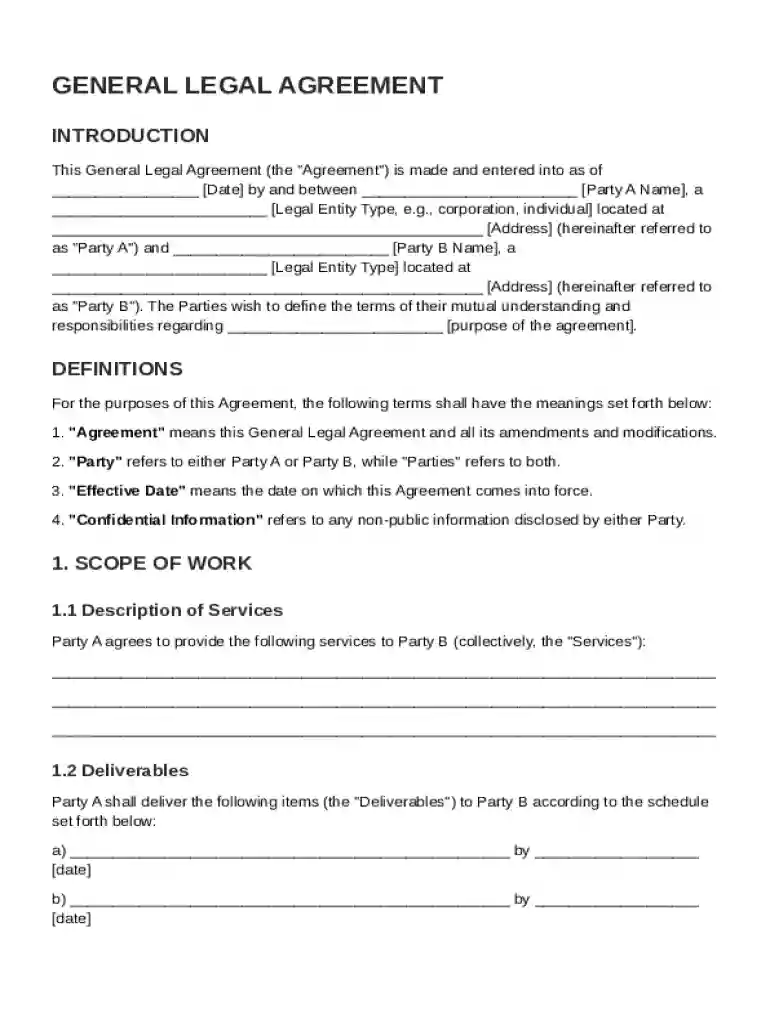
The General Legal Agreement Template is structured to outline key components necessary for establishing a clear and enforceable contract between parties. This template includes several essential elements:
Parties Involved: Clearly identifies the parties involved as Party A and Party B. This section should include full legal names, addresses, and role descriptions within the agreement.
Scope of Services: Defines the services or tasks that Party A is to perform for Party B. This should be detailed and specific to avoid misunderstandings.
Payment Terms: Outlines the payment structure, including amounts, due dates, and acceptable payment methods. Conditions under which delayed or missed payments may occur should be detailed.
Confidentiality Obligations: Specifies any information that is considered confidential and how it should be handled. This section often includes the duration for which information must remain confidential.
Term and Termination Rights: Details the period for which the agreement is valid and the conditions under which the agreement can be terminated by either party.
Indemnification Responsibilities: Describes the circumstances under which one party may be held liable for losses or damages suffered by the other party.
Governing Law and Jurisdiction: Identifies the state laws that govern the agreement and the jurisdiction in which disputes will be settled.
Miscellaneous Provisions: Covers additional clauses such as dispute resolution processes, amendments, assignment rights, and force majeure clauses.
Completing the General Legal Agreement Template requires careful attention to details and adherence to legal standards:
Gather Information: Collect relevant details about both parties, including contact information and specific roles in the agreement.
Define Services and Payments: Clearly outline the services to be provided and the specific terms of payment. Ensure these sections are detailed and transparent.
Draft Confidentiality Terms: Specify what information is confidential, the obligations of each party to protect this data, and the duration of confidentiality.
Determine Term and Termination Conditions: Set the start and end dates of the agreement and outline how and under what conditions either party can terminate the agreement.
Establish Indemnification Clauses: Draft clauses that clarify indemnification responsibilities and circumstances where one party indemnifies the other.
Choose Governing Law: Decide which state’s law will apply and the jurisdiction for any legal disputes that may arise.
Review Miscellaneous Provisions: Finalize additional clauses, such as amendment procedures and assignment rights, to ensure comprehensive coverage.
Consult With Legal Counsel: Before signing, both parties should seek legal advice to confirm the agreement meets all regulatory and legal standards.
Understanding specific terminology is crucial when dealing with a General Legal Agreement Template:
The General Legal Agreement Template serves to formalize mutual obligations and rights through a legally binding contract:
Binding Legal Contract: Establishes enforceable rights and obligations that protect parties from unwarranted risks.
Dispute Prevention: Clearly defined terms help prevent disputes by ensuring all parties understand their obligations and rights.
Formal Understanding: Provides a documented acknowledgment of the terms agreed upon, which can be referenced in case legal action is required.
The versatility of the General Legal Agreement Template allows its application across various industries and scenarios:
Vendor Services: Used when a business hires a vendor to provide services such as IT support, catering, or transportation.
Partnership Collaborations: Serves when two entities are collaborating on a project and need to outline respective responsibilities and sharing of resources or profits.
Freelance Gigs: Utilized by freelancers to formalize agreements with clients, detailing project scopes, timelines, and payment details.
Consultancy Services: Assists consultants in defining their role, deliverables, and remuneration structure clearly with clients.
While the General Legal Agreement Template provides a framework, state-specific regulations must be adhered to for enforceability:
Statute of Limitations: Varied by state, it dictates the period within which legal action must be commenced.
Usury Laws: State laws that govern maximum interest rates that can be charged on overdue payments or loans.
Consumer Protection Act: Differences in consumer protection laws may affect contractual terms related to refunds, damages, and liability.
Employment Law Variations: Employment-focused agreements must factor in state-specific labor and employment laws that can impact clauses like non-compete agreements or termination procedures.
Streamlining contract management through software aids efficiency and compliance:
DocHub Integration: This template can be managed digitally on platforms like DocHub, which offer features for editing, signing, and sharing contracts securely.
Google Workspace Sync: DocHub’s integration with Google Workspace allows seamless document access and sharing via Google Drive or Gmail.
E-signature Functionality: Platforms like DocHub support legally binding e-signatures, making contract finalization straightforward.
Document Template Storage: Use software systems to store templates for easy retrieval, ensuring that legal documents remain consistent and comply with current standards.
Non-compliance with the terms of a General Legal Agreement can have serious repercussions:
Financial Penalties: May include fines or interest on overdue payments and costs incurred due to breach of contract.
Legal Action: Failure to comply with terms can lead to lawsuits, resulting in additional legal expenses and damages.
Reputational Damage: Breaches or non-compliance can tarnish a company’s reputation and result in loss of business.
Termination of Agreement: Repeated violations may lead to premature termination of the agreement, affecting business operations and financial forecasts.
At DocHub, your data security is our priority. We follow HIPAA, SOC2, GDPR, and other standards, so you can work on your documents with confidence.



Contract Templates and Forms. Agreement Template Appearance or Performance Agreement. Phone: 202-806-2650
This sample agreement represents a format that can be adapted by the grant recipient to be used as either a two-party or three-party document
May 12, 2012 COFESA, Contractors, and contracts of employment. Determining the existence of a contract of employment has always been difficult.Read more


