
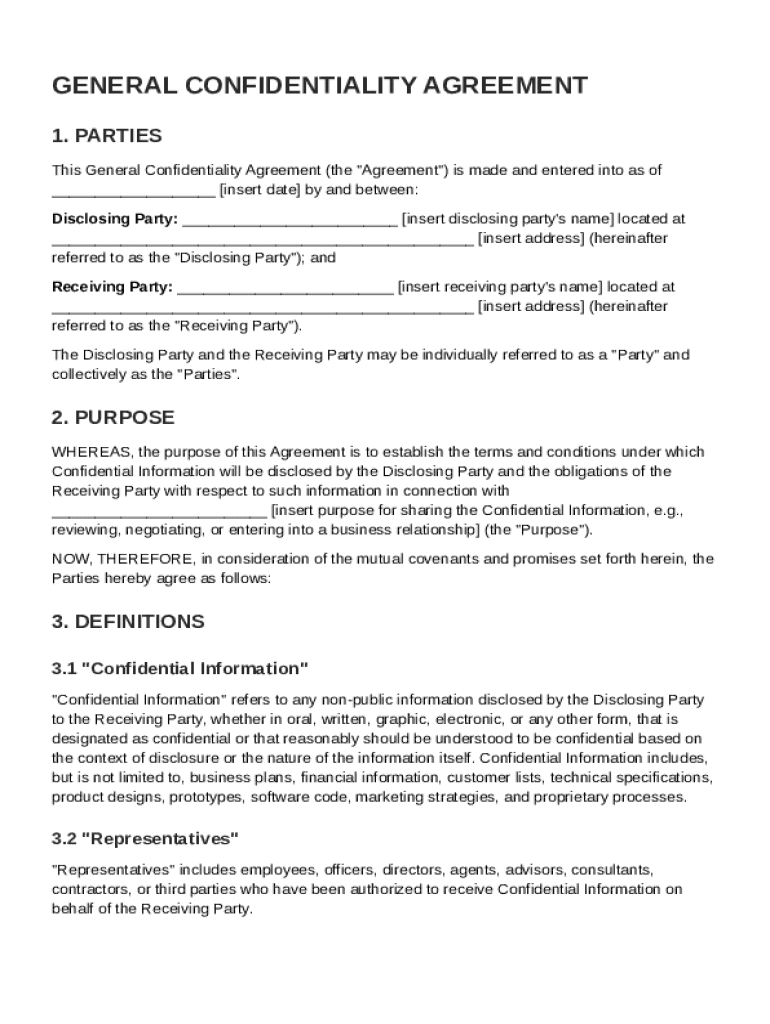







Definition & Meaning
A General Confidentiality Agreement is a legal contract that establishes how confidential information will be handled between two or more parties, typically a Disclosing Party and a Receiving Party. This agreement outlines the specific details of what constitutes "Confidential Information" and sets out obligations for the Receiving Party to protect such information. It provides the framework for maintaining the confidentiality of the information shared during business dealings, negotiations, or collaborations, minimizing the risk of unauthorized disclosure or use.
Examples of Confidential Information
- Personal data, like customer names or employee records
- Trade secrets, such as formulas or manufacturing processes
- Business strategies, including marketing plans or sales strategies
- Financial data, such as earnings reports or budget forecasts
Key Elements of the Agreement
A General Confidentiality Agreement typically consists of several crucial components that define the scope and enforceability of the contract.
-
Definition of 'Confidential Information':
- Specifies the types of information considered confidential.
- May include both written and verbal communications.
-
Obligations of the Receiving Party:
- Details how the Receiving Party must handle the confidential information.
- Prohibits unauthorized disclosure or use of the information.
-
Exceptions to Confidentiality:
- Outlines any circumstances where disclosure is permitted.
- May include legal obligations requiring disclosure.
-
Duration of Confidentiality:
- Sets a time period for how long confidentiality must be maintained.
- Often extends beyond the termination of the business relationship.
Steps to Complete the General Confidentiality Agreement Template
Completing a General Confidentiality Agreement Template involves several steps to ensure all necessary details are included and comprehended by all parties involved.
-
Identify Parties:
- Clearly state who the Disclosing and Receiving Parties are.
- Include full legal names and contact details.
-
Define Confidential Information:
- Specify what information is to be considered confidential.
- Use broad categories if needed to encompass various types of data.
-
Set Obligations and Rights:
- Detail the responsibilities of each party regarding information handling.
- Include rights related to accessing and using the information.
-
Establish Duration:
- Indicate how long the confidentiality obligations will remain in effect.
- Consider both the active relationship and post-termination periods.
-
Include Legal Provisions:
- Add clauses about governing law and dispute resolution.
- Consider adding conditions for modifying the agreement.
Important Terms Related to the Agreement
Understanding specific terminology used in the General Confidentiality Agreement is vital for the proper drafting and enforcement of the contract.
- Nondisclosure Clause: A provision preventing the Receiving Party from disclosing confidential information to unauthorized third parties.
- Return/Destruction Clause: Conditions under which confidential information must be returned or destroyed.
- Ownership Rights: Clarification that the Disclosing Party retains ownership over their confidential information.
Legal Use of the Agreement
The General Confidentiality Agreement is legally binding and can be enforced in court if one party breaches the terms of the agreement. Adhering to legal statutes like the Uniform Trade Secrets Act or state-specific laws governing confidentiality is essential for ensuring its enforceability. Provisions for dispute resolution, such as mediation or arbitration, are also generally included to resolve any disagreements amicably and expeditiously.
How to Use the General Confidentiality Agreement Template
Using the General Confidentiality Agreement Template within DocHub is a streamlined process, allowing you to adapt the template to fit your specific needs.
- Start by Importing: Upload the template from your computer or cloud storage service.
- Edit Online: Use DocHub's editing tools to fill out the necessary fields directly within the template.
- Add Annotations: Insert text boxes for adding additional terms or clauses and use the highlighting tool to emphasize key points.
- Secure Signing: Utilize DocHub's electronic signature feature to finalize the agreement securely.
Business Types that Benefit Most
Certain businesses frequently utilize General Confidentiality Agreements to protect sensitive information as part of their operations.
- Startups: Managing new technologies and seeking investors.
- Tech Companies: Protecting intellectual property such as software code.
- Healthcare Providers: Safeguarding patient data in compliance with HIPAA.
- Manufacturing Firms: Shielding proprietary manufacturing processes.
State-Specific Rules
While the General Confidentiality Agreement is widely applicable, certain state-specific rules and precedents might influence its application and enforceability. For instance, California has specific exceptions under its business laws that might change how confidentiality agreements are interpreted in court. Understanding and adjusting to these nuances ensures compatibility and compliance with regional laws and practices.




