
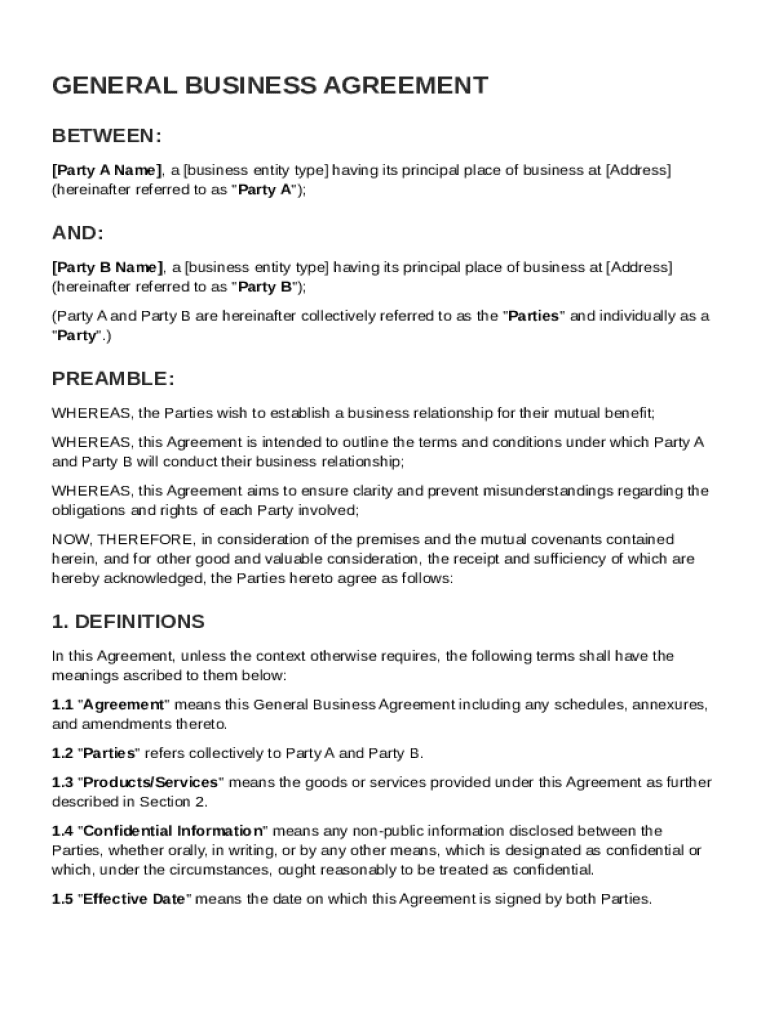







Definition and Meaning of a General Business Agreement
A General Business Agreement is a legally binding document used to outline the terms and conditions between two parties engaged in a business relationship. This template serves as a foundational tool, defining aspects such as the scope of work, payment terms, confidentiality obligations, and other key elements that establish mutual responsibilities. These agreements are pivotal in preventing misunderstandings and ensuring that all parties have a clear understanding of their contractual obligations. In essence, they create a structured framework that specifies how business activities will be conducted, protecting the interests of the involved parties.
Key Elements of the General Business Agreement Template
Scope of Work
- Defines the specific services or products to be delivered.
- Clarifies each party's responsibilities to avoid confusion.
Payment Terms
- Details the agreed-upon compensation structure.
- Specifies payment methods, deadlines, and any penalties for late payments.
Confidentiality Obligations
- Protects sensitive business information from unauthorized disclosure.
- Includes non-disclosure clauses to maintain confidentiality.
Liability and Indemnification
- Establishes the extent of each party’s liability for damages.
- Provides indemnification clauses to protect against third-party claims.
Dispute Resolution
- Outlines methods for handling conflicts, such as mediation or arbitration.
- Sets jurisdiction and governing law to streamline conflict management.
Steps to Complete the General Business Agreement Template
-
Gather Necessary Information:
- Identify the parties involved, including legal names and contact details.
- Determine the scope of work and clearly define terms.
-
Draft the Agreement:
- Utilize the template to fill in the necessary details.
- Include specific clauses, such as confidentiality, payment terms, and scope.
-
Review Legal Requirements:
- Ensure the agreement complies with applicable state and federal laws.
- Consult legal professionals to verify the contractual language.
-
Seek Mutual Agreement:
- Share the draft with all parties involved for review.
- Make adjustments based on feedback to reach mutual consent.
-
Finalize and Execute:
- Once agreed upon, all parties should sign the document.
- Retain copies for legal compliance and future reference.
Who Typically Uses the General Business Agreement Template


Small Businesses and Startups
- Establish legal frameworks without needing extensive legal resources.
- Secure agreements with partners, suppliers, or clients efficiently.
Corporations
- Formalize complex partnership agreements or contractual obligations.
- Manage diverse contractual relationships in a consistent manner.
Freelancers and Independent Contractors
- Clarify terms with clients to ensure professional and payment protection.
- Set clear expectations regarding deliverables and confidentiality.
Legal Use of the General Business Agreement Template
Legal use of the General Business Agreement Template involves ensuring that the document adheres to state and federal laws. This includes compliance with the Electronic Signatures in Global and National Commerce (ESIGN) Act for electronic signatures if applicable. By meeting these legal standards, the agreement becomes enforceable, providing a secure basis for business relationships.
Compliance Considerations
- Confirm that all parties have legal capacity to enter into the agreement.
- Ensure that the template’s language complies with local jurisdiction requirements.
State-Specific Rules for the General Business Agreement Template
While a General Business Agreement template provides a standardized framework, state-specific requirements may necessitate adjustments to the template. For example, certain states may have particular laws governing contract terms, dispute resolution procedures, or confidentiality agreements that need to be addressed.
Examples of Variations
- Some states require specific disclosure for indemnity clauses.
- Jurisdictions may dictate particular terms for non-compete agreements.
Digital vs. Paper Versions of the General Business Agreement Template
Using a digital version of the template can significantly streamline the process of creating, editing, and signing agreements. Digital forms allow for easy updates, electronic signatures, and secure storage, leading to improved efficiency and accessibility. However, physical copies are still important for parties who prefer traditional methods or require hard-copy documentation for record-keeping.
Benefits of Digital Versions
- Enhanced convenience with electronic filing and sharing.
- Secure cloud storage offering easy retrieval and backup.
Considerations for Paper Copies
- May be necessary for compliance with specific regulatory requirements.
- Useful for record-keeping in environments where digital access is limited.
Business Types That Benefit Most from a General Business Agreement Template
Limited Liability Companies (LLCs)
- Define business arrangements with members and service providers.
- Manage operations through clear, contractual agreements.
Partnerships
- Specify each partner's role and responsibilities.
- Protect the interests of individual partners through defined terms.
Corporations
- Structure high-value transactions and strategic partnerships.
- Ensure proper documentation of responsibilities across corporate divisions.




