






Definition & Meaning
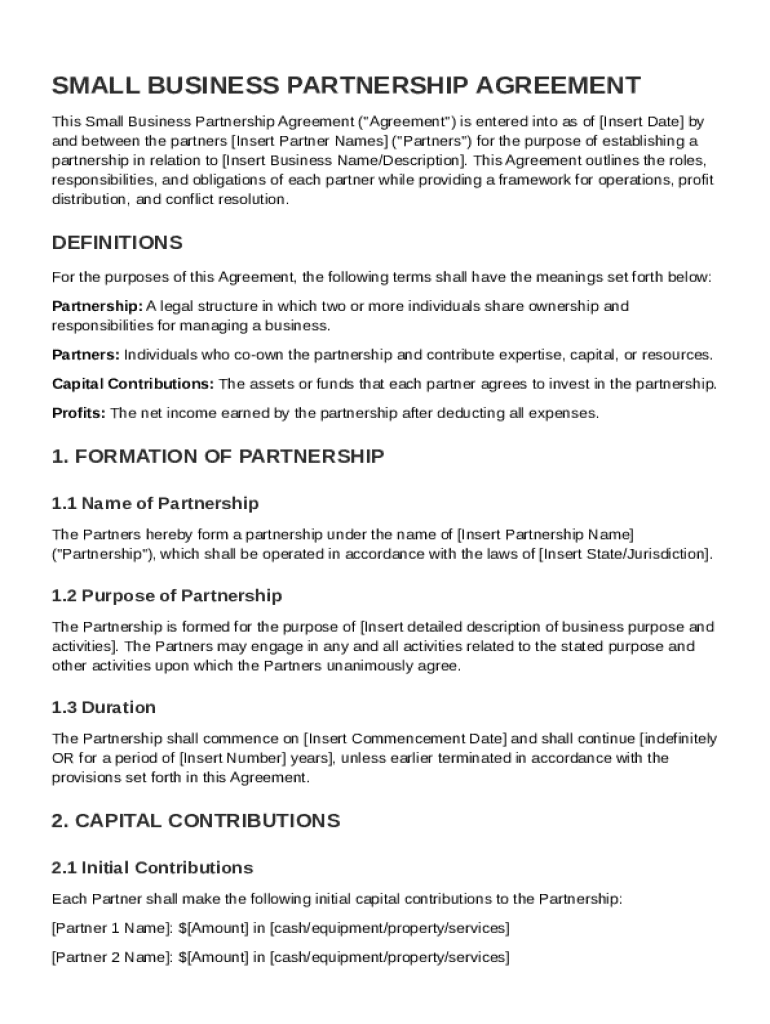
A Small Business Partnership Agreement Template is a formal document that delineates the rights, responsibilities, and legal relationships between partners in a small business. This agreement serves as a crucial foundation for any partnership by establishing clear guidelines for the business's operations. It includes roles, capital contributions, profit distribution, dispute resolution, and termination conditions. By documenting these elements, the template ensures that all partners are aligned with the business objectives and the governance framework. This agreement is particularly essential for maintaining transparency and reducing the risk of misunderstandings among partners.
Key Elements of the Small Business Partnership Agreement Template
The key elements of a Small Business Partnership Agreement Template provide a roadmap for structuring the partnership efficiently. Essential components include:
-
Partner Roles and Responsibilities: Clearly define the specific roles and duties each partner will undertake, ensuring there is no overlap or confusion regarding their contributions to the business.
-
Capital Contributions: Identify how much each partner will invest in the business, whether in the form of money, property, or services. This section should specify the value of non-monetary contributions.
-
Profit and Loss Sharing: Outline how profits and losses will be distributed among partners. This can be based on capital contributions or another agreed-upon formula.
-
Decision-Making Process: Establish protocols for making business decisions, including voting rights and what constitutes a majority vote.
-
Dispute Resolution: Provide mechanisms for resolving conflicts, such as mediation or arbitration, to avoid litigation.
-
Exit Strategy and Termination: Define the process for a partner to exit the partnership, including notice periods and buyout options, as well as the conditions under which the partnership may be dissolved.
How to Use the Small Business Partnership Agreement Template
Using a Small Business Partnership Agreement Template involves several strategic steps to ensure that it is tailored to the specific needs of the partnership:
-
Review Partnership Goals: Before customizing the template, partners should discuss their long-term business objectives to ensure alignment.
-
Customize Key Sections: Modify the template to reflect the unique aspects of the partnership, including partner contributions, roles, and division of profits.
-
Consult Legal Experts: Although templates provide a starting point, consulting with legal professionals can ensure compliance with legal standards and protect partner interests.
-
Review and Revise: Partners should jointly review the customized agreement, making adjustments as necessary.
-
Formalize the Agreement: All partners should sign the finalized document, ensuring it's notarized if required, for legal enforceability.
Important Terms Related to Small Business Partnership Agreement Template
Understanding the terminology used in a Small Business Partnership Agreement Template is vital for effective communication among partners:
-
General Partner: An individual responsible for the management of the partnership and liable for its debts.
-
Limited Partner: In contrast to a general partner, a limited partner typically only contributes financially and has limited liability.
-
Fiduciary Duty: The obligation of partners to act in the best interest of the partnership and with loyalty and good faith.
-
Indemnification: Provisions that protect partners from liability for actions taken in good faith as part of their involvement in the partnership.
-
Non-Compete Clause: An agreement preventing partners from engaging in business activities that compete with the partnership during and after their involvement.
Steps to Complete the Small Business Partnership Agreement Template
Completing a Small Business Partnership Agreement Template involves a structured approach:
-
Gather Partner Information: Collect detailed information about each partner, including names, addresses, and contributions.
-
Define Business Objectives: Clearly state the purpose and primary activities of the business to align partner goals.
-
Assign Roles and Responsibilities: Document the specific roles and responsibilities of each partner to facilitate operational clarity.
-
Set Financial Terms: Specify how financial elements like contributions, profits, and losses will be divided.
-
Detail Governance Structure: Outline the partnership's decision-making framework, including voting rights and leadership roles.
-
Include Legal Provisions: Add sections covering dispute resolution, amendments, and the process for partner withdrawal or addition.
-
Review and Finalize: Engage all partners in reviewing the document before making any necessary revisions and obtaining signatures.
Legal Use of the Small Business Partnership Agreement Template
The legal use of a Small Business Partnership Agreement Template is governed by both federal and state laws, which can potentially affect its enforceability:
-
Compliance with State Laws: Ensure that the agreement adheres to relevant state laws, which might require specific clauses or formalities.
-
Federal Legal Requirements: Adherence to federal regulations, especially those concerning tax obligations and employment laws, is essential.
-
Enforceability Measures: Include signatures, notarization, or any other requirements that might enhance the document's legal standing.
Additionally, partners should regularly review and update the agreement to reflect any changes in business operations or regulations.
State-by-State Differences
State-specific variations can significantly influence the drafting and execution of a Small Business Partnership Agreement Template:
-
Varying State Laws: Different states may have unique requirements regarding profit-sharing, partnership registration, and partner liability.
-
Legal Protections: Some states offer additional legal protections for partners, which should be incorporated into the agreement.
-
Regulatory Compliance: Compliance with state-specific regulations may require specific language or clauses to be included in the agreement.
Ensuring the agreement is tailored to the laws of the state where the partnership is formed is crucial for its validity and effectiveness.
Examples of Using the Small Business Partnership Agreement Template
Examples illustrate the versatility and applicability of the Small Business Partnership Agreement Template in various scenarios:
-
Startup Ventures: New businesses often use the template to formalize roles and responsibilities among co-founders, ensuring alignment from inception.
-
Professional Services: Accountants or legal professionals may form partnerships to combine expertise and resources effectively.
-
Family Businesses: Family-owned businesses can benefit from formal agreements to prevent disputes over roles, finances, and succession.
In each scenario, leveraging the template helps provide a structured approach to partnership governance, tailored to meet the unique needs of the business.